Recommended resources
The freely available resources this lesson will direct you to.
- Supply Chain Security - The Ultimate Guide to Software Composition Analysis (SCA) Toolswww.youtube.com
- What is SBOM and Why is it so Important This Year?www.youtube.com
- [PDF] Breaking Down Software Composition Analysis: An Adversarial ...harvest.usask.ca
- Dependency Resolution Methods | Andrew Nesbittnesbitt.io
Hello again! It's great to dive into our next topic.
In our previous lessons, we've designed key components of Static Application Security Testing (SAST) and Dynamic Application Security Testing (DAST) tools. We've seen how they analyze either the source code at rest or the running application's behavior. However, modern applications are not built in isolation; they are assembled from a vast ecosystem of open-source libraries and frameworks. A vulnerability in one of these dependencies is a vulnerability in your application.
This brings us to our topic for today, the third pillar of application security testing. Our learning outcome is to: Design a Software Composition Analysis (SCA) engine, including dependency tree resolution and vulnerability correlation via version matching.
We will architect a system that inspects your project's third-party components to create an inventory—a Software Bill of Materials (SBOM)—and then checks that inventory against a global database of known vulnerabilities. This is a fundamentally different approach from SAST and DAST, and a critical capability for any modern security program.
1. What is Software Composition Analysis (SCA)?
Before we architect an SCA engine, let's build a first-principles understanding of what it does and why it's essential. Modern software development heavily relies on open-source packages to accelerate development. This creates a complex supply chain. An SCA tool is designed to secure this supply chain.
Let's start with a video that gives an excellent overview of the problem space.
Supply Chain Security - The Ultimate Guide to Software Composition Analysis (SCA) Tools
This guide from Aikido Security clearly explains the core concepts of SCA. It introduces the 'Russian nesting doll' problem of transitive dependencies and uses the famous Log4j vulnerability as a prime example of why SCA is so crucial.
Please watch the following segments: 00:00 - 03:37: This introduces SCA, the prevalence of open-source code, and the critical concept of transitive dependencies. 03:37 - 05:39: This part explains how SCA tools identify dependencies by looking at manifest files (like package.json) and introduces the concept of a Software Bill of Materials (SBOM). 05:39 - 06:43: This explains how SCA tools use vulnerability databases (like the NVD) and CVEs to find known issues in the identified dependencies.
The video gives us the essential components of our engine. At a high level, an SCA process involves discovering all dependencies, creating a list, and comparing that list against known vulnerabilities.
Let's look at a high-level architectural diagram to see where an SCA engine fits within the Software Development Lifecycle (SDLC).
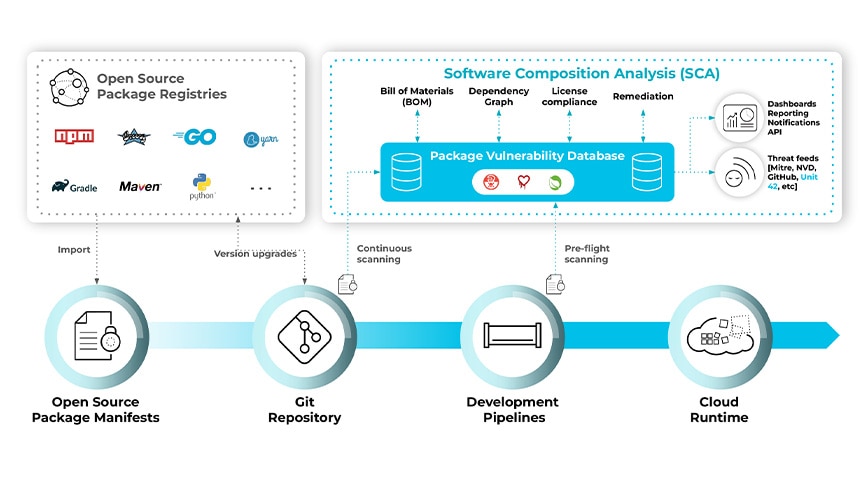
2. The Core Architecture of an SCA Engine
Based on our introduction, we can model our SCA engine's architecture as a pipeline with a few distinct stages. A comprehensive academic paper on SCA provides a useful four-stage framework: Scanning, Comparison, Analysis, and Remediation.
[PDF] Breaking Down Software Composition Analysis: An Adversarial ...
The paper 'Breaking Down Software Composition Analysis' provides a formal structure for the SCA workflow. We'll use this structure to guide our design.
Please read Section 2.5, 'SCA process'. It outlines the four stages that we will use as the blueprint for our engine's architecture: Scanning, Comparison, Analysis, and Remediation.
For this lesson, we will focus on designing the first two, most critical stages:
- Scanning (Dependency Discovery & Resolution): The process of identifying every single third-party component in a project, including direct and transitive dependencies. The output is a complete dependency graph, often formalized as a Software Bill of Materials (SBOM).
- Comparison (Vulnerability Correlation): The process of taking the SBOM and cross-referencing each component and its specific version against one or more vulnerability databases to find matches.
Let's start with the first, and arguably most complex, stage.
3. Designing the "Scanning" Stage: Dependency Tree Resolution
The goal of this stage is to produce an exhaustive list of all third-party code. As the video mentioned, this isn't just about the dependencies you list in your pom.xml or package.json; it's about the dependencies of those dependencies, and so on, down the entire tree.
3.1. Dependency Discovery Methods
Our engine first needs to identify the dependencies. There are several architectural approaches, each with its own trade-offs.
- Manifest File Parsing: This is the most basic method. The engine parses files like
pom.xml(Maven),requirements.txt(Python), orpackage.json(npm).- Limitation: These files typically only declare direct dependencies and version ranges, not the exact, full dependency tree. This is an incomplete starting point.
- Lockfile Parsing: This is a more robust approach. The engine parses files like
package-lock.json(npm),Gemfile.lock(RubyGems), orpoetry.lock(Python/Poetry).- Advantage: Lockfiles contain the fully resolved dependency tree with pinned, exact versions for every direct and transitive dependency. For an SCA engine, parsing a lockfile is the most reliable and efficient way to generate an accurate SBOM.
- Build Integration: In some ecosystems (like Java with Maven/Gradle), the full dependency tree is only resolved during the build process. An SCA tool might need to hook into the build system (e.g., as a Maven plugin) to capture the resolved graph. This is more complex but necessary for accuracy.
3.2. Dependency Resolution Algorithms
What if a lockfile isn't available? Our SCA engine must be able to resolve the dependency graph itself, starting from the manifest file. This is a classic, non-trivial problem in computer science, equivalent to the Boolean satisfiability problem (SAT), which is NP-complete.
The core challenge is the diamond dependency problem:
- Your project
Adepends onBandC. Bdepends onD >= 2.0.Cdepends onD < 2.0.
This creates an unsolvable conflict. A resolver must find a compatible set of versions or prove that one doesn't exist.
Let's explore the different architectural strategies a resolver can use. This is a fascinating area where different ecosystems have made very different design trade-offs.
Dependency Resolution Methods | Andrew Nesbitt
The blog post 'Dependency Resolution Methods' by Andrew Nesbitt is an excellent deep dive into the algorithms that power package managers. It breaks down the various architectural approaches from first principles, which will be invaluable for our design.
This is a detailed resource. Please read the following sections to understand the major architectural patterns for a dependency resolver: Start with the introduction to understand the core problem (NP-completeness, diamond dependencies). Read the sections on 'SAT solving', 'PubGrub', and 'Backtracking'. These are the three main 'solver' architectures. Read 'Minimal version selection' to understand Go's unique approach. Finally, read 'Deduplication with nesting' to see how npm handles conflicts by relaxing constraints.
Let's summarize the key architectural options for our resolver, based on this reading:
| Resolution Strategy | How It Works | Examples | Architectural Trade-offs |
|---|---|---|---|
| Backtracking | Tries versions greedily (newest first). If a conflict is found, it "backs up" and tries the next version. | pip, Cargo |
Pro: Simple to implement, works well for most cases. Con: Can be very slow on complex graphs with deep conflicts. |
| SAT Solving | Encodes all version constraints as a boolean satisfiability problem and uses a generic SAT solver. | conda, dnf |
Pro: Complete. Can find a solution if one exists and prove when one does not. Con: Computationally expensive in the worst case; complex to implement. |
| PubGrub | A modern, domain-specific variant of a SAT solver designed for version solving. | poetry, uv, bundler |
Pro: Complete like a SAT solver. Key Feature: Produces human-readable error messages explaining why a conflict occurred, which is a major UX improvement. |
| Minimal Version Selection | Avoids a search problem by always picking the oldest possible version that satisfies constraints. | Go modules | Pro: Extremely fast and deterministic. Con: You don't get the latest bug/security fixes automatically; you must explicitly update your manifest. |
| Deduplication w/ Nesting | A relaxation strategy. If two packages require conflicting versions of a dependency, it installs both. | npm, yarn |
Pro: Avoids resolution failure. Con: Increases package size and can cause subtle runtime bugs (e.g., if code relies on a shared singleton instance). |
The output of this entire "Scanning" stage is a Software Bill of Materials (SBOM)—a structured list of all components. Formats like CycloneDX and SPDX are industry standards for this.
4. Designing the "Comparison" Stage: Vulnerability Correlation
With a complete and accurate SBOM, our engine's next task is to determine if any of these components are vulnerable. This is a matching problem.
4.1. The Vulnerability Database
The engine needs a source of truth for vulnerabilities. This is typically a database that maps a package name and a set of vulnerable versions to a vulnerability identifier (like a CVE).
- Public Sources: The National Vulnerability Database (NVD), GitHub Advisory Database, and language-specific databases (e.g., PyPA advisory database).
- Proprietary Sources: Commercial SCA tools like Snyk, Mend.io, and Black Duck curate their own databases, often augmenting public data with their own research. This is a key value proposition for them.
Architecturally, our SCA engine would need a data ingestion pipeline to pull data from these sources, normalize it, and store it in a queryable format (e.g., in a database indexed by package name).
4.2. Version Matching Logic
This is the core of the "Comparison" stage. For each component in our SBOM (e.g., lodash version 4.17.20), the engine must:
- Query the vulnerability database for
lodash. - For each vulnerability found, get the associated range of affected versions (e.g.,
>=4.0.0, <4.17.21). - Check if our component's version (
4.17.20) falls within that range.
This requires a robust implementation of Semantic Versioning (SemVer) logic. Package managers use special characters to define version ranges.
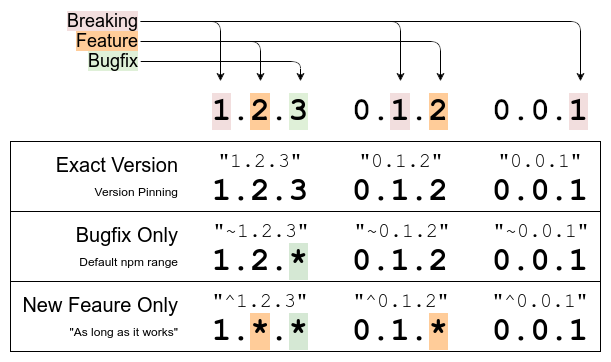
Our engine would need to embed a library that can parse and evaluate these version constraints for the relevant ecosystem. For example, it would need to know that for ^1.2.3, version 1.3.0 is a match, but 2.0.0 is not.
4.3. Beyond Version Matching: The "Analysis" Stage
A simple version match can lead to many false positives. What if the vulnerability exists in a function your application never calls? This is where the more advanced Analysis stage comes in.
- Reachability Analysis: This technique, also called "call analysis," tries to determine if the vulnerable code within a dependency is actually reachable from your application's code. This requires combining SCA with SAST-like techniques to analyze call graphs. For example, Snyk and Mend.io offer this as a premium feature to help prioritize which vulnerabilities matter most.
While designing a full reachability engine is beyond today's scope, it's a critical architectural consideration for a mature SCA product to improve its accuracy and reduce alert fatigue.
Conclusion
In this lesson, we have designed the core architecture of a Software Composition Analysis (SCA) engine. We moved from a high-level understanding of its purpose to the specific architectural components and algorithms required to build it.
Key Takeaways:
- An SCA engine's primary function is to discover all dependencies in a project and correlate them against known vulnerabilities.
- The Scanning stage is responsible for dependency discovery. The most reliable method is parsing lockfiles. If unavailable, the engine must perform dependency resolution, a complex problem with various algorithmic solutions (e.g., Backtracking, SAT Solving, PubGrub), each with distinct architectural trade-offs.
- The output of the Scanning stage is a Software Bill of Materials (SBOM), a formal inventory of all components.
- The Comparison stage performs vulnerability correlation by matching the SBOM components against vulnerability databases. This requires robust version matching logic that understands semantic versioning.
- Advanced SCA engines can incorporate reachability analysis to reduce false positives by checking if vulnerable code is actually used, blending SCA with SAST techniques.
Preview of the Next Lesson:
We have now explored the architectures of SAST, DAST, and SCA tools. In our next lesson, we will bring these three pillars of application security testing together to address the outcome: "Evaluate the architectural trade-offs across SAST, DAST, and SCA regarding coverage, accuracy, and CI/CD integration speed." We will compare their strengths and weaknesses to understand how they complement each other in a comprehensive security strategy.