Recommended resources
The freely available resources this lesson will direct you to.
Introduction
Welcome back! In our previous lesson, we explored the three crucial stages of memory: encoding, consolidation, and retrieval. We established that for learning to stick, information must be effectively processed, stabilized over time, and successfully accessed when needed.
This lesson builds directly on that foundation by tackling a fundamental "bug" in our memory system: forgetting. We'll be addressing the learning outcome: Explain the forgetting curve and its implications for planning review sessions.
You've mentioned that improving retention is one of your key goals. This lesson provides a cornerstone for that effort. We'll explore why we forget things so quickly and, more importantly, introduce a scientifically-backed, systematic strategy to counteract this natural tendency. By the end of this lesson, you'll understand not just why you forget, but how to plan your learning to ensure knowledge lasts for the long term.
The Predictable Nature of Forgetting
It can be frustrating to spend hours learning something new—whether it's a set of user research methods or a new coding library—only to find that you can barely recall the details a few days later. This isn't a personal failure; it's a predictable feature of human memory first mapped out in the 19th century.
Understanding the Science Behind Learning Retention
The article 'Understanding the Science Behind Learning Retention' introduces the foundational concept of the forgetting curve, discovered by psychologist Hermann Ebbinghaus.
Please read the section titled 'The Science Behind Learning', starting from 'The Forgetting Curve' and ending just before 'The "Baby Shark" tune!'. Focus on how Ebbinghaus studied memory and the key characteristic of the curve he discovered.
As the article explains, Ebbinghaus discovered that memory loss is exponential. The sharpest decline in retention happens almost immediately after learning, and then the rate of forgetting slows down over time.
This is what the forgetting curve looks like:
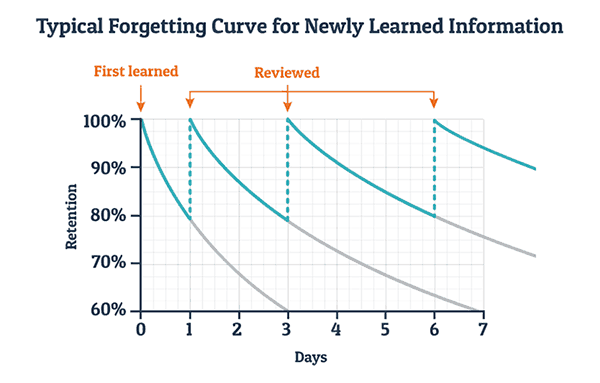
For someone with your background in visual design, this graph is a powerful illustration of the default state of our memory. Without any intervention, a significant portion of newly learned information simply fades away. The key question then becomes: how can we change the shape of that curve?
Hacking the Curve with Spaced Repetition
The good news is that we are not helpless victims of the forgetting curve. Ebbinghaus himself discovered the antidote: reviewing the information at specific intervals. Each time you review, you interrupt the process of forgetting and strengthen the memory.
To see how this works, let's watch a short video that explains the mechanism behind this powerful strategy, known as spaced repetition.
How to Study for Exams - Spaced Repetition | Evidence-based revision tips
In this video, Ali Abdaal provides a clear, evidence-based explanation of spaced repetition and how it directly counters the forgetting curve.
Please watch from 01:04 to 04:22. The first part (until 03:03) explains how spaced repetition interrupts the forgetting curve. The second part (from 03:09) explains why the timing of these interruptions is so important, linking back to the idea of 'desirable difficulties' we've discussed.
Here are the critical takeaways from the video:
- Interrupting the Curve: As shown in the Forgetting Curve graph above, each review (the blue curves) boosts your retention back up to 100%.
- Flattening the Curve: Crucially, after each review, the curve becomes less steep. This means you forget the information more slowly.
- The Importance of Timing: The magic of spaced repetition lies in timing your review for the "sweet spot"—when you've started to forget the material but haven't forgotten it completely. This makes retrieval an effortful act (a desirable difficulty), which, as we learned, strengthens the memory trace and aids consolidation. Reviewing too soon is inefficient, and reviewing too late means you have to relearn it from scratch.
Test your understanding!
Imagine you're learning the WCAG 2.1 accessibility guidelines. Based on the principle of spaced repetition, which of these two review strategies would be more effective for long-term retention, and why?
A) Reviewing the guidelines for one hour every morning for five consecutive days.
B) Reviewing the guidelines for one hour on Day 1, then again on Day 2, Day 5, Day 10, and Day 20.
Show answer
Strategy B would be far more effective. It uses increasing intervals between review sessions, allowing you to forget a little bit of the information each time. This forces your brain to work harder to retrieve the guidelines, strengthening the memory more effectively than the massed practice of Strategy A (cramming).
Designing Your Review Schedule
Understanding the theory is the first step; applying it is what leads to results. The implication of the forgetting curve is clear: effective learning must involve a deliberate plan for reviewing material over time. A "one-and-done" approach is doomed to fail.
So, what does a practical review schedule look like? The core idea is to use expanding intervals. A common starting point looks something like this:
- Review 1: 1 day after initial learning.
- Review 2: 3 days after the last review.
- Review 3: 7 days after the last review.
- Review 4: 14-21 days after the last review.
- ...and so on.
The exact schedule isn't as important as the principle of consistent, spaced-out reviews. The following visual provides a great, actionable template for implementing this.
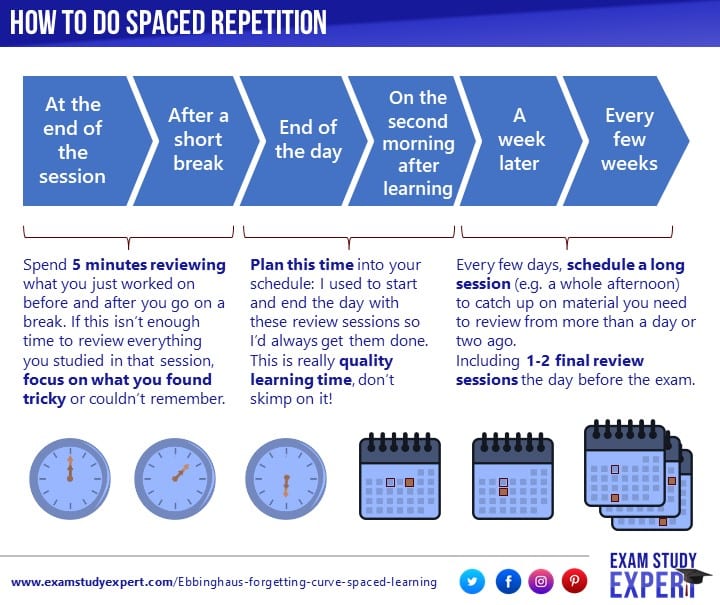
Applying this to Your Learning
Let's say you spend an hour learning about a new UX methodology, like the Jobs-to-be-Done (JTBD) framework. Here's how you could structure your reviews based on the principles we've discussed:
- Immediate Recall (End of Session): Before you close your books or browser tabs, take 5 minutes to jot down the key points of JTBD from memory. What problem does it solve? What are the core components?
- Day 1 Review (10 mins): The next day, try the same free recall exercise. Then, check your notes to fill in any gaps. This is your first critical interruption of the forgetting curve.
- Day 4 Review (5 mins): A few days later, quickly quiz yourself. For example: "What's the difference between a 'job' and a 'task' in the JTBD framework?"
- Day 11 Review (5 mins): A week later, try to explain the concept out loud as if you were teaching it to a junior designer.
Notice that the review sessions get shorter and are spaced further apart. You're not re-learning the topic each time; you're simply practicing retrieval to keep the memory strong and accessible.
Conclusion
In this lesson, we demystified the process of forgetting and armed you with a powerful strategy to combat it. You now have a mental model and a practical framework for improving your knowledge retention, a key part of "debugging" your learning process.
Key Takeaways:
- The Forgetting Curve: Forgetting is a natural process that happens exponentially, with the steepest memory loss occurring shortly after learning.
- Spaced Repetition: We can counteract the forgetting curve by reviewing information at strategically timed, increasing intervals.
- Effortful Retrieval: The most effective time to review is when retrieval has become slightly difficult, as this effort strengthens the memory for the long term.
- Planning is Key: To retain information, you must move from a "learn-once" mindset to a planned system of review.
In our next lesson, we'll add another powerful tool to your retention toolkit. We will explore elaborative encoding, a technique focused on making new information more memorable from the very beginning by connecting it deeply to what you already know.