Recommended resources
The freely available resources this lesson will direct you to.
Hello! Welcome back to our module on smart contract security.
In our last lessons, we focused on securing your contract's internal logic, first by preventing reentrancy attacks with the Checks-Effects-Interactions pattern, and then by handling integer overflows and underflows using the built-in protections of modern Solidity. Now, we shift our focus from what the code does to who is allowed to do it.
This lesson introduces access control, a concept that should be very familiar from your backend development experience. Just as you'd restrict certain API endpoints to administrators, in smart contracts, we must restrict sensitive functions—like minting new tokens or changing critical settings—to authorized addresses.
Today, we'll implement the most fundamental access control pattern: single ownership. By the end of this lesson, you will be able to implement ownership-based access control using OpenZeppelin's battle-tested Ownable contract.
1. The Concept of Ownership
The simplest model for access control is to assign a single account as the "owner" of the contract. This owner has special privileges that other users do not. This is analogous to a root user on a Linux system or a super-admin in a web application.
For a token contract, the owner might be the only one who can:
- Mint an initial supply of tokens.
- Pause or unpause the contract in an emergency.
- Change a fee parameter.
Instead of writing this logic from scratch, we will use OpenZeppelin's Ownable contract. OpenZeppelin provides secure, community-vetted, and reusable smart contract components that are the industry standard.
Access Control - Ownership and Ownable
First, let's read the official OpenZeppelin documentation to understand what the Ownable contract provides. This will give you a solid conceptual foundation.
Read the section titled 'Ownership and Ownable'. Focus on the code example and the description of the functions it provides, like transferOwnership and renounceOwnership.
As the documentation shows, using Ownable involves three key steps:
- Inheriting the contract:
contract MyContract is Ownable { ... } - Setting the owner in the constructor:
constructor() Ownable(initialOwner) {} - Protecting functions with a modifier:
function specialThing() public onlyOwner { ... }
The onlyOwner modifier is the gatekeeper. It automatically ensures that if any account other than the owner tries to call the function, the transaction will revert.
2. Implementing Ownable in Your Contract
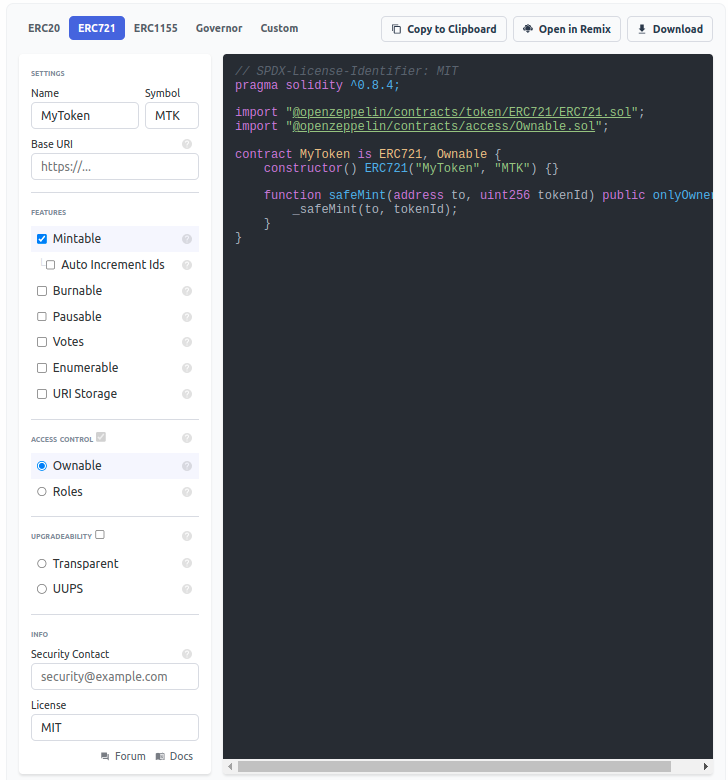
Now let's see how to integrate Ownable into a contract from scratch. While you could manually create an owner state variable and write require statements in each function, this is repetitive and error-prone. Using OpenZeppelin's implementation is safer and more efficient.
The following video provides a great hands-on demonstration. It starts by showing how you would build this pattern manually before moving on to the superior OpenZeppelin approach. This progression will help solidify why using a standardized library is a best practice.
Access Control with Solidity & OpenZeppelin | Authorization, RBAC (Role Based Access Control)
This video from EatTheBlocks will walk you through implementing the Ownable pattern in the Remix IDE. It clearly demonstrates the contract's functions and security features.
Please watch from 09:52 to 19:21. Pay close attention to how the contract is imported, how the is Ownable keyword is used for inheritance, and how the onlyOwner modifier is applied to a function. The demonstration of deploying and testing the functions in Remix is particularly valuable.
Let's break down the key elements from the video and the OpenZeppelin library.
Core Implementation
Here is a clean, minimal example based on what you just saw, which you can use as a template. This is very similar to the Box contract example in the OpenZeppelin documentation.
Developing smart contracts - Importing OpenZeppelin Contracts
The OpenZeppelin documentation provides another excellent, concise example of adding Ownable to a simple contract. Let's review it to reinforce the pattern.
Focus on the Box contract code snippet. Observe how it imports Ownable.sol, inherits from it using is Ownable, sets the deployer as the owner in the constructor with Ownable(msg.sender), and protects the store function with the onlyOwner modifier.
The code demonstrates a complete, secure, and simple implementation. The msg.sender in the constructor is a global variable in Solidity that refers to the address that is calling the current function. When deploying a contract, msg.sender is the address of the account that is deploying it, making it the perfect candidate for the initial owner.
3. Managing and Transferring Ownership
An owner isn't always permanent. You might need to transfer ownership to a new address, perhaps a more secure multi-signature wallet (which we'll cover later in the course). The Ownable contract provides built-in functions for this.
owner() public view returns (address): A public function to see the current owner's address.renounceOwnership() public onlyOwner: Allows the current owner to permanently relinquish ownership. The owner is set to the zero address (0x0...0). This is an irreversible action. If you renounce ownership, all functions protected byonlyOwnerbecome unusable forever.transferOwnership(address newOwner) public onlyOwner: Allows the current owner to transfer ownership to a new address.
Test your understanding!
You deploy a contract that uses Ownable and has a function mintTokens(uint256 amount) public onlyOwner. You accidentally call transferOwnership with the address of a token contract (0x...) instead of your own new wallet address. What is the consequence of this mistake?
Show answer
The ownership of your contract is now transferred to the token contract's address. Since a contract address does not have a private key, no one can ever call mintTokens or any other onlyOwner function again. You have effectively locked yourself out and lost administrative control of your contract permanently. This is why careful management of ownership is critical.
A Safer Way to Transfer: Ownable2Step
Because of the risk highlighted above, OpenZeppelin provides a safer alternative called Ownable2Step. This contract modifies the ownership transfer into a two-step process to prevent accidental transfers to incorrect addresses.
- The current owner calls
transferOwnership(address newOwner). This doesn't transfer ownership yet; it only sets apendingOwner. - The
newOwnermust then callacceptOwnership()to confirm the transfer.
This ensures the new owner is an address that someone can actually control, because they must actively sign a transaction to accept the role. For production contracts, using Ownable2Step is a highly recommended safety measure.
4. The Limits of Ownable and What's Next
The Ownable pattern is powerful for its simplicity, but it's not suitable for every scenario. It creates a single point of failure and centralization. What if you need more complex permissions?
Consider a system where:
- One group of addresses can mint new tokens (a "Minter" role).
- A different group can pause the contract (a "Pauser" role).
- A third, highly secure address has the power to change these roles (an "Admin" role).
A single owner cannot handle this level of complexity.
Setting Up Access Control for Smart Contracts
This short clip from an OpenZeppelin presentation perfectly explains why a single-owner model falls short for more decentralized or complex applications, setting the stage for a more granular system.
Watch from 06:26 to 09:58. The video uses a stablecoin example to illustrate a scenario with different actors and permissions, showing why Ownable is insufficient and introducing the concept of 'roles'.
This limitation of Ownable leads us directly to the topic of our next lesson: Role-Based Access Control (RBAC).
Conclusion
You've now learned how to implement the most common form of access control in Solidity. By leveraging OpenZeppelin's Ownable contract, you can quickly and securely add administrative capabilities to your smart contracts.
Key Takeaways:
- Access control is essential for restricting sensitive functions to authorized users.
- The
Ownablepattern assigns all special privileges to a singleowneraddress. - Implement it by inheriting from OpenZeppelin's
Ownable.soland using theonlyOwnermodifier. - Ownership management functions like
transferOwnershipandrenounceOwnershipmust be used with extreme care. For added security, preferOwnable2Step. Ownableis best for simple contracts; complex systems require more granular permissions.
Preview of the Next Lesson:
We'll build directly on the limitations we just discussed. In the next lesson, you will learn how to implement Role-Based Access Control (RBAC) using OpenZeppelin's AccessControl contract. This will allow you to create multiple roles (like MINTER_ROLE, PAUSER_ROLE) and assign them to different addresses, enabling far more flexible and decentralized governance structures.