Recommended resources
The freely available resources this lesson will direct you to.
Good to see you again. In the previous lesson, you separated a yield-bearing position into two dated claims: PT for principal at maturity and YT for the variable yield earned until that same maturity. We also noted that a matched PT and YT can reconstruct the whole position before maturity.
This lesson makes that relationship operational. You will use the identity
to recognize when a market creates a stripping or merging arbitrage opportunity. The objective is not merely to spot a price difference, but to determine whether the complete, executable transaction still produces profit after fees, price impact, and routing.
The identity is a conversion right, not just a valuation slogan
For one specific underlying asset and one specific maturity, the protocol permits two reversible transformations before maturity:
- Stripping: deposit one unit of the eligible underlying position and receive one matched PT and one matched YT.
- Merging: provide equal quantities of the matching PT and YT and recover the underlying position.
The instruments must match exactly. A PT and YT are mergeable only when they refer to the same:
- underlying yield source;
- market;
- maturity date;
- protocol-specific token standard or wrapper.
A PT on JitoSOL with a July maturity cannot be merged with a JitoSOL YT expiring in September. In fixed-income terms, this is not a generic “principal claim plus coupon claim” relationship; it is a claim-level relationship tied to a particular dated instrument.
Exponent describes the identity in a user-facing, normalized form:
The earlier discussion of SY still matters. SY standardizes potentially different yield sources before the protocol creates PT and YT. Depending on the integration, an SY exchange rate can affect the conversion between base assets and standardized units. For arbitrage analysis, use the protocol’s actual market convention, but compare all legs in the same unit of account and at the same point in time.
Read Exponent’s official explanation before working through the price logic.
Yield Stripping & Swap - Exponent Docs
Read Exponent Docs’ “Yield Stripping & Swap” page for the protocol-level definition of issuance, merging, and flash-swap routing. Focus on the fact that PT and YT are created as a matched pair, and that the pair can be converted back into the underlying before maturity.
In “How Stripping Works,” read from the issuance explanation through the steps that mint PT and YT. Then read the complete “Stripping Example” and “Merging” portions, especially the accounting identity and price cases. Finally, in “Flash Swaps,” read the flash-swap explanation to see why a user can trade YT without manually assembling every leg.
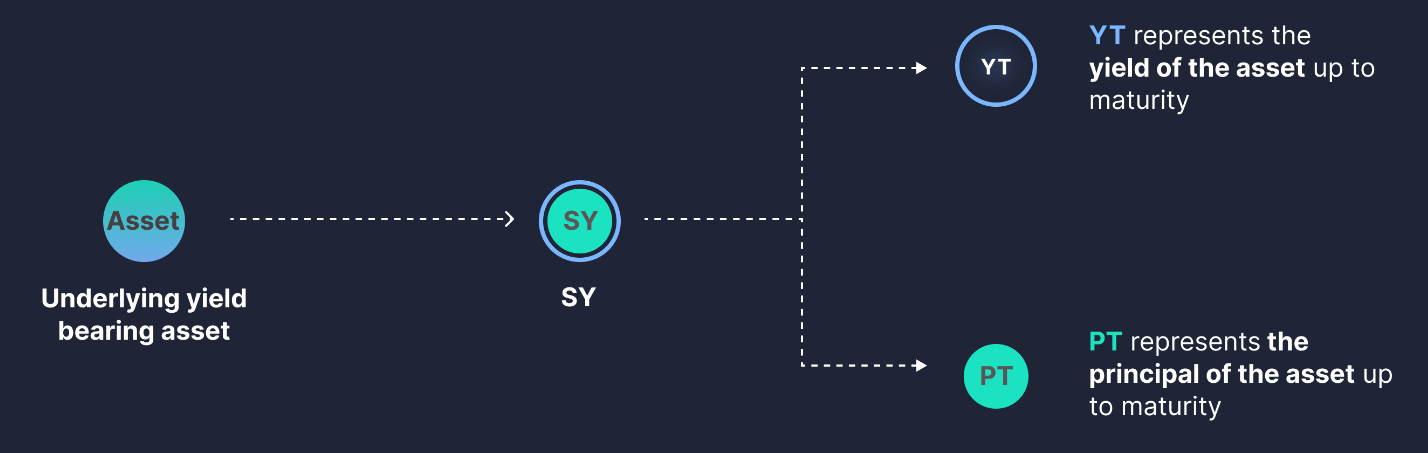
The Yield Stripping schematic below captures the issuance side of the identity: the underlying asset is standardized as SY, then its principal and future-yield rights are separated into PT and YT.
Pricing parity: what should the matched claims be worth?
Let the executable price of one unit of the underlying position be , and let the corresponding PT and YT prices be and .
Ignoring transaction costs for a moment, conversion rights imply parity:
In a live market, equality will rarely hold to the last decimal place. There are trading fees, slippage, routing costs, and different bid and ask prices. A more realistic statement is:
The key question is whether the difference is wider than the all-in cost of converting and executing the trade.
This is useful to distinguish from an ordinary yield view:
- “YT looks cheap because I expect staking rewards to rise” is a directional view on future yield.
- “PT plus YT is cheaper than the underlying, and I can merge them immediately” is a parity trade.
- “PT plus YT is more expensive than the underlying, and I can strip and sell them” is also a parity trade.
A PT might look cheap in isolation and still offer no merging arbitrage if YT is expensive. Equally, a high YT price may be economically justified by expectations of high yield. Arbitrage emerges only when the whole matched pair is mispriced relative to the asset into which it can be converted.
Case one: the matched pair is too expensive — strip the underlying
Suppose all prices are expressed in USDC per normalized unit of the same Solana yield market:
| Instrument | Executable price |
|---|---|
| Underlying position | |
| PT bid | |
| YT bid | |
| Combined PT and YT proceeds |
The matched pair trades above the underlying:
An arbitrageur can:
- Buy or source one unit of the eligible underlying position for .
- Strip it into one PT and one YT for the relevant maturity.
- Sell the PT at its executable bid.
- Sell the YT at its executable bid.
The gross spread is:
For this example:
The trade is called stripping arbitrage because the arbitrageur creates PT and YT from the relatively cheap whole position, then sells the more expensive components.
Its market effect tends to close the gap:
- buying the underlying increases demand for it;
- stripping increases the available supply of PT and YT;
- selling PT and YT puts downward pressure on their prices.
The opportunity persists only while the pair’s premium exceeds total execution costs.
Case two: the matched pair is too cheap — merge PT and YT
Now reverse the prices:
| Instrument | Executable price |
|---|---|
| Underlying position bid | |
| PT ask | |
| YT ask | |
| Cost of matched PT and YT |
Here:
An arbitrageur can:
- Buy one PT and one YT from the same market and maturity.
- Merge the matched pair through the protocol.
- Receive one unit of the underlying position.
- Sell that underlying asset, or retain and redeploy it.
The gross merging spread is:
In the example:
This is merging arbitrage. The arbitrageur buys the underpriced pieces, converts them to the more valuable whole position, and monetizes or deploys that recovered underlying.
The corrective pressure runs in the opposite direction:
- buying PT and YT supports their prices;
- merging reduces the supply of outstanding PT and YT;
- selling or deploying the recovered underlying increases its market supply.
The protocol’s mint-and-merge functionality does not guarantee that prices are always identical. It supplies the conversion mechanism that gives informed traders a reason to restore parity when deviations are sufficiently large.
The executable spread is what matters
A displayed mid-price is not an arbitrage opportunity. The proper institutional calculation uses executable prices and complete costs.
For stripping:
For merging:
Here, should include:
- protocol swap and conversion fees;
- Solana transaction fees and priority fees where relevant;
- price impact at the intended trade size;
- routing or aggregator fees;
- the cost of acquiring inventory or temporary financing;
- operational costs of custody, signing, and reconciliation;
- a risk buffer for failed, delayed, or partially executed routes.
For an active market maker, a one-basis-point discrepancy may be meaningful if it can be executed atomically at size. For an institution trading manually or moving meaningful size, a nominal spread can disappear once it crosses the order book or concentrated-liquidity range.
A practical screen therefore compares:
| Check | Why it matters |
|---|---|
| Same asset and maturity | Only matching claims are mergeable. |
| Same pricing unit | Avoid comparing SY-denominated prices with raw base-asset values without conversion. |
| Bid versus ask, not midpoint | The trade must actually sell at bids and buy at asks. |
| Sufficient depth at target size | A profitable first unit may become unprofitable for the full order. |
| All-in fees and route costs | The theoretical spread must exceed real costs. |
| Atomic or tightly coordinated execution | Exposure to one leg without the other can turn an arbitrage into market risk. |
| Market and protocol status | Paused functions, stale quotes, redemption constraints, or wrapper issues can invalidate the route. |
This is why it is better to call the opportunity conditional arbitrage rather than “free yield.” The economics are market-neutral once all matching legs are secured, but the execution remains exposed to liquidity, operational, and protocol assumptions.
Why YT routing often does not look like a simple two-token trade
In a conventional spot market, you might expect a separate pool for PT and YT. Exponent’s documentation describes a more capital-efficient design: trading infrastructure is primarily organized around PT and the underlying yield asset, while YT exposure can be synthesized through flash swaps.
For example, when a user buys YT, the protocol can source the necessary PT and underlying liquidity, strip the underlying atomically, deliver YT to the buyer, and settle the PT leg through available liquidity. When a user sells YT, the protocol can pair it with PT, merge the two, and route the recovered underlying through available liquidity.
For an analyst or institutional execution team, this changes the diligence approach:
- Do not assume a visible standalone YT pool is the full source of YT liquidity.
- Evaluate the final quoted route, including its PT and underlying liquidity dependencies.
- Treat a YT quote as an output of the entire strip-or-merge path, not simply as an isolated token price.
- Confirm that the route can execute at the desired size without excessive price impact.
The economic identity remains the anchor:
Flash swaps simply allow the protocol to use that identity within one transaction rather than making every user manually acquire, strip, merge, and rebalance each component.
What changes at maturity
The stripping-and-merging relationship is most relevant before maturity, while YT still represents a remaining future-yield claim.
At maturity:
- PT is redeemable for its specified principal claim under the market’s terms.
- YT stops accruing new yield.
- Any already accrued but uncollected yield remains claimable according to the protocol’s rules.
- After final yield collection, YT has no remaining economic claim and its residual market value is zero.
Therefore, a seemingly unusual price relationship near or after maturity must be interpreted with the redemption and yield-claim mechanics in mind. It is not enough to mechanically apply a pre-maturity merging model after the YT’s future-yield period has ended.
Key takeaways
The core conversion identity gives fixed-maturity yield markets their pricing discipline:
- When is more expensive than the underlying, an arbitrageur can strip the underlying and sell the two claims.
- When is cheaper than the underlying, an arbitrageur can buy the matched pair, merge it, and recover the underlying.
- The relevant comparison uses matching asset, maturity, normalization, executable bid and ask prices, and all-in costs.
- A view on future yields is not automatically arbitrage. Arbitrage requires a profitable conversion path between the whole position and its matched claims.
- On Exponent, flash swaps can route YT trades through PT and underlying liquidity, so the effective trade route matters as much as a displayed token price.
Next, you will turn the PT side of this identity into a fixed-income calculation: deriving the annualized fixed yield implied by a PT’s price and time remaining to maturity.