Recommended resources
The freely available resources this lesson will direct you to.
Welcome back. In the previous lesson, you saw why a PT’s market price changes with implied rates before maturity, even though its redemption amount is fixed in units of the underlying asset. We now move behind the quote screen: how the protocol actually delivers PT or YT exposure without requiring a separately funded YT liquidity pool.
The central idea is that Exponent concentrates its exchange liquidity in PT and SY. A PT trade is direct. A YT trade is assembled atomically through temporary borrowing, stripping or merging, and a PT liquidity trade. By the end of this lesson, you should be able to trace both flows clearly enough to explain where liquidity comes from, what settles in the transaction, and what an institutional trader should validate before execution.
From yield-bearing asset to tradable claims
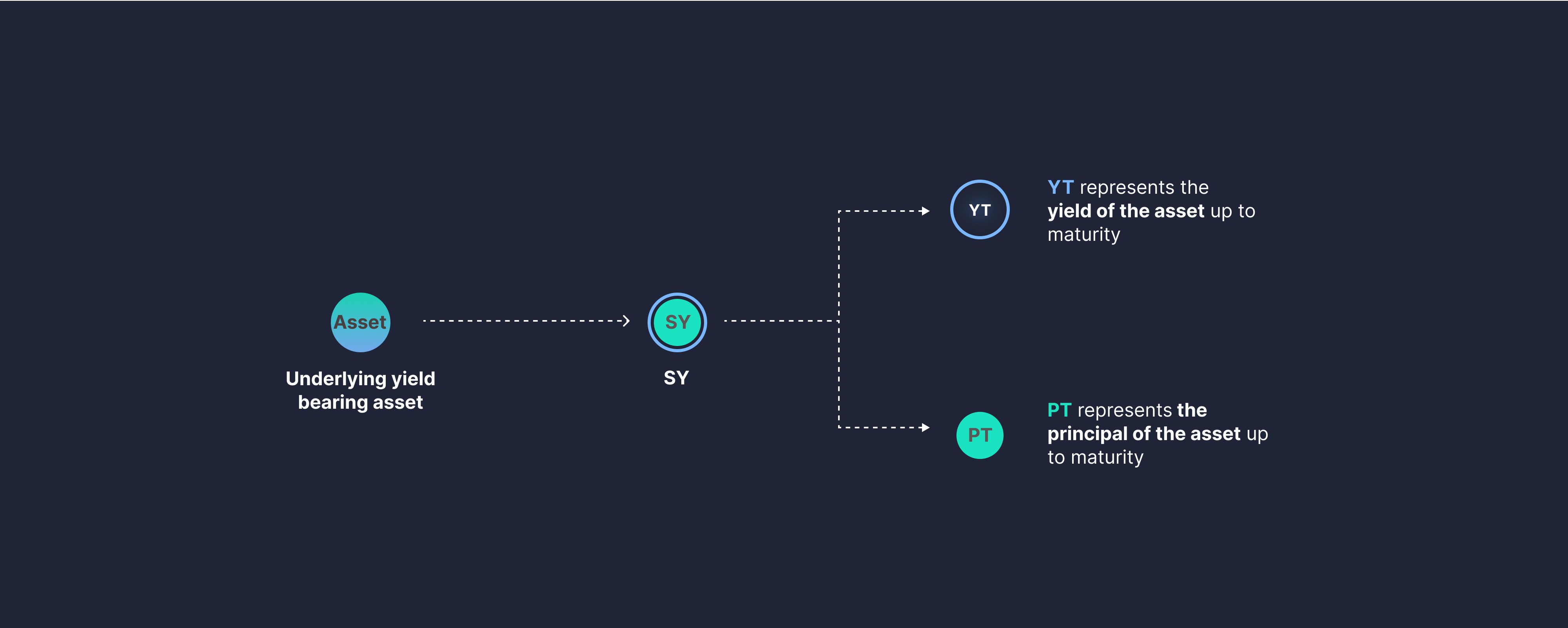
Exponent first standardizes an eligible yield-bearing asset into SY, then divides the economic claim for a specified maturity into two tokens:
- PT, the principal claim redeemable at maturity;
- YT, the claim on yield generated until that maturity.
At the user level, documentation often calls the deposited asset the underlying. At the exchange-mechanics level, the relevant standardized representation is SY. For a given market and maturity, the key accounting relationship is:
The equality is not merely a valuation heuristic. It describes an operational capability:
- Stripping converts SY into matched PT and YT.
- Merging converts equal quantities of PT and YT from the same market back into SY.
Yield Stripping & Swap - Exponent Docs
Read Exponent’s official “Yield Stripping & Swap” documentation to establish the issuance, merging, and flash-swap mechanics before following the transaction traces below.
Start with “How Stripping Works.” Read the three issuance steps, noting that one deposited unit creates one PT and one YT for a specified maturity. Then read the “Merging” subsection in full. Focus on the reversibility of the position. A PT and YT only merge when they belong to the same underlying market and maturity. Finally, read “Flash Swaps,” including “How Flash Swaps Work” and “Why Flash Swaps Matter.” Focus on the atomic settlement principle, then on why Exponent can route YT exposure through PT-based liquidity.
Why the identity keeps prices connected
Suppose that one SY is worth 1.00 unit of account and a PT is trading at 0.97 SY. Ignoring fees, the corresponding YT claim is economically worth approximately 0.03 SY:
If the combined cost of PT and YT became materially less than one SY, an arbitrageur could buy both components and merge them into SY. If the combined sale proceeds became materially greater than one SY, an arbitrageur could obtain SY, strip it, and sell the two components. These actions pressure the relative prices back toward consistency.
This does not mean that YT has a static price of 0.03. PT prices move with the implied rate and time to maturity; YT’s value is the residual claim on the market’s expected variable yield, incentives where applicable, and the remaining term.
The market’s liquidity: PT and SY, not a standalone YT pool
The important architectural fact is:
The Rate CLMM holds PT and SY. It does not need to carry a separate inventory of YT.
That choice concentrates liquidity around the PT market, where fixed-rate exposure is priced. YT trades borrow the required side of the pair only during the transaction, perform the strip or merge, execute the PT leg, and settle the temporary loan before the transaction completes.
Technical Concepts - Exponent Docs
Read the Exponent developer documentation for the precise flash-swap sequence. It is technical in tone, but it gives the clearest account of what the pool lends and what must be returned.
In “YT Trading via Flash Swaps,” read the setup of the flash swap, then follow both the Buy YT and Sell YT descriptions carefully. Pay particular attention to which asset is temporarily borrowed in each direction. Next, read “Swap Routing.” Focus on the two PT swap directions and price limit. The PT leg is the liquidity and execution leg that supports the YT trade.
A flash swap here is not an unsecured loan that remains open. The pool temporarily releases an asset during an atomic transaction. The transaction must finish with the pool repaid according to its rules; otherwise, the full transaction fails and state is rolled back.
For a sales or diligence conversation, the concise explanation is:
YT liquidity is synthetically assembled from the underlying SY and the PT market. The protocol temporarily borrows one component, strips or merges it with the other, executes the PT liquidity leg, and settles everything atomically.
That is capital-efficient, but it does not eliminate execution risk. A large YT order still depends on available, executable PT liquidity and on the transaction staying within the trader’s price limits.
Trace 1: a direct PT purchase
A PT trade is the simplest path. A trader exchanges SY for PT through the market’s active liquidity.
Assume an institution wants to buy PT of a particular SOL liquid-staking market with a particular maturity. Assume the executable price is SY per PT, before fees and price impact.
| Party | Delivers | Receives |
|---|---|---|
| Institution | approximately SY | PT |
| PT/SY liquidity pool | PT | approximately SY |
The PT buyer has acquired a maturity claim on units of the designated underlying representation. If it holds to maturity and redemption operates as designed, it receives units of the underlying asset. Its purchase discount supplies the fixed return in underlying-asset terms.
The reverse transaction is a PT sale:
| Party | Delivers | Receives |
|---|---|---|
| Institution | PT | SY |
| PT/SY liquidity pool | SY | PT |
Exponent supports both exact-in and exact-out PT swap variants. Operationally, this distinction matters:
- An exact-in instruction specifies the amount supplied and accepts whatever output is produced within a minimum-output constraint.
- An exact-out instruction specifies the desired output and limits the maximum input paid.
The documentation also describes an optional priceSpotLimit. Its role is to abort a swap if the price moves beyond the specified limit, providing a protection against adverse price movement, including sandwich-style execution risk.
For an institutional trade ticket, a PT order should therefore record the desired quantity, price or implied-rate limit, expected fees, expected price impact, maturity, and intended holding horizon.
Trace 2: buying YT through a flash swap
Now assume the institution wants variable-yield exposure rather than the fixed-rate PT. It wants to buy YT. It does not manually acquire SY, strip it, sell the PT, and retain the YT. Exponent can package those actions into one atomic flow.
Continue with the simplified PT price of SY. Ignore fees for the moment.
What happens within the transaction
-
The pool flash-lends SY.
The SY is temporary: it must be returned before transaction completion. -
The protocol strips the SY.
This mints PT and YT for the same market and maturity. -
The buyer receives YT.
The institution now owns the right to the yield generated by the matched principal position until maturity. -
The newly created PT are sold into the PT/SY liquidity market.
At a price of SY per PT, this produces approximately SY. -
The flash loan is repaid.
To repay the original SY loan, the transaction uses the approximately SY generated by the PT sale plus roughly SY supplied by the YT buyer. -
All legs settle atomically.
The trader ends with YT; the temporary borrowing disappears; the pool has been repaid.
Economically, the buyer has paid about SY for the YT:
The 0.03 SY is the residual value after financing the purchase by selling the corresponding PT. In the real transaction, the actual amount also reflects the executable PT price, liquidity curve, trade size, swap fees, and any YT-specific fee treatment.
Why this is better than an isolated YT market
Without the flash-swap design, Exponent would need dedicated pools carrying YT inventory. That could split liquidity across PT/SY and YT/SY pairs. Instead, a YT buyer accesses the PT market’s liquidity, while the protocol creates the matching PT and YT pair only as needed.
This is a key commercial point, stated carefully:
- Benefit: YT trading can use the principal rate market’s liquidity rather than relying on standalone YT inventory.
- Constraint: the YT quote still depends on the depth and executable price of the PT leg.
- Risk control: the trader needs an output minimum or price limit appropriate to trade size, especially in thin markets.
The developer documentation notes that YT flash-swap fees are charged on YT value, rather than the full PT amount used as an internal settlement leg. That avoids charging users as though the temporary PT notional were an independently desired position.
Trace 3: selling YT through a flash swap
Selling YT reverses the economic result. The institution gives up its remaining claim on future variable yield and receives SY.
Assume the institution holds YT, again with a matching PT price of SY. It sells before maturity, and we continue to ignore fees for clarity.
-
The pool flash-lends PT.
The YT seller temporarily receives precisely the PT required for a merge. -
The temporary PT is merged with the seller’s YT.
The matched pair converts into SY. -
Part of that SY buys PT in the PT/SY market.
At the assumed price, the transaction spends approximately SY to acquire the PT required to repay the pool. -
The pool is repaid in PT.
The temporary PT loan is closed. -
The trader receives the residual SY.
The seller retains approximately SY, less applicable fees and execution costs.
| Economic result | Approximate amount, before fees |
|---|---|
| SY obtained from merging PT and YT | SY |
| SY used to re-acquire PT for repayment | SY |
| SY retained by YT seller | SY |
The exact output is not guaranteed by this illustrative arithmetic. If PT liquidity is shallow or the sale moves the market, buying the required PT back can cost more than expected. The actual output must be determined from the executable route at that moment.
What can fail, and what an institution should check
The key protection of a flash swap is atomicity: a partially completed flow should not leave the user with an accidental temporary loan or unpaired token position. But atomic settlement should not be confused with guaranteed execution at an attractive price.
Before submitting a meaningful PT or YT order, a trading or operations team should confirm:
| Check | Why it matters |
|---|---|
| Correct market and maturity | PT and YT only merge when they are from the same market and dated series. |
| Trade direction | Buying PT fixes a maturity return; buying YT buys variable yield exposure. |
| Executable PT liquidity | Both direct PT trades and YT flash routes depend on PT/SY liquidity. |
| Quote, price impact, and limits | A displayed implied rate is not necessarily the rate achieved at institutional size. |
| Fees and routing | YT has an internal PT settlement leg, but the protocol’s stated fee treatment differs from charging on the full PT notional. |
| Maturity status | After maturity, PT is redeemable for the underlying; YT stops accruing yield and has no continuing yield claim. |
| Underlying-asset denomination | A successful PT or YT trade does not remove the fiat or stablecoin price risk of the underlying asset. |
This gives you a precise way to distinguish Exponent from a conventional centralized spot exchange. A CEX can match a listed asset directly against a book or internal liquidity. Exponent can instead manufacture a yield exposure within the transaction by using the strip/merge identity and the PT market as its execution venue. That is a more composable market structure, but it makes liquidity analysis and transaction constraints central to the client conversation.
Key takeaways
Exponent’s yield market is anchored by the relation:
- PT trades are direct swaps between SY and PT through active PT liquidity.
- Buying YT temporarily borrows SY, strips it into PT and YT, sends YT to the trader, and sells the PT to fund repayment.
- Selling YT temporarily borrows PT, merges it with the trader’s YT into SY, uses part of that SY to repurchase PT, repays the pool, and returns the residual SY to the trader.
- These flows are atomic, but their economics still depend on executable PT liquidity, fees, price impact, and trade limits.
- For institutional positioning, flash swaps are best described as a mechanism that lets YT access the same core yield-market liquidity as PT, rather than requiring a separate YT pool.
Next, we will break down the YT payoff itself: how base yield, incentive emissions, acquisition cost, and the decay of remaining time determine whether a variable-yield position ultimately performs well.