Recommended resources
The freely available resources this lesson will direct you to.
- L17. Find the starting point of the Loop/Cycle in LinkedList | Multiple Approacheswww.youtube.com
- Linked List Cycle 2 (LeetCode 142) | Full solution with mathematical proof | Study Algorithmswww.youtube.com
- Fast & Slow Pointers: Master Floyd's Cycle Detectionmedium.com
- Linked List Interview Questions & Tips for Senior Engineersinterviewing.io
Welcome back! In our previous lesson, we established a powerful, constant-space method—Floyd's Tortoise and Hare algorithm—to determine if a linked list contains a cycle. We saw that if a fast pointer (moving two steps) and a slow pointer (moving one step) ever collide, a cycle is guaranteed.
Today, we address the natural follow-up question, a classic in technical interviews: how do you find the exact node where the cycle begins? We will see that the solution is a clever and elegant extension of the very same algorithm. By the end of this lesson, you will not only be able to implement the solution but also understand the mathematical reasoning that makes it work.
The Two-Phase Approach
Finding the cycle's start is a two-phase process that builds directly on what you already know.
Phase 1: Detect the Cycle
This is exactly what we covered in the last lesson. We use a fast and a slow pointer, starting from the head. We advance them at their respective speeds until they meet. If the fast pointer reaches null, there is no cycle. If they meet, we've found a collision point somewhere inside the cycle, and we proceed to Phase 2.
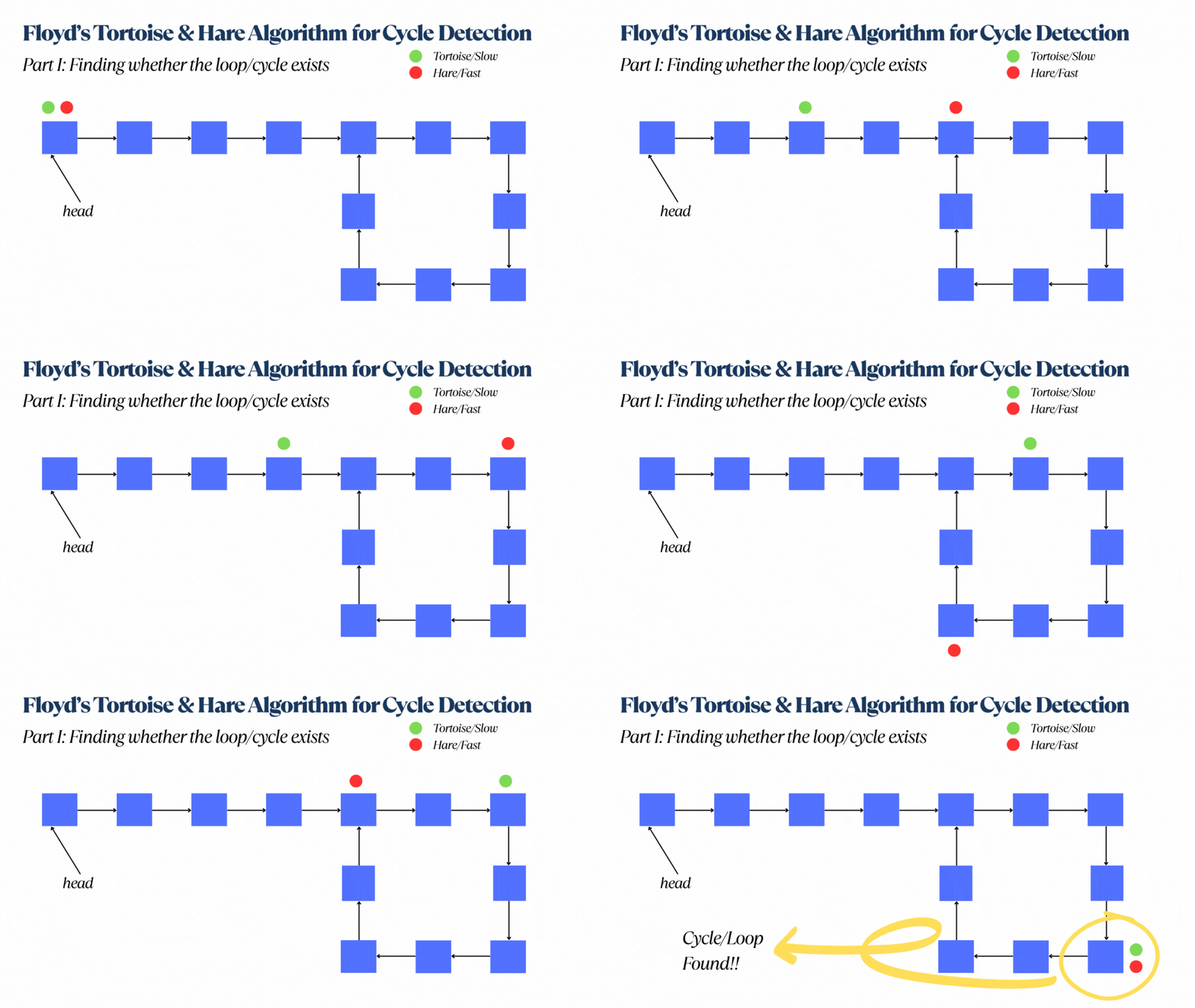
Phase 2: Pinpoint the Starting Node
Once the slow and fast pointers have collided, the magic happens. The algorithm is surprisingly simple:
- Leave one pointer (say, the
fastpointer) at the collision point. - Move the other pointer (the
slowpointer) back to theheadof the linked list. - Now, advance both pointers one step at a time.
- The node where they meet for the second time is the starting node of the cycle.
This might seem like a non-obvious trick, but it is guaranteed to work. To understand why, we need to analyze the distances traveled by the pointers.
The "Why": Unpacking the Intuition
Let's break down the linked list into distinct parts to reason about the distances.

Let's define our terms based on this diagram:
- m: The distance from the
list start(head) to thecycle start. - n: The total length of the cycle.
- k: The distance from the
cycle startto themeeting point.
When the slow and fast pointers collide at the meeting point in Phase 1:
- Distance traveled by
slowpointer:m + k - Distance traveled by
fastpointer: It has traveledm + kand also completed some number of full laps (p) around the cycle. So, its distance ism + k + p * n.
Since the fast pointer moves twice as fast as the slow pointer, we have the crucial relationship:Distance(fast) = 2 * Distance(slow)
Now, let's isolate m:
This equation is the key. It might look a bit abstract, so let's rephrase it. We can rewrite p * n - k as (p - 1) * n + (n - k). This tells us:
The distance from the head to the cycle start (
m) is equal to some number of full cycles plus the distance from the meeting point to the cycle start (n - k).
Because full cycles don't change the relative position within the loop, this means that if you start one pointer at the head (and travel m steps) and another at the meeting point (and travel m steps), they are guaranteed to meet at the cycle's starting node.
The following video provides an excellent, step-by-step visual and intuitive proof of this exact logic. Watching it will help solidify why this two-phase approach is correct.
L17. Find the starting point of the Loop/Cycle in LinkedList | Multiple Approaches
The "take U forward" channel, which we used in the last lesson, offers a very clear continuation of the topic. This video focuses on finding the start of the loop.
First, watch the walkthrough of the algorithm itself from step two. Then, pay close attention to the intuitive proof, which uses diagrams and distance variables (L1 and d) to prove why the two pointers meet at the starting node. This is the core conceptual part of our lesson.
Implementation
Now that you understand the logic, implementing it is straightforward. The code consists of two distinct loops: the first for Phase 1 (detection) and the second for Phase 2 (finding the start).
Fast & Slow Pointers: Master Floyd's Cycle Detection
This article on Medium provides a concise implementation of the full algorithm.
Focus on the Python code block under the heading "Python Solution". Notice how it's structured: An initial check for an empty or single-node list. Phase 1: The while loop to find the collision. It includes a check (else: return None) for the no-cycle case. Phase 2: After the collision, one pointer is reset to head, followed by the second while loop where both pointers move at the same speed.
The structure of this code is a classic pattern for this problem. You first establish that a meeting point exists and then use that point as an anchor to find the cycle's entrance.
Complexity Analysis
- Time Complexity: . The first phase has the slow pointer traversing at most
Nnodes. In the second phase, the pointer starting from the head travelsmsteps to the cycle's entrance. Sincem < N, the total time complexity remains linear. - Space Complexity: . Just like in the previous lesson, we only use a few pointers, making this the optimal solution in terms of space.
Conclusion
In this lesson, we've extended our knowledge of Floyd's Cycle-Finding Algorithm to not just detect a cycle but to pinpoint its exact starting node. This demonstrates the depth and utility of the fast and slow pointer pattern.
Key Takeaways:
- Finding the cycle start is a two-phase algorithm.
- Phase 1 is cycle detection: find the collision point using fast and slow pointers.
- Phase 2 is finding the start: reset one pointer to the
head, keep the other at the collision point, and move both one step at a time until they meet again. - The mathematical insight underpinning this is that the distance from the
headto thecycle startis equivalent (in terms of position within the cycle) to the distance from themeeting pointto thecycle start.
We've now seen the fast and slow pointer pattern used to find the middle of a list and to solve cycle-related problems. In our next lesson, we will explore another creative application: determining if a linked list is a palindrome. This will require combining fast/slow pointers with another fundamental operation: list reversal.