Recommended resources
The freely available resources this lesson will direct you to.
Introduction
In our last lesson, we established a rigorous framework for identifying and prioritizing use cases for a Personal Agentic Operating System. By applying an "Agent-Readiness Score" and an Impact/Effort matrix, we concluded that building an agent for multi-source research synthesis represents a high-impact "Strategic Project."
This lesson will now move from what to build to how to build it. Our learning outcome is to design an agent workflow for multi-source research synthesis with defined scope and output format. We will deconstruct the complex, often ambiguous act of "research" into a structured, repeatable system that an AI agent can execute autonomously. This is not a coding exercise; it is an architectural design session focused on systems thinking—defining the components, data flows, and decision points of an intelligent process.
1. The Anatomy of a Research Agent
Before diving into the workflow, let's establish a conceptual model of the agent itself. A research agent is more than just a search bar connected to an LLM. It's a system of coordinated functions designed to mimic the cognitive process of a human researcher.
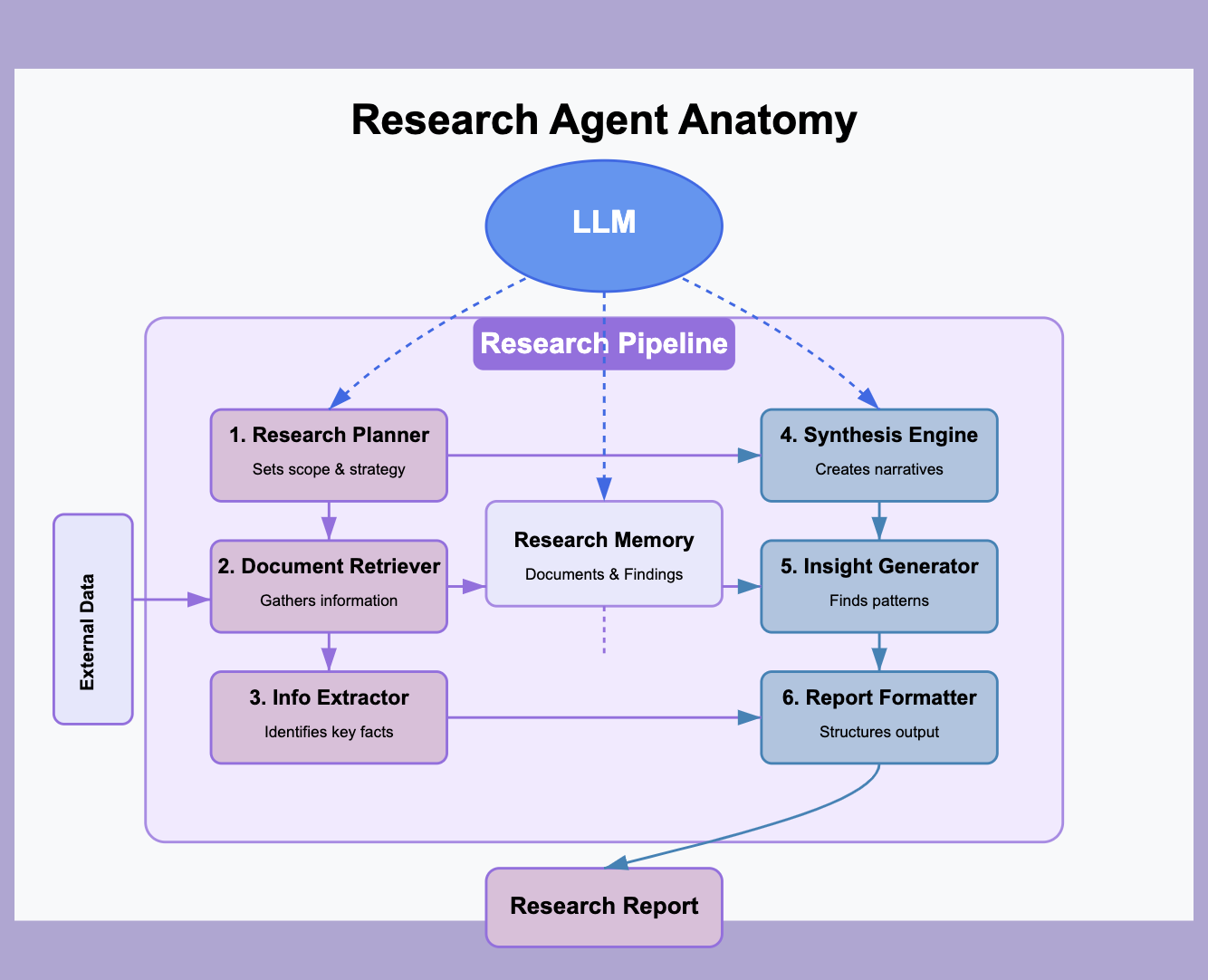
As shown in the "Research Agent Anatomy," a robust research agent comprises several key modules:
- Research Planner: Defines the scope and strategy, breaking down the main query.
- Document Retriever: Gathers raw information from external sources (e.g., web search APIs, local files, databases).
- Info Extractor: Scans retrieved documents to pull out key facts and relevant passages.
- Synthesis Engine & Insight Generator: Weaves the extracted information into a coherent narrative and identifies higher-order patterns or contradictions.
- Report Formatter: Structures the final output into a clear, usable format with citations.
The core idea is to transform research from a monolithic, creative task into a deterministic, yet intelligent, workflow. To understand the thinking behind this, it's useful to consider how we can model an agent's behavior on that of a skilled human researcher.
Building an Intelligent Deep Research Agent: From Query to Insights ...
This article, 'Building an Intelligent Deep Research Agent', provides the foundational philosophy for our design. It posits that effective research agents replicate the decision-making process of human experts.
Please read the sections 'The Core Intuition: Mimicking Human Research Behavior' and 'The Agentic Leap: From Reactive to Proactive'. Focus on how research is framed as a series of decisions and the agent's shift from simply reacting to proactively planning, adapting, and knowing when to stop.
2. A Structured Workflow for Deep Research
With our conceptual model in place, we can now design the step-by-step workflow. We will use a structured, multi-phase approach that ensures the process is observable, controllable, and produces a high-quality output. The following workflow is heavily informed by production-grade agentic systems designed for "controlled autonomy."
For a comprehensive overview of such a system, the article "Steerable Deep Research" provides a detailed technical walkthrough. We will use its pipeline structure as our primary blueprint.
Steerable Deep Research: Building Production-Ready Agentic ...
This article from ZenML outlines a production-ready 'Deep Research pipeline'. It's an excellent example of the kind of structured, workflow-driven approach we are designing.
Please read the 'Deep Research Pipeline Code Walkthrough' section, paying close attention to the descriptions of these key steps: 'Query Decomposition', 'Parallel Information Gathering', 'Merge Results', 'Cross-Viewpoint Analysis', 'Reflection Generation', and 'Final Report Generation'. This will serve as the architectural foundation for our agent's workflow.
Drawing from that blueprint, we can define our agent's workflow in five distinct phases:
Phase 1: Query Decomposition and Planning
The agent does not immediately search. It first analyzes the user's query to break it down into a set of smaller, focused sub-questions.
- Input: A single, complex research query (e.g., "What are the primary risk factors and mitigation strategies for AI agent deployment in regulated financial institutions?").
- Process: The agent uses an LLM with a specific prompt to generate a list of atomic sub-questions.
- "What are the key categories of risk (e.g., operational, compliance, security)?"
- "What are common mitigation strategies for model hallucination?"
- "How do 'human-in-the-loop' systems address regulatory compliance?"
- Output: A structured plan consisting of the main query and a list of sub-questions to investigate.
This initial planning stage scopes the research and transforms an ambiguous task into a clear set of parallelizable work items.
Phase 2: Parallel Information Gathering (Fan-Out)
For each sub-question, the agent initiates an independent research task. This "fan-out" architecture is highly efficient.
- Input: The list of sub-questions from Phase 1.
- Process (for each sub-question in parallel):
- Generate Search Queries: The agent uses an LLM to generate several targeted search engine queries for the sub-question.
- Execute Search: The agent calls an external tool (e.g., Tavily, Google Search API) with these queries.
- Retrieve & Synthesize: For each search result, the agent retrieves the content and performs an initial, brief synthesis, answering the sub-question based only on that single source.
- Output: A collection of preliminary answers for each sub-question, with each answer tied to its specific sources.
Phase 3: Cross-Synthesis and Reflection (Fan-In)
Once all parallel tasks are complete, the agent aggregates the results and begins the crucial synthesis work.
- Input: All preliminary answers and their sources from Phase 2.
- Process:
- Merge & Synthesize: The agent consolidates the answers for each sub-question, creating a unified summary that integrates findings from multiple sources.
- Cross-Viewpoint Analysis: The agent is prompted to look across all the synthesized answers to identify patterns, agreements, and contradictions. This is a critical step that elevates the output from a summary to an analysis.
- Reflection & Gap Analysis: The agent reflects on the collected information, identifying any gaps in its understanding or areas that require further investigation.
- Output: A synthesized body of knowledge and a set of "follow-up questions" or identified gaps.
Phase 4: Iterative Refinement (The Agentic Loop)
Based on the reflection phase, the agent can decide to perform additional, more targeted research. This creates an iterative loop that deepens the quality of the research.
- Input: The follow-up questions from Phase 3.
- Process: The agent can loop back to Phase 2, but this time with highly specific queries designed to fill the identified gaps. The agent can also be given a budget (e.g., "perform at most two refinement loops") to prevent "spinning out" in endless research.
- Output: An enriched body of knowledge that has been iteratively improved.
Phase 5: Final Report Generation
The final phase is about structuring the synthesized knowledge into the user-defined output format.
- Input: The complete, synthesized body of knowledge.
- Process: The agent populates a pre-defined template. In a technical context, this could be a Pydantic model in Python that defines fields for:
executive_summaryintroductionmain_findings(a list of sections, one for each sub-question)cross_analysis(insights from the cross-viewpoint step)conclusionsources_cited(a formatted list of URLs)
- Output: A structured, well-formatted document (e.g., Markdown, HTML, or JSON) that presents the research findings clearly and professionally.
3. Implementation Patterns and Considerations
While we are not writing code, it's important to consider the architectural patterns that enable this workflow.
Multi-Agent vs. Single-Agent Architecture
The workflow we've designed can be implemented using different agentic architectures. The "LangGraph Template" video provides a clear example of a multi-agent approach.
LangGraph Template: Multi-Agent RAG Research
This video from LangChain demonstrates a multi-agent architecture for research. It introduces the powerful concept of a 'parent' agent for planning and 'child' agents for execution.
Watch from 00:11 to 05:23. Focus on: The division of labor between the 'parent' agent (planning, routing) and the 'researcher' agent (retrieval). The concept of a 'subgraph', where one agent's workflow is nested inside another's. This is a key pattern for managing complexity and isolating context, which is especially useful for token-heavy research tasks.
The key takeaway is that you can use a supervisor-worker pattern:
- A Supervisor Agent handles Phase 1 (Planning) and Phase 5 (Final Reporting).
- It then spawns multiple Researcher Agents in parallel, one for each sub-question, to execute Phase 2. This isolates the context for each research task, making the process more robust and scalable.
The Centrality of Tools and Instructions
An agent is only as capable as its tools and its instructions. The "Deep Agents" framework highlights this with exceptional clarity.
Build a Research Agent with Deep Agents
This video on 'Deep Agents' provides a practical look at how to equip a research agent with the necessary tools and—crucially—the right instructions to guide its behavior.
Please watch the segment from 03:47 to 08:05. Pay attention to: Task-specific tools: The agent is explicitly given a search tool. Task-specific instructions: The importance of high-quality prompting, including heuristics to prevent 'spin-out' (endless searching). Sub-agents for context isolation: Reinforcing the idea that delegating token-heavy tasks is an effective architectural choice.
This reinforces two critical design principles:
- Tooling is Explicit: Your agent must be explicitly granted access to necessary tools (e.g., web search, file access).
- Instructions are Paramount: The agent's prompts must be carefully engineered to guide its reasoning, define its constraints (e.g., budgets), and specify its output format.
Conclusion
You have now designed a complete, end-to-end workflow for a multi-source research synthesis agent. This design transforms a vague goal into a structured, five-phase process that is observable, repeatable, and capable of producing high-quality, synthesized insights.
Key Takeaways:
- Structure is Key: A robust research workflow consists of distinct phases: Decomposition, Parallel Gathering, Synthesis, Iteration, and Reporting.
- Plan First, Act Second: The most critical step is the initial decomposition of a complex query into a manageable research plan.
- Fan-Out/Fan-In: This architecture allows for efficient, parallel information gathering and subsequent deep synthesis.
- Synthesis is More Than Summary: True synthesis involves cross-viewpoint analysis, identifying contradictions, and reflecting on knowledge gaps.
- Define the Output: A structured output format (like a pre-defined report template) is essential for making the agent's work usable and consistent.
- Architecture Matters: Patterns like supervisor-worker multi-agent systems and the use of sub-agents for context isolation are powerful tools for building complex workflows.
Preview of the Next Lesson:
Having designed this complex, information-gathering agent, we will turn our attention to a different but equally valuable type of personal agent. In the next lesson, we will design the core logic and data model for a discipline-tracking agent, focusing on state management, goal monitoring, and proactive user interaction.