Recommended resources
The freely available resources this lesson will direct you to.
- BA Bootcamp - BABOK Untangled Series - Episode 5 Elicitation & Collaborationwww.youtube.com
- Requirement Gathering Techniques For A Business Analystwww.youtube.com
- Engaging Stakeholders in Elicitation and Collaborationwww.iiba.org
- [PDF] Study Notes Week 2: Requirements Elicitation & Collaborationbusiness-analysis-excellence.com
Welcome back. In the previous lesson, you turned a requested feature into an evidence-based problem statement with affected users, a measurable target, and explicit assumptions. That work gives elicitation a purpose: you are not simply collecting a list of requested features; you are finding the information needed to understand the problem, define its boundaries, and make sound decisions.
This is the first lesson focused on discovery within the Role Targeting and Cross-Industry Discovery module. You will create a stakeholder-specific elicitation plan: a practical plan that identifies who to involve, what each person can contribute, how much authority they have, and which technique respects their time while producing credible information. This is a portfolio-worthy analyst artifact and a frequent interview topic for Technical Business Analyst and Requirements Analyst roles.
Elicitation is planned evidence collection, not meeting scheduling
An elicitation plan is often mistaken for a calendar of workshops. A calendar answers, “When will people meet?” A good elicitation plan answers five more important questions:
- What must be learned or decided?
- Which stakeholder, document, system record, or observation can provide that information?
- What authority does that participant hold?
- What kind of knowledge do they possess?
- Which technique will obtain reliable information within their availability constraints?
The distinction matters because authority and knowledge are not the same.
- A business sponsor may approve budget, scope, or priority but have only second-hand knowledge of daily operational problems.
- A frontline user may understand workarounds, exceptions, and pain points in detail but have no authority to approve a solution.
- A compliance officer may be the authoritative source for a policy rule but may only have twenty minutes for a focused review.
- A technical lead may not decide business priority but can identify integration dependencies, data limitations, and implementation risks.
A common elicitation failure is to ask one senior person to answer every question. That produces a fast answer, but not necessarily an accurate one. The analyst instead designs a small system of complementary evidence.
A useful principle is:
Match the technique to the information needed, then adapt it to the stakeholder’s authority, knowledge, and availability.
Profile stakeholders before choosing techniques
Before sending invitations, build a stakeholder profile. Start with the problem statement from the previous lesson and identify who is affected, who performs the work, who provides inputs, who controls rules, who owns data, and who can make decisions.
The stakeholder power-interest matrix below helps prioritize engagement. It is not a substitute for analysing knowledge or decision rights, but it prevents a plan from overlooking influential stakeholders.
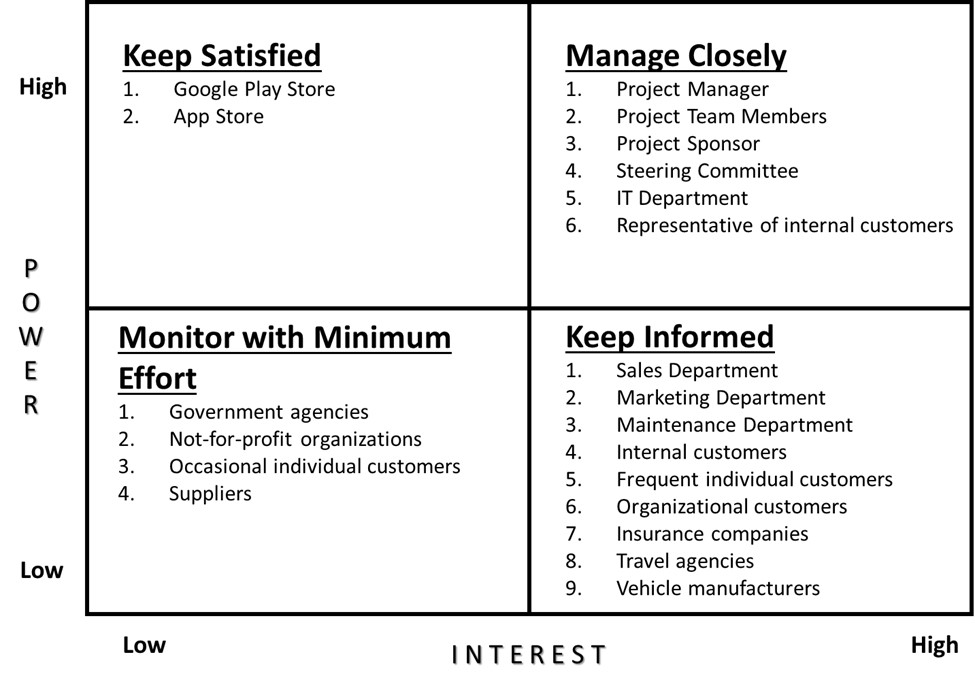
Use the matrix carefully:
- High power, high interest: involve closely in key decisions and trade-offs. These people may be sponsors, product owners, or accountable operations leaders.
- High power, lower day-to-day interest: keep satisfied through concise decision briefs and well-timed approval checkpoints. Do not consume their time with detailed workflow interviews unless they genuinely own that knowledge.
- Lower power, high interest: keep informed and involve them in discovery when they use, support, or are strongly affected by the process.
- Lower power, lower interest: monitor proportionately. They may still need consultation if they own a dependency or are affected by a particular exception.
For each stakeholder or group, record the following.
| Planning dimension | What to capture | Why it matters |
|---|---|---|
| Stake and role | What they do, what they gain or lose, and how the change affects them | Clarifies why they belong in the plan |
| Authority | Decision-maker, approver, policy owner, influencer, contributor, or informed party | Prevents seeking approval from the wrong person |
| Knowledge type | Operational, policy, technical, customer, data, or strategic knowledge | Determines what they can credibly validate |
| Availability and access | Shift pattern, location, time zone, workload peak, language, and access constraints | Determines whether workshops, interviews, observation, or asynchronous methods are realistic |
| Information needed | Current workflow, exception, metric definition, business rule, technical constraint, or decision | Prevents vague meetings |
| Technique and output | Method, format, expected artifact, and confirmation approach | Makes the activity purposeful and traceable |
Knowledge is not all of one kind
It helps to distinguish four common forms of knowledge.
| Knowledge type | Typical holder | Strong elicitation approach |
|---|---|---|
| Explicit knowledge | Policy owner, process owner, technical architect | Document analysis, focused interview, structured review |
| Tacit procedural knowledge | Agent, coordinator, technician, operations user | Observation, shadowing, workflow walkthrough, contextual interview |
| Quantitative knowledge | Data analyst, operations manager, reporting owner | Data analysis, report review, interview to interpret findings |
| Experiential knowledge | Customer, end user, support representative | Interview, usability feedback, prototype review, survey followed by deeper conversations |
For example, a call-centre agent may say, “We just check three systems before answering the customer.” Observation can reveal the actual details: which system is checked first, which status is unreliable, when they switch to a spreadsheet, and which exception requires a supervisor. That is tacit knowledge. It is often missed in sponsor interviews and process documents.
BA Bootcamp - BABOK Untangled Series - Episode 5 Elicitation & Collaboration
Watch the relevant parts of BA Bootcamp – BABOK Untangled Series: Episode 5 Elicitation & Collaboration from BA Bootcamp. It connects preparation activities with observation as a technique for uncovering work that people may not describe fully in a meeting.
Watch elicitation preparation for the elements to plan before engaging stakeholders: scope, techniques, logistics, supporting material, and stakeholder preparation. Then watch observation to focus on why direct observation is valuable when daily routines, workarounds, and tacit knowledge matter.
The planning principle is particularly relevant where participants have limited availability. Shift workers, field staff, customer-support agents, and busy approvers should not be forced into a technique that is convenient only for the analyst.
[PDF] Study Notes Week 2: Requirements Elicitation & Collaboration
Read the preparation guidance in Study Notes Week 2: Requirements Elicitation & Collaboration from Business Analysis Excellence. It provides a practical example of adapting techniques to stakeholders who work in shifts and highlights the logistical choices that belong in an elicitation plan.
On pages 2–5, find the section “TASK: Prepare for elicitation.” Read the planning purpose to identify the intended outputs of preparation. Then read the shift-work example, noting why a survey plus scheduled individual follow-ups is more suitable than one large workshop. Under “Element 2: Select elicitation techniques,” read the technique-selection guidance. Finish with the beginning of “Element 3: Set up logistics,” including the logistics checklist.
Match the technique to the stakeholder and the decision
Elicitation generally combines three approaches:
- Collaborative elicitation: direct interaction with people through interviews, workshops, observation, reviews, and co-design.
- Research elicitation: analysis of documents, policies, tickets, process records, metrics, logs, and existing requirements.
- Experimental elicitation: prototypes, simulations, pilots, or other controlled ways to learn what will work.
A reliable plan uses more than one approach because stakeholders may disagree, documents may be outdated, and operational data may reveal a pattern without explaining its cause.
Choosing the right technique
| Technique | Use it when | Stakeholder fit | Main limitation |
|---|---|---|---|
| Document and record analysis | Existing policies, SOPs, tickets, reports, or requirements provide useful context | Busy approvers, policy owners, data owners, technical teams | Documents may be incomplete, outdated, or different from real practice |
| One-to-one interview | You need rationale, context, rules, priorities, or detailed follow-up | Sponsors, process owners, SMEs, technical leads, compliance owners | One person’s view is not automatically organisational truth |
| Observation or shadowing | You need to understand actual work, handoffs, workarounds, and exceptions | Frontline users, support teams, coordinators, field staff | Requires time, consent, and representative sampling |
| Workshop | Multiple teams must align on a workflow, definition, dependency, or trade-off | Cross-functional representatives with sufficient authority | Expensive in participant time; poor preparation can let senior voices dominate |
| Survey or questionnaire | You need broad input, frequency estimates, or prioritised themes from many people | Large, distributed, shift-based, or externally located groups | Provides breadth rather than depth; question design can bias results |
| Prototype review | Users need something concrete to react to, especially for screens or interactions | End users, customer-facing teams, product owners | Validates understanding of an option; does not prove that the option solves the root problem |
| Data analysis | You need to validate scale, trend, baseline, or performance claims | Data owners, reporting leads, operations managers | Explains what is happening, but usually needs interviews to explain why |
A technique should never be selected merely because it is familiar. For example:
- A workshop is not automatically appropriate just because several departments are involved. If the team does not yet understand the current process, start with targeted interviews, document review, and observation.
- A survey is not a replacement for speaking to key users. It can identify patterns, but it rarely uncovers exceptions or causes.
- An interview with a sponsor is not a substitute for observing frontline work.
- A prototype is valuable after you have understood the user need sufficiently to test an interaction or workflow assumption.
Authority determines the participant’s role in the plan
Use authority to define what you need from each person.
| Authority level | Appropriate role in elicitation | Suitable methods |
|---|---|---|
| Accountable decision-maker | Confirm objectives, success measures, priority trade-offs, scope boundaries, and unresolved decisions | Short structured interview, decision review, targeted workshop checkpoint |
| Approver or control owner | Validate policy, regulatory, security, financial, or governance constraints | Document analysis, focused review, exception-based interview |
| Process owner | Confirm end-to-end workflow, ownership, KPIs, and escalation paths | Interview, process walkthrough, workshop |
| Subject-matter expert | Explain rules, terminology, edge cases, data meaning, or technical constraints | Interview, model review, technical walkthrough |
| Frontline contributor | Reveal real work, pain points, workarounds, and exception handling | Observation, contextual interview, short survey, prototype feedback |
| External user or customer | Describe needs, outcomes, comprehension, and service experience | Interview, survey, usability or prototype feedback |
| Influencer | Surface concerns, adoption risks, and informal organisational dynamics | Targeted interview, workshop participation, review of findings |
The key distinction is this: people contribute according to their knowledge, and decisions are confirmed according to authority.
Worked example: service-request status visibility
Continue the fictional home-services scenario from the previous lesson.
The sponsor’s initial request was:
“Add WhatsApp notifications for every service-request update. Customers keep calling for status.”
The problem statement was broader:
Customers cannot reliably confirm appointment and request status, creating uncertainty and avoidable status-enquiry contacts.
The elicitation objective is not “collect requirements for WhatsApp.” It is:
Understand why customers lack reliable status information, identify the affected workflow and constraints, validate the contact-rate baseline, and agree the scope and success measures for an improvement.
Here is a stakeholder-specific plan.
| Stakeholder or group | Authority and knowledge | Availability | Technique and format | Expected output |
|---|---|---|---|---|
| Customer operations sponsor | High decision authority; strategic view of customer experience and cost | Thirty minutes per week | Structured interview, then a concise decision review | Confirm business outcome, target metric, priorities, and scope trade-offs |
| Contact-centre manager | Medium authority; strong knowledge of contact reasons, staffing, and operational KPIs | Forty-five-minute session | Interview supported by ticket-category and report review | Validate baseline, contact classification, peak periods, and operational impact |
| Contact-centre agents | Low formal authority; high tacit knowledge of customer questions and workarounds | Shift-based; difficult to schedule together | Two short observations, contextual interviews, and a brief asynchronous pulse survey | Identify actual lookup steps, recurring uncertainty, and exception scenarios |
| Scheduling and dispatch lead | Medium authority; strong knowledge of appointment rules and technician-status updates | One-hour scheduled session | Workflow walkthrough using a draft current-state sketch | Clarify status changes, ownership, timing, rescheduling, and data gaps |
| Technical lead | Authority over technical feasibility; knowledge of integrations and data flow | Forty-five-minute technical session | Existing-interface review followed by targeted interview | Identify data source, update timing, integration constraints, and failure risks |
| Privacy or compliance owner | Approval authority for customer communications and data handling | Limited time; available for focused review | Policy and consent-record analysis, then a twenty-minute exception review | Confirm communication consent, retention, audit, and channel constraints |
| Customers with recent open requests | Lived experience; no delivery authority | Distributed and variable availability | Short survey, followed by selected interviews or prototype feedback | Validate whether the issue is confirmation, rescheduling, delay explanation, channel preference, or another concern |
Notice several deliberate choices:
- The sponsor is consulted early but is not asked to explain agent workarounds.
- Agents are not placed in a long workshop during shifts. Observation and short follow-ups respect their availability and reveal actual practice.
- Compliance receives focused material rather than a general discovery invitation.
- The customer survey provides breadth, but selected interviews provide context behind the responses.
- The technical lead is involved before a preferred communication channel becomes an assumed solution.
- A cross-functional workshop happens after initial evidence is collected, not as the first activity.
Sequence the activities to reduce confusion
For this scenario, the plan could be organised as follows:
- Research preparation: review ticket categories, service-request statuses, existing customer communications, consent rules, reports, and prior change requests.
- Targeted discovery: interview the sponsor, contact-centre manager, dispatch lead, and technical lead; conduct observation with selected agents.
- Broad validation: issue a short customer or agent survey if the initial evidence needs wider confirmation.
- Cross-functional alignment: facilitate a focused workshop with representatives from operations, support, dispatch, technology, and compliance.
- Confirmation and decision: circulate a concise summary of findings, assumptions, conflicts, and proposed scope; obtain confirmation from the appropriate decision-maker and approvers.
The workshop should have a narrow purpose, such as agreeing the status events customers need to understand and identifying ownership for each event. It should not attempt to solve every unknown in one sitting.
Build the elicitation plan artifact
For an interview portfolio, create a one-page Stakeholder-Specific Elicitation Plan for a sanitised scenario. You may use the home-services case or a disguised automotive, content-platform, or internal-workflow scenario.
Start with a short header:
| Field | Example |
|---|---|
| Initiative | Improve service-request status visibility |
| Problem statement | Customers and agents lack timely, reliable request-status information, causing avoidable status enquiries |
| Elicitation objective | Validate root causes, workflow gaps, rules, constraints, scope, and measurable success criteria |
| Primary decision owner | Customer Operations Director |
| Planned completion window | Two weeks |
| Confirmation method | Findings summary reviewed by process owner, technical lead, compliance owner, and sponsor |
Then use this planning table.
| Stakeholder / source | Stake and role | Authority | Knowledge needed | Availability constraint | Technique | Planned activity and output | Confirmation owner |
|---|---|---|---|---|---|---|---|
| [Name or role] | [Why affected] | [Decision / approval / SME / contributor] | [What only they can clarify] | [Time, shift, location] | [Method] | [Session or analysis output] | [Who validates] |
A high-quality plan normally includes at least:
- one accountable decision-maker;
- one or more frontline or end-user perspectives;
- a process or domain SME;
- a technical or data perspective where systems are affected;
- policy, security, finance, legal, or compliance input when relevant;
- existing evidence sources such as documents, reports, system records, or tickets.
Final quality check
Before sharing the plan, check the following:
- Every stakeholder has a clearly stated reason for involvement.
- Every planned activity has a defined outcome, not just a meeting title.
- High-authority stakeholders are engaged for decisions, priorities, and approvals rather than assumed to know every operational detail.
- High-knowledge contributors are engaged for the information they actually possess.
- Limited availability has led to a suitable method, such as asynchronous review, observation, brief interviews, or surveys.
- Important claims will be triangulated using more than one source where possible.
- The plan identifies who will confirm each important finding.
- The plan is realistic about time, culture, location, confidentiality, and language.
Do not write “workshop with all stakeholders” unless you can explain who must attend, what decision or artifact the workshop will produce, and why an individual interview or document review would not be sufficient.
Key takeaways
An elicitation plan is a deliberately designed approach for obtaining reliable information and decisions. It is more than an agenda: it links an elicitation objective to participants, evidence sources, authority, knowledge, availability, techniques, expected outputs, and confirmation responsibilities.
Use authority to identify who can decide or approve, and use knowledge to identify who can explain reality. Interviews uncover rationale, observation exposes tacit work, surveys provide breadth, workshops enable alignment, documents and data establish context, and prototypes test a tangible interpretation.
Next, you will turn this plan into a structured set of discovery questions for an unfamiliar business domain—questions that uncover goals, workflows, rules, data, exceptions, risks, and success measures without prematurely prescribing a solution.