Recommended resources
The freely available resources this lesson will direct you to.
Welcome back. Last time, we looked at why an interruption can land as more than a break in your sentence: it may feel like disrespect, bring on bodily tension, and make a louder response more likely. Today, we’ll take that general picture and use it to examine one recent moment. The aim is not to decide who was right. It is to see what happened between being interrupted and responding, including what happened afterward.
Turn the cycle into a timeline
The NHS diagram below shows anger as a cycle involving an event, thoughts, emotions, physical symptoms, and behaviour. Its example concerns a medical situation rather than a conversation, but the same categories can help us look closely at an interruption.
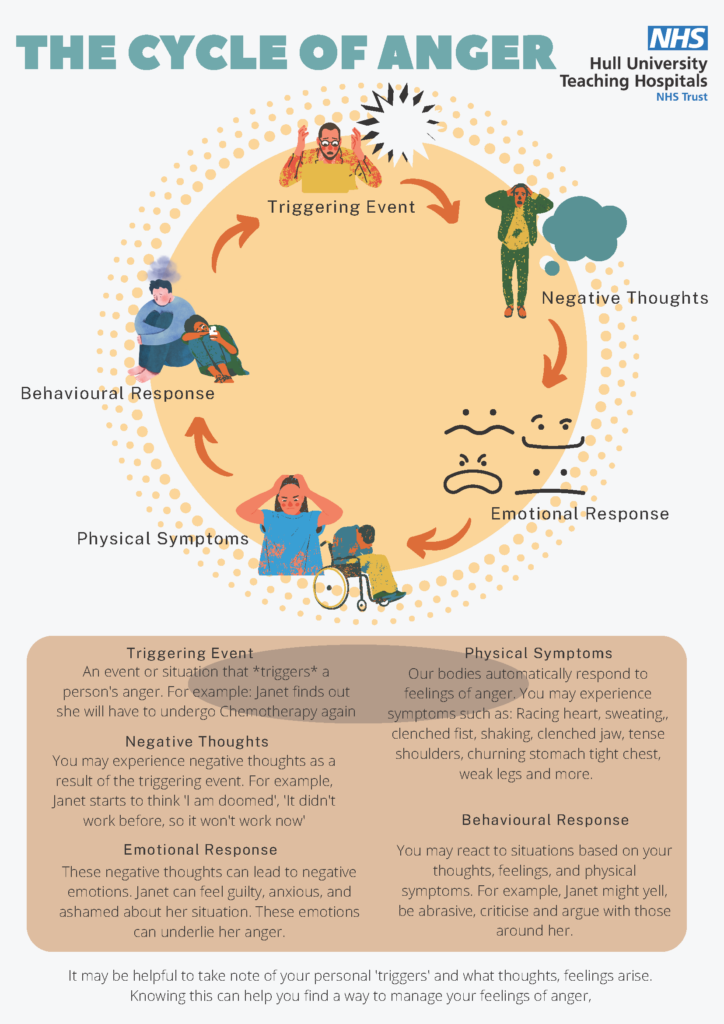
For this lesson, we’ll give that cycle a six-part timeline:
- Trigger: What happened that someone else could have seen or heard?
- Interpretation: What did you take it to mean at the time?
- Body cues: What did you notice physically?
- Urge: What did you want to do in that instant?
- Action: What did you actually say or do?
- Consequence: What happened immediately afterward, and what followed later?
The timeline is a way to examine a fast-moving experience, not a claim that every part occurs neatly in order. You might notice a tight jaw before you can name a thought. The urge is especially worth separating from the action: wanting to talk over someone, for example, is not the same as doing it.
What makes an account useful?
A useful account stays close to what you know. “My partner started speaking while I was halfway through explaining my plans” is a trigger. “They thought my plans were unimportant” is an interpretation. That interpretation may turn out to be accurate, but you cannot establish it from the interruption alone. Keeping the two separate lets you take your reaction seriously without treating a guess about someone’s intention as an observed fact.
An NHS anger guide uses a short diary to make that distinction visible. Its example is not an interruption, but it shows how an event, a thought, a behaviour, and the aftermath can tell a more informative story than “I got angry.”
Managing Anger :: Cumbria, Northumberland, Tyne and Wear NHS Foundation Trust
Read the Stage 1 diary example in Managing Anger from Cumbria, Northumberland, Tyne and Wear NHS Foundation Trust. Notice how recording what happened afterward adds something that the initial event and angry thought cannot tell us.
In the subsection “Managing anger - Managing angry behaviours,” find “Stage 1.” Start with the instruction to keep a diary. Read through Alex’s two-row diary and the paragraph immediately beneath it; stop before “Stage 2.” Pay particular attention to the difference between what Alex’s partner asked and what Alex thought the request meant.
In the diary, a partner asks Alex to say what time he will be in. Alex thinks, “she doesn’t trust me,” then storms out and slams the door; afterward, she does not speak to him for the rest of the day. The record does not prove why she asked, or why she later went quiet. It does show a sequence that “We argued” would conceal.
For an interruption conflict, we can make the diary more precise by adding body cues and urge. Body cues might be a hot face, a tight chest, clenched hands, or a quicker voice. An urge might be “make them stop,” “get my point out before I lose it,” or “leave the room.” You need not find a cue in every category. If you cannot remember one, “not sure” is more useful than filling in what probably happened.
A close look at one interruption
Suppose you are telling your partner about a difficult day. Midway through a sentence, they begin explaining what they would have done. That is the trigger as you remember it. Your immediate interpretation is, “They don’t care enough to hear the rest.” You feel hurt and angry; you notice your jaw tightening and your speech speeding up. Those are body cues, not evidence of your partner’s intention.
Your urge is to reclaim the floor immediately. Your action is to say, much louder than you intended, “Can I finish?” The words name a reasonable need. The volume is also part of the action, and it may affect what follows. Your partner stops talking, so you get to finish your sentence—an immediate consequence that may feel like relief. They then answer briefly and the conversation ends earlier than you wanted. That is another consequence, though you do not yet know what they were thinking.
This account does not excuse an interruption or make the raised voice inevitable. It shows why both details matter. If you record only “They interrupted, so I shouted,” you miss the perceived meaning, the buildup, and the urge to be heard. If you record only “I was hurt,” you miss what you did and its possible effect on the conversation. A raised voice might secure a turn in the short term while making the larger conversation harder; in another incident, the aftermath could be different.
Put a recent moment into words
If a recent interruption comes to mind, make a private six-line note using the headings trigger, interpretation, body cues, urge, action, consequence. Choose one brief exchange rather than the whole history of a disagreement. Quote the words you remember, but mark uncertain details as uncertain. For the consequence, include both what happened right away and anything you noticed later; separate observations such as “they went quiet” from inferences such as “they were punishing me.” If this feels too charged today, use a less upsetting interruption or stay with the worked example.
The result need not be tidy. “I’m not sure what I thought, but I felt my face get hot and wanted to cut in” already identifies more of the moment than “I just snapped.” That is enough to begin seeing where the response became louder.
Takeaway
An interruption conflict can be understood as more than a trigger and a reaction. The interpretation, body cues, and urge fill in the space between the event and the action; the consequences show what the action changed. A careful account distinguishes what you observed from what you inferred, without dismissing either your feelings or a real pattern of being interrupted.
In the next lesson, we’ll move from looking back to responding in the moment: using a brief pause, slow exhalation, and muscle release when the first signs of escalation appear.