Recommended resources
The freely available resources this lesson will direct you to.
Hello again. In the previous lesson, you used to connect an amount of charge with the time taken and the rate of flow. This lesson uses the same idea of a rate, but for physical movement: speed tells you how much distance is covered per unit of time.
You will calculate distance, time, speed, and velocity in situations such as moving a cable trolley or feeding cable from a drum. The main challenges are choosing the right quantity, keeping units consistent, and noticing whether a question asks about the whole route or a change in position.
Distance and time give you speed
Suppose a cable trolley travels along a straight route in . Its average speed is the distance travelled divided by the time taken:
A speed of means 0.60 metres per second on average over that interval. It does not tell you that the trolley moved at exactly that speed every second. Speed is commonly expressed in metres per second () or kilometres per hour (); the unit depends on the distance and time units used.
Watch Calculate Speed & Velocity Easily from Tadashi Science for the formula triangle and examples of all three calculations. Its velocity example involves travel in one direction; later in this lesson, you will see why a change of direction needs extra care.
Calculate Speed & Velocity Easily: Step-By-Step Tutorial - Practice Problems | Physics
Watch Tadashi Science’s Calculate Speed & Velocity Easily to see how to select a formula from the quantity a question asks you to find.
Watch the formula triangle for speed, distance, and time. Then watch the worked examples, following how each answer gets its unit and how direction is included in the velocity example.
The triangle is a memory aid, not a different rule. In the image, distance () sits above speed () and time (). Cover the quantity you need: the remaining symbols show either a division or a multiplication.
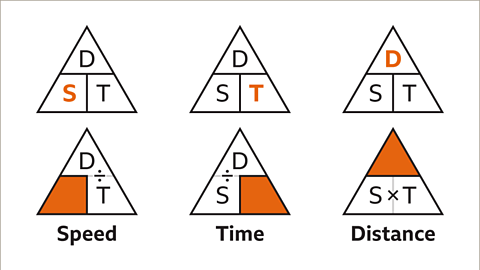
Writing the relationships as equations makes them easier to check:
For example, if a cable-feeding machine moves cable at a steady for , the length fed is
The seconds cancel, leaving metres. If instead you know that of cable is fed at a steady , find the time by dividing distance by speed:
Check the result in the original relationship: feeding each second for gives . When the motion is not steady, these same calculations can describe an average speed over the stated interval, provided you use its total distance and total time.
Make the units agree before calculating
A formula can be correct while its numerical answer is wrong because the units do not match. For an answer in , use metres and seconds. For an answer in , use kilometres and hours.
Suppose equipment travels along a route in . Dividing by gives , not . To report metres per second, first convert the time:
Speed units can also be converted directly. Because and ,
FuseSchool’s Speed Distance Time shows this kilometre-per-hour to metre-per-second conversion with a different value. Focus on converting both parts of the speed unit, rather than multiplying or dividing the speed by alone.
Speed Distance Time | Forces & Motion | Physics | FuseSchool
Watch the unit-conversion segment of Speed Distance Time from FuseSchool to reinforce why distance and time must both be converted.
In the conversion, follow how kilometres become metres and one hour becomes 3600 seconds before the speeds are compared.
A useful final check is to read your answer aloud with its unit. “Ten metres per second” describes a distance covered each second; “ten metres” does not describe a speed.
Speed is not always velocity
Distance is the total length of the route travelled, regardless of direction. Displacement is the change in position from start to finish, including direction. Speed uses distance; velocity uses displacement:
Read the “Average Velocity” discussion in CK-12’s Average Velocity. It explains why a journey can have a nonzero average speed but zero average velocity, and why an average need not be the speed at every moment.
Read CK-12’s Average Velocity to distinguish distance from displacement before applying the formulas to a route with a change of direction.
Under “Average Velocity,” just after the opening image and description, read the core discussion. Stop at the end of the paragraph contrasting constant velocity with average velocity, immediately before “Example.” Focus on the trip that goes out and returns: which quantity counts the full route, and which compares only the starting and finishing positions?
Consider a trolley that moves east, then west, taking altogether. It covers of distance, but finishes only east of where it started. Its results are therefore different:
Velocity needs a direction; speed does not. If the trolley had returned all the way to its starting point, its displacement and average velocity would be zero, even though it had travelled a distance and had a nonzero average speed.
For motion along a straight line in one direction, the distance travelled equals the size of the displacement. In that case, speed and the magnitude of velocity have the same numerical value; reporting velocity also requires the direction. To find a displacement from a velocity and time, or a time from a displacement and velocity, you can rearrange their relationship just as you did for speed—but keep the direction consistent.
These motion calculations describe a moving object, such as a trolley, vehicle, or length of cable being fed. Do not assume that a cable-feeding speed is the speed of electric charge or of an electrical signal; those are different questions.
Key takeaways
Use distance divided by time for average speed, speed multiplied by time for distance, and distance divided by speed for time. Convert units before substituting, and check that your answer’s unit describes the quantity requested. For average velocity, replace total distance with displacement—the change in position with direction.
This completes the foundations module. Next, you will turn from quantities and calculations to basic circuit diagrams, identifying how a source, conductors, a load, control equipment, and protection fit together.