Recommended resources
The freely available resources this lesson will direct you to.
Introduction
In our last lesson, we developed a framework for designing intentional listening protocols, treating a raga performance as a system with inputs (raga, laya, instrumentation) and a desired output (a specific emotional state). This moved us from passive listening to active, purposeful engagement with music. Now, we will apply this analytical lens to your core interest: cultivating bhakti bhav, or a state of devotion.
This lesson directly addresses the learning outcome: to analyze the musical characteristics—the common swara patterns and intervals—of ragas typically associated with bhakti rasa. We will investigate the "musical DNA" of devotion, exploring why certain melodic structures are so effective at stirring feelings of love, yearning, and surrender towards the divine. Think of this as reverse-engineering a specific emotional experience by examining its underlying code, a process that should resonate with your work in software development.
What is Bhakti Rasa?
First, let's situate bhakti within the broader theory of rasa we first encountered in Module 4. As you'll recall, Bharata Muni's Natyashastra codified eight (later nine) primary aesthetic emotions, or rasas, that can be evoked by art. While Bhakti was not one of the original nine, later scholars and artists, particularly within the medieval devotional movements, elevated it to the status of a major rasa.
This makes sense when we consider the building blocks of rasa.
This Hindi article provides a concise overview of the relationship between rasa and sthayi bhava (permanent emotion).
Please review the table on page 8, under the heading that begins with "भरत ने 8 स्थायी भाव". This table maps each sthayi bhava to its corresponding rasa. Note the connection between Rati (रति) and Shringar (शृंगार), which is love and beauty.
As the reading highlights, every rasa originates from a sthayi bhava, a latent, permanent emotional state within us. Bhakti rasa is understood to arise from the same sthayi bhava as Shringar rasa—namely, rati (love). However, in bhakti, this love is directed not towards a human beloved, but towards a divine principle. This love can manifest in many forms: as profound peace (shanta), as poignant sadness or longing (karuna), or as celebratory joy (shringar). The specific musical characteristics of a raga determine which facet of devotion is brought to the forefront.
The Swara Signature of Bhakti Ragas
The emotional character of a raga is most fundamentally defined by its selection of swaras (notes). Certain combinations of shuddha (natural), komal (flat), and teevra (sharp) notes create distinct emotional palettes. For bhakti, the use of komal swaras is particularly significant.
The following reading provides a systematic classification of ragas based on their swara content and the rasas they tend to evoke.
[PDF] THE IMPORTANCE OF RASA IN HINDUSTANI MUSIC
This article offers a clear breakdown of how a raga's note structure corresponds to its emotional impact.
Focus on the section titled "The significance of rasa in Hindustani Music". Pay close attention to the list that begins with the heading "Nature of the Raga". This section outlines five categories of ragas based on the swaras they employ. Read through point (v), ending at "Jaunpur etc.".
Let's synthesize the key patterns from this reading and connect them to the different flavors of bhakti:
-
Ragas with Komal Re and Komal Dha: These notes are the heart of many deeply devotional ragas. They create a mood of introspection, supplication, and sometimes profound sadness or yearning (karuna rasa). The instability of the flat second and sixth degrees relative to the tonic (Sa) generates a melodic tension that can mirror the spiritual longing for union with the divine.
- Examples: Ragas from the Bhairav, Poorvi, and Todi thaats. Raga Bhairav, which we studied, is a prime example. Ahir Bhairav is another, creating a feeling of serene, morning devotion.
-
Ragas with Komal Ga and Komal Ni: This combination is strongly associated with Shringar rasa (love, romance, beauty). When applied in a devotional context, it evokes a more tender, loving, and sometimes playful form of bhakti, often found in compositions celebrating the divine in a personal, intimate form (like the stories of Krishna and Radha).
- Examples: Ragas from the Kafi thaat, such as Kafi itself and Bageshri.
-
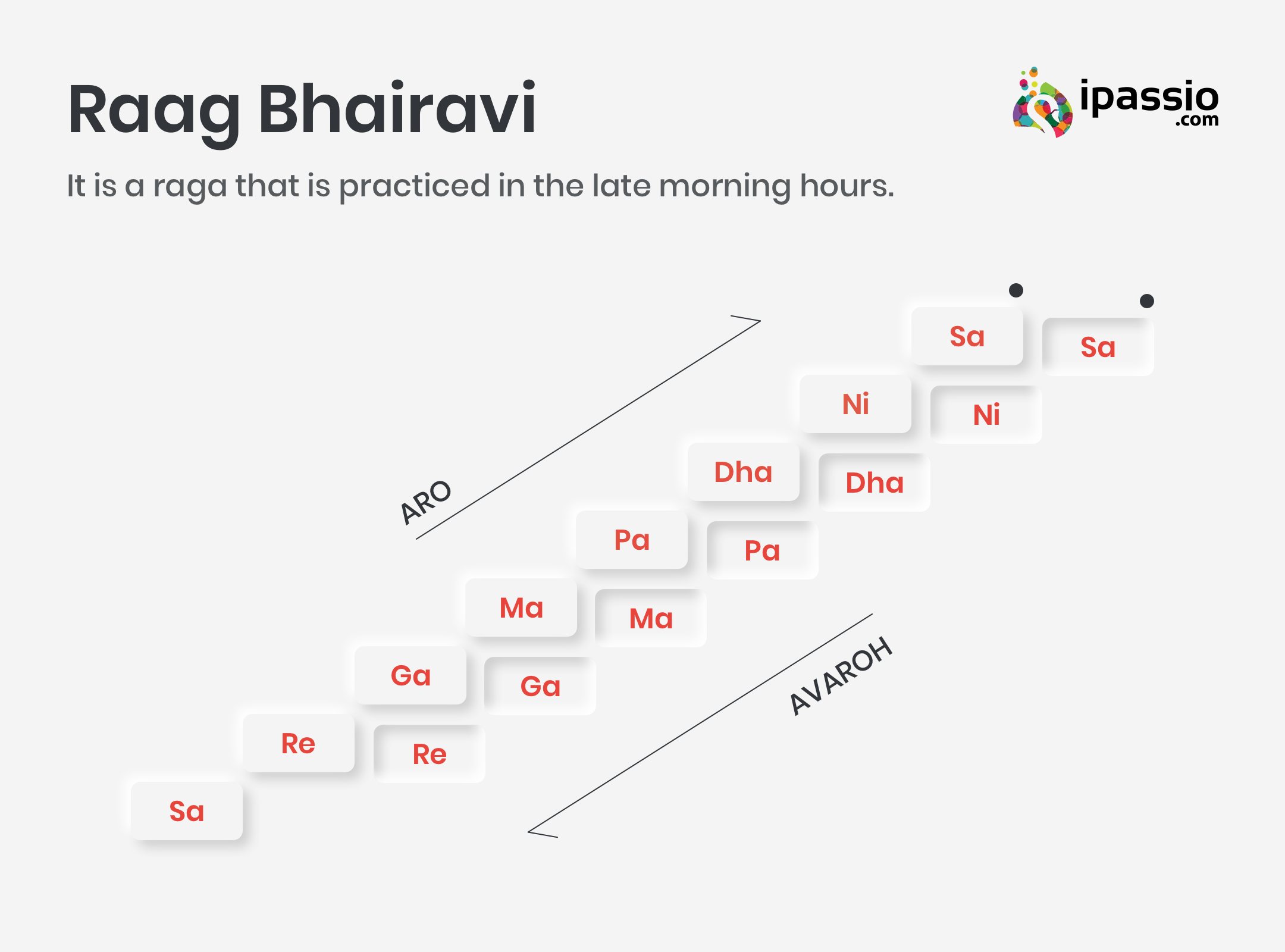
Ragas with All Komal Swaras (Bhairavi Thaat): Raga Bhairavi is perhaps the quintessential raga for devotional music. By employing all four possible komal swaras (Re, Ga, Dha, Ni), it has an immense emotional range, capable of expressing everything from deep pathos to absolute surrender and universal compassion. It is a favorite for bhajans (devotional songs).
The power of a single swara to completely transform a raga's mood cannot be overstated. Watch this demonstration, where a small change in a single note creates a seismic shift in emotional territory.
This segment from the "Understanding Raga" series offers a powerful and clear demonstration of how a single note variant can change the entire mood of a melodic phrase.
Watch the portion from this timestamp. The musician first plays a well-known melody. He then repeats it, changing only one note—the Gandhar (Ga)—from its shuddha (natural) to its komal (flat) variant. Notice how the first version sounds bright and assertive, while the second, with the komal Ga, immediately sounds more poignant and melancholic.
This simple, powerful example demonstrates the core principle: the specific choice of swaras is the primary building block for evoking a specific rasa.
Beyond Swaras: Intervals and Embellishments
While the notes themselves are foundational, the way they are connected and ornamented adds layers of emotional subtlety. This is where the true artistry of raga music lies. For bhakti rasa, two elements are especially important:
-
Meend (मींड): This is a smooth, unbroken slide from one note to another. Instead of jumping discretely between pitches, the voice or instrument glides, blurring the boundaries. This technique is fundamental to evoking feelings of surrender, tenderness, and deep emotion. A melody filled with meend feels fluid and heartfelt, embodying the melting of the self in devotion.
-
Andolan (आंदोलन): This is a slow, controlled oscillation on a single note. It imparts a sense of gravity, depth, and emotional weight. The gentle rocking motion of an andolan on a komal swara—like the komal Dha in Raga Darbari or the komal Re in Raga Bhairav—can feel like a deep, contemplative sigh, full of pathos and devotion.
The following reading directly confirms the role of these embellishments in generating bhakti.
[PDF] THE IMPORTANCE OF RASA IN HINDUSTANI MUSIC
This short section connects specific musical embellishments to the rasas they help create.
In the same article, find the list item titled "Nature of Embellishements" and read just the first sentence: "The use of meend...". Notice that Bhakti is explicitly listed as a rasa evoked by meend, often in conjunction with ragas like Bhairav. The text also links gamak and andolan to serious moods, which aligns with their use in contemplative devotional music.
Conclusion
Today, we have deconstructed the musical essence of bhakti rasa. We've seen that it's not a mysterious or random phenomenon, but a psychological and aesthetic response to a specific set of musical patterns. By analyzing these characteristics, we move closer to your goal of understanding how to intentionally craft a soundscape for devotion.
Key Takeaways:
- Bhakti Rasa is a powerful aesthetic emotion rooted in the sthayi bhava of rati (love), directed towards the divine.
- The musical signature of bhakti often involves the use of komal (flat) swaras, particularly komal Re and komal Dha for yearning and introspection, and komal Ga and komal Ni for tenderness and love.
- The choice of a single swara can completely alter a melody's emotional impact, shifting it from joy to sorrow or from celebration to contemplation.
- Melodic embellishments like Meend (slides) and Andolan (oscillations) are crucial for conveying the fluidity, surrender, and emotional depth characteristic of bhakti.
In our next lesson, we will put this knowledge to practical use. We will identify specific ragas that are traditionally used in Jain stavan and other devotional compositions, analyzing their structures to see how these very principles are applied to create a powerful atmosphere of bhakti and shanti.