Recommended resources
The freely available resources this lesson will direct you to.
Hello! Welcome to the first lesson of our final module, "Real Estate Portfolio Management and Optimization."
In the last module, we mastered the art of analyzing a single real estate asset in Spain, culminating in a Python model to compare ownership structures. You now have a robust framework for evaluating a property from acquisition to disposition on a standalone basis.
Now, we zoom out. A single property, no matter how good, carries concentrated risk. Advanced investors think in terms of portfolios, where multiple assets work together. This module is about building and managing a collection of properties as a single, cohesive investment strategy.
Our goal in this lesson is to lay the theoretical groundwork for portfolio management by addressing a fundamental question: why is owning a portfolio of properties often safer than owning just one? To answer this, we will describe the role of diversification and correlation in managing real estate portfolio risk. Understanding these two concepts is the first and most critical step toward building a resilient and optimized real estate portfolio.
1. The Foundation: Modern Portfolio Theory (MPT)
The old adage "don't put all your eggs in one basket" is the informal version of a Nobel Prize-winning economic theory. The formal framework for understanding diversification is Modern Portfolio Theory, or MPT, developed by Harry Markowitz in the 1950s.
To get a clear and concise introduction to MPT, please start by watching the first few minutes of the following video.
Markowitz Model and Modern Portfolio Theory - Explained
This video from Finance Explained provides an excellent introduction to Modern Portfolio Theory (MPT), the risk-return trade-off, and the crucial concept of correlation.
Please watch from the beginning until 02:52. Focus on understanding: The relationship between risk (volatility) and return. How Markowitz defined risk using volatility (standard deviation). The idea that assets can move in correlated or uncorrelated ways, and why this is important for a portfolio.
As the video explains, the core ideas of MPT are:
- Risk is Volatility: Risk can be quantified by the standard deviation of an asset's returns. Higher volatility means a wider range of possible outcomes, which is seen as higher risk.
- Correlation is Key: Assets don't move in isolation. Some move together (positive correlation), some move in opposite directions (negative correlation), and some have no relationship (uncorrelated).
- Portfolio Risk is Not the Average Risk: This is the magic of diversification. Because assets are not perfectly correlated, the total risk of a portfolio is less than the simple weighted average of the individual assets' risks. When one asset performs poorly, another may perform well, smoothing out the overall returns of the portfolio.
This concept is explained very clearly in the following resource from Morgan Stanley.
Real Estate Portfolio Risk Management and Monitoring
This excerpt from a Morgan Stanley paper, 'Real Estate Portfolio Risk Management and Monitoring', provides a practitioner's view on risk and diversification.
Please read the section 'What Do We Mean by Risk Management in This Context?' on page 3. Pay close attention to the sentence: '...the total risk in a portfolio should be less than the sum of each asset’s individual risk.'
2. Visualizing the Power of Diversification
Theory is great, but let's visualize what this looks like in practice. The relationship between the number of assets in a portfolio, their correlation, and the resulting portfolio risk is striking.

Take a moment to analyze this chart:
- The Y-Axis represents portfolio risk (volatility). Lower is better.
- The X-Axis represents the number of assets in the portfolio.
- The colored curves show how risk declines for different levels of correlation. The
p=0%curve shows a portfolio of completely uncorrelated assets, while thep=60%curve shows a portfolio of highly correlated assets.
There are two critical takeaways here:
- Risk Reduction: For any correlation level greater than zero, adding more assets reduces the overall portfolio risk. The biggest risk reduction comes from the first few assets you add.
- Correlation Matters Most: The lower the correlation between your assets (the
p=0%curve vs. thep=60%curve), the more effective diversification is at reducing risk. A portfolio of 20 highly correlated assets can be riskier than a portfolio of just 5 assets with low correlation.
Your background in systems engineering might provide a useful analogy: think of correlation as the coupling between microservices. Tightly coupled services (high correlation) mean a failure in one is likely to cascade and cause failures in others, leading to systemic risk. Loosely coupled services (low correlation) create a more resilient, fault-tolerant system. The same principle applies to investment portfolios.
3. Applying Diversification to Real Estate Portfolios
Now, let's apply this to our domain. How do we build a real estate portfolio with low correlation among its assets? We can diversify across several dimensions.
A comprehensive report by Oxford Economics for EPRA explores this in detail. While the full report is extensive, we will focus on the sections that directly address correlation and the different ways real estate can act as a diversifier.
The strategic role of real estate in multi-asset portfolios
This report, 'The strategic role of real estate in multi-asset portfolios', analyzes how real estate fits into a diversified investment strategy. We will use it to understand correlation both between real estate and other assets, and within real estate itself.
First, please read section 2.4 'PERFORMANCE OF REAL ESTATE RELATIVE TO OTHER ASSET CLASSES' (pages 14-15). Focus on the 'Correlation between annual returns' matrix in Figure 8. This shows how real estate correlates with other major asset classes like stocks and bonds.
The correlation matrix in Figure 8 shows that direct real estate has a relatively low correlation with stocks (0.37) and government bonds (-0.04). This is why real estate is considered a powerful diversifier in a multi-asset portfolio (e.g., a pension fund holding stocks, bonds, and property).
More importantly for us, we need to think about diversification within our real estate holdings. What are the "baskets" we can use?
a) Geographic Diversification
Properties in different cities or regions are exposed to different local economic conditions, job markets, and regulations. A downturn in one city's tech sector might not affect a tourist-driven coastal town. Therefore, their returns are not perfectly correlated.
Let's look at a concrete example from Spain.
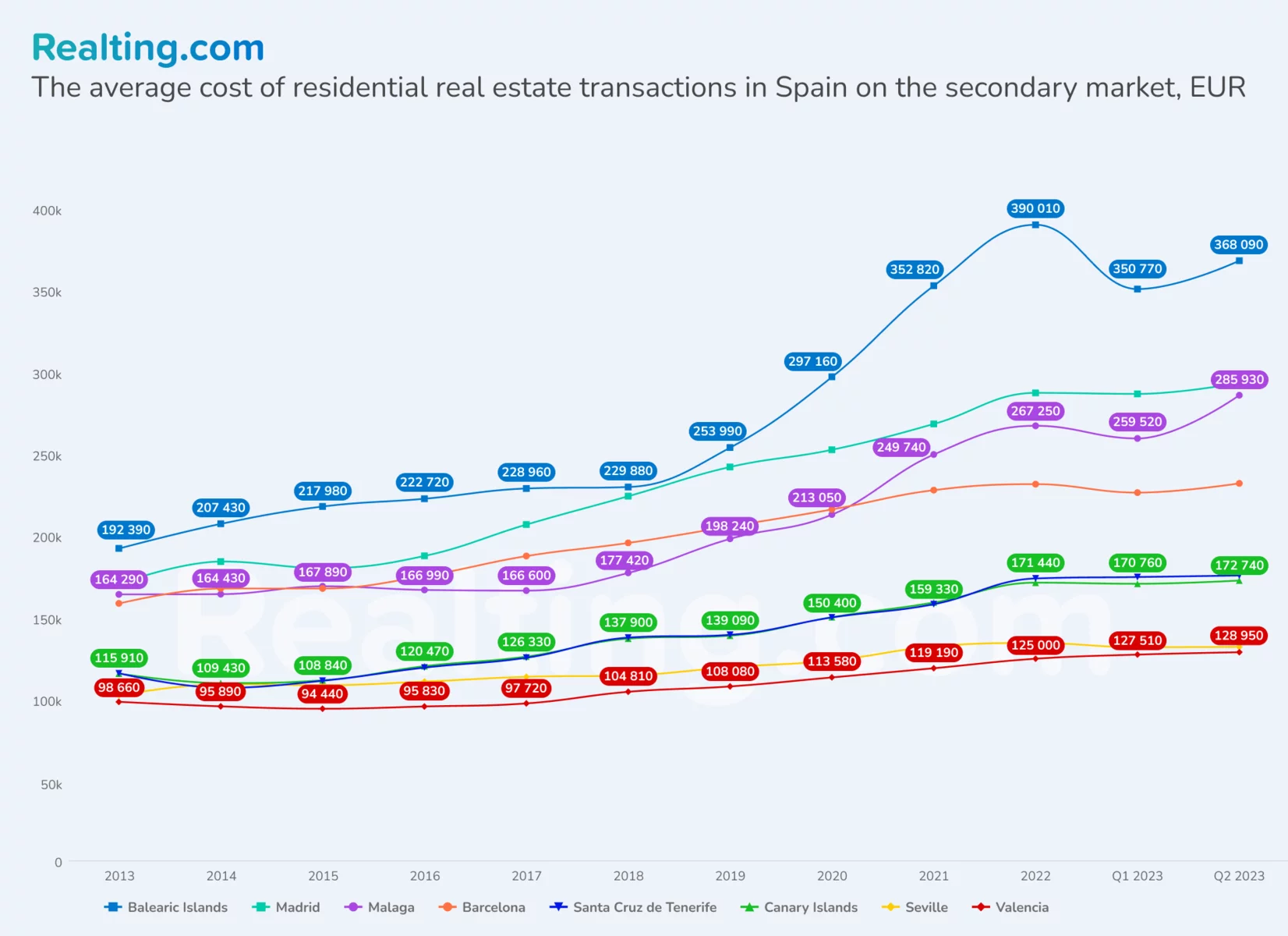
Observe the lines for Madrid and Barcelona versus Malaga and Valencia. While all have generally trended up, their paths, growth rates, and volatility are different. This visual difference in their price paths is a real-world illustration of imperfect correlation. Owning a property in Madrid and another in Valencia provides geographic diversification and reduces your portfolio's dependence on the fate of a single city's market.
b) Property Type Diversification
Different real estate sectors are driven by different economic fundamentals:
- Residential: Driven by population growth, household income, and interest rates.
- Office: Driven by corporate employment, business sentiment, and remote work trends.
- Industrial/Logistics: Driven by e-commerce growth and supply chain logistics.
- Retail: Driven by consumer spending and the competition from e-commerce.
The COVID-19 pandemic was a perfect case study: demand for industrial warehouses soared while office and high-street retail properties struggled. A portfolio with a mix of these assets would have been more stable than one concentrated solely in office buildings.
c) Investment Vehicle Diversification (Direct vs. Listed)
This is a more advanced diversification strategy. You can own real estate directly (buying a physical property) or indirectly through listed vehicles like Real Estate Investment Trusts (REITs), known in Spain as SOCIMIs (Sociedades Cotizadas Anónimas de Inversión en el Mercado Inmobiliario).
These two forms of investment have very different characteristics, which leads to imperfect correlation. Let's explore these differences.
The strategic role of real estate in multi-asset portfolios
Let's return to the EPRA report to understand the practical differences between owning listed vs. direct real estate.
Please read section 2.3 'OTHER DIFFERENCES BETWEEN LISTED AND DIRECT REAL ESTATE' and review the table in Figure 7 (page 11). Focus on the differences in Liquidity, Volatility, and Control.
As the report details, listed real estate (SOCIMIs) is liquid, traded on a stock exchange, and its price reflects market sentiment instantly. Direct real estate is illiquid, transactions are slow, and valuations are appraisal-based and infrequent. Because of these differences, their returns don't move in lockstep. A well-rounded strategy might include a core of directly-owned properties complemented by more liquid SOCIMI shares for exposure to different sectors or geographies.
Test your understanding!
Imagine you currently own two residential apartments in the same building in central Madrid as long-term rentals. Propose three distinct ways you could hypothetically change this two-property portfolio to decrease the correlation between your assets and improve diversification. Explain your reasoning for each.
Show answer
Here are three possible answers:
-
Geographic Diversification: Sell one of the Madrid apartments and buy a similar one in a different economic region, like Malaga. Reasoning: The Madrid market is heavily influenced by finance, government, and corporate sectors, while the Malaga market is more influenced by tourism, technology, and international buyers. An economic shock specific to Madrid would have less impact on the Malaga property, reducing the portfolio's overall volatility.
-
Property Type Diversification: Sell one apartment and buy a small commercial unit (local comercial) or a garage space in Madrid. Reasoning: The residential rental market is driven by housing demand and tenant incomes. The commercial rental market is driven by small business activity, and garage spaces by car ownership and parking scarcity. These drivers are different, meaning the returns from the apartment and the commercial unit will be less correlated.
-
Strategy & Vehicle Diversification: Keep one Madrid apartment as a long-term rental (direct ownership). Sell the other apartment and use the proceeds to buy shares in a SOCIMI that specializes in logistics warehouses across Spain (listed ownership). Reasoning: This diversifies on multiple levels. You are swapping a residential asset for an industrial one, and moving from direct, illiquid ownership to liquid, listed ownership. The performance of your apartment depends on Madrid's rental market, while the SOCIMI's performance depends on national e-commerce trends and broader stock market sentiment. The correlation would be significantly lower.
Conclusion
In this lesson, we established the theoretical foundation for portfolio management. By moving from a single-asset focus to a portfolio view, we can actively manage and reduce risk.
Key Takeaways:
- Diversification reduces risk: By combining assets that are not perfectly correlated, the overall volatility (risk) of a portfolio can be significantly lower than that of its individual components.
- Correlation is the driver: The effectiveness of diversification depends entirely on the correlation between assets. The lower the correlation, the greater the risk reduction.
- Real estate diversification has many dimensions: To build a resilient portfolio, investors should consider diversifying across geographies (e.g., Madrid vs. Valencia), property types (e.g., residential vs. industrial), and even investment vehicles (e.g., direct ownership vs. SOCIMIs).
Preview of the Next Lesson:
We now understand why diversification and correlation are critical. The logical next question is, "How do I measure how diversified my portfolio is?" In the next lesson, we will learn to analyze portfolio concentration by property type and geographic market, giving you the tools to quantify your portfolio's exposure and identify opportunities to improve its diversification.