Recommended resources
The freely available resources this lesson will direct you to.
Hello! This course is about making room for reading and watching that you can enjoy, remember, and use—not about finding a way to keep up with everything you encounter. We’ll begin by controlling intake, then work on engaging with a chosen source, retaining its ideas, and building a repeatable reading ritual.
Today’s task is the first decision: What deserves your attention? With about 30 minutes available on a typical day, an interesting article, book, or video cannot earn a place in your routine merely by being interesting. By the end of this lesson, you’ll have a short personal test that distinguishes what to engage with soon, what to defer for a specific reason, and what to let go.
Begin with purpose, not the feed
A feed answers, “What could I look at next?” Your value test answers, “What would I like my attention to do?” That purpose might be to resolve a question, make a decision, explore an enduring interest, or enjoy a work for its own sake. Pleasure is a valid reason; mindless continuation is simply a different choice from deliberate enjoyment.
Cal Newport’s account of digital minimalism makes a useful starting point. He argues for choosing technology according to what you value, rather than treating either constant use or total avoidance as the goal.
Digital Minimalism with Cal Newport
Watch “Digital Minimalism with Cal Newport,” from Cal Newport, for its distinction between using a tool on purpose and following everything the tool offers.
Watch the central idea, where Newport explains why intentional use is not simply using less technology. Continue with the example of using one part of a platform for a valued purpose while declining its feed. Notice that the boundary comes from knowing why you opened the tool.
You can apply the same distinction to an individual item. A newsletter may contain one article that addresses a question you care about; that does not oblige you to read the whole issue. A YouTube recommendation might be worth watching; that does not oblige you to browse the next ten recommendations. The source can offer a candidate, but it does not get to make the decision.
Forte Labs describes a related shift from reacting to incoming information toward choosing what to consume later. Its advice to notice what resonates is helpful as an initial signal: curiosity often tells you something about your interests before you can articulate it.
Building a Second Brain: The Definitive Introductory Guide
Read the “Think like a curator” and “Keep only what resonates” subsections of Forte Labs’ guide. They offer two reasons to pause before following incoming content: to escape reactive consumption and to notice genuine interest.
Under “Capture only the most important information,” begin in “Think like a curator” with the paragraph starting “The second we pick up our mobile device.” Read curation and resonance through the final paragraph of “Keep only what resonates.” Focus on the difference between something placed in front of you and something that connects to a question you care about.
There is one important adjustment for your situation: resonance identifies a candidate; it does not require a save. If you already save more than you consume, “this seems interesting” needs a second question: Interesting for what, and is now the right time?
Give “valuable” a meaning you can use
You do not need to assign every item a score. A quick test is more likely to survive contact with an RSS feed, an article shared on Reddit, or a shelf of unread books. Start with the outcome you want from giving the item your time.
Finding Alpha: What's Worth Consuming in the Age of AI
Read the “Become more outcome-oriented” section of this Forte Labs article for its practical question: what outcome are you seeking from this piece of content? Its point is not that every choice must be productive; enjoyment can be an honest answer.
In “Become more outcome-oriented,” begin with the paragraph starting “When you put on an outcome-oriented lens.” Read the outcome filter through the paragraph ending “which is the whole point.” The coding example is an illustration, not a prerequisite: notice how a specific aim narrows the field, then find the question the author proposes asking before consumption.
For this course, a useful outcome could be modest: “I want one workable idea for a reading ritual,” or “I want to understand this argument well enough to decide whether I agree.” “I want to spend an enjoyable half-hour with this story” is equally clear. “I should probably know about this” is less useful: it gives you no way to decide between this item and the many others competing for the same half-hour.
The How to Organize image offers another prompt: would an item be useful to a current project, an ongoing responsibility, or a topic you genuinely want to explore?
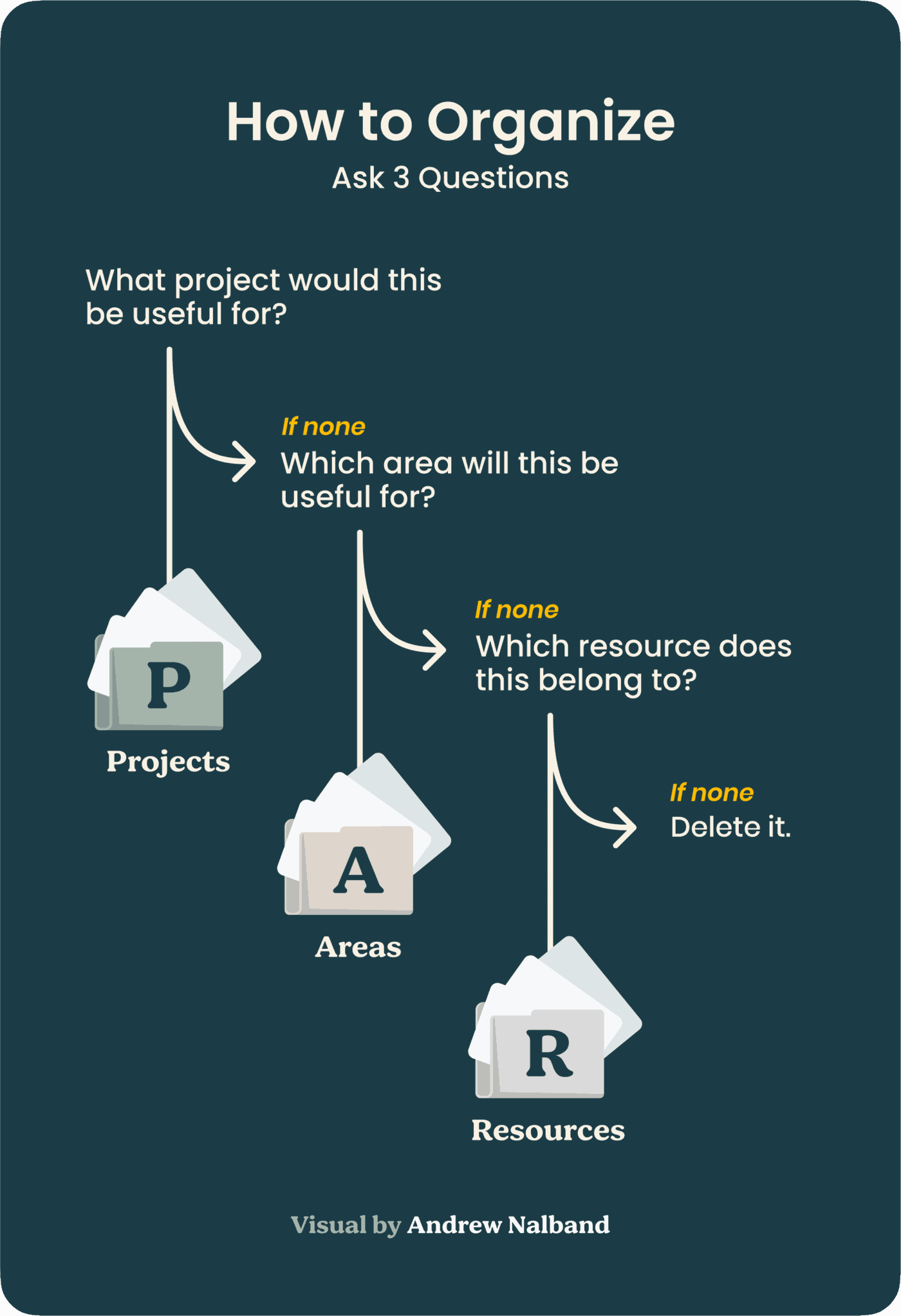
That tree is not a complete account of value. A novel, film, or essay may be worthwhile because of the experience itself, without serving a project. Conversely, almost any article could be filed under a broad topic such as “health” or “technology.” A possible category is weaker than a reason to give it attention.
A three-decision value test
When an item catches your eye, use three questions. At first, a glance at the title, source, and opening may be enough; you are deciding whether to commit attention, not trying to understand the whole work in advance.
- Why this? Can you name a current question, intended use, meaningful curiosity, or experience you want from it? If the only answer is “it appeared in my feed” or “I might need it someday,” that is a reason to pause, not to save.
- Why this source? From what you can see, does it offer a credible or distinctive contribution—an original account, a thoughtful argument, a useful explanation, or a work you genuinely want to experience? A familiar topic alone does not make a repetitive item worthwhile. Nor does the format settle the question: a careful video can be more valuable than a shallow book.
- Why now? Given your limited reading time, would you choose this over the other material you could engage with in your next available session?
Those questions lead to three decisions:
Give it focused attention soon when you can state its purpose, see enough promise in the source, and would willingly choose it for an upcoming session. “Soon” matters: this is a choice you expect to act on, not a compliment paid to an item you may never open.
Defer it when it has a credible, specific future use but is not timely. Name what would make it relevant: “when I choose my next book,” or “when I revisit this question next month.” Deferral is not a polite word for keeping everything. If you cannot name a plausible occasion to return, discarding is usually the more honest decision.
Discard it when its purpose is vague, its contribution looks weak or repetitive, or it cannot compete for your attention now and has no clear later use. Discarding does not mean declaring the item worthless. It means declining to make it part of your reading obligations.
Imagine three things arriving on the same day. A well-explained article about recalling ideas after reading might merit focused attention if you want to improve retention this week. An interview with the author of a book you plan to consider next month might be deferred until you choose that book. A thread repeating tips you have already seen can be discarded, even if its headline sparks momentary curiosity. The difference is not “serious” versus “fun,” or article versus video; it is the relationship between each item and your time.
Write the rule you will actually use
Here is a compact version you can adapt:
I will give an item focused attention when I can name what I want from it, it appears capable of delivering that, and I would choose it for one of my next reading or watching sessions. I will defer it only when I can name a specific future occasion to return. Otherwise, I will let it go—even if it seems generally interesting.
Take a minute to replace the broad phrase “what I want from it” with the purposes that matter most to you right now. They may include a question you are exploring, an idea you might try, or a kind of reading or viewing you find genuinely rewarding. Keep the rule short enough to recall before opening another tab.
This test applies before you save something, but it can also apply after you begin it. If a promising article does not deliver what you sought, you may stop. Finishing is not the price of having chosen it.
Closing
A good value test protects attention without requiring you to reject curiosity. Purpose tells you why an item matters; a quick look at its contribution tells you whether this source is promising; timing distinguishes focused attention from a justified deferral. When none of those supports a choice, you can let the item go.
In the next lesson, you’ll turn this decision rule into a bounded plan for when to check different sources and where worthwhile material should go.