Recommended resources
The freely available resources this lesson will direct you to.
- How to Study for the GMAT: Your Most Important Tool, the Error Logwww.youtube.com
- How my friend ranked 1st at Medical School - The Active Recall Frameworkwww.youtube.com
- Exam Mistakes Error Log: Reduce Errors, Improve Scoreswww.collegenp.com
- Creating an Error Log for Missed Questions | Grasppaths.grasp.study
Hello! In the previous lesson, you distinguished a missing fact from a faulty inference, a misread instruction, and a mistake caused by time pressure. Those diagnoses become useful only when they change what you study next. This lesson turns them into a small error log that selects topics for later recall and chooses the right kind of practice for each weakness.
Allow about 40 minutes for the video, reading, and lesson. The aim is not to document every imperfect answer in elaborate detail. It is to leave each review session knowing what to revisit, when to revisit it, and how you will tell whether the problem is fixed.
An error log is a decision tool
A score reports how many answers you missed. Even a list of corrected answers cannot tell you whether the next hour should go to author–work attributions, assertion–reason logic, or reading stems more carefully. An error log adds that missing decision layer.
Watch these portions of PrepScholar GMAT’s How to Study for the GMAT: Your Most Important Tool, the Error Log. The sample questions come from another exam, but the distinction between identifying an error and preventing its recurrence transfers to UGC-NET and GATE preparation.
How to Study for the GMAT: Your Most Important Tool, the Error Log
PrepScholar GMAT’s video gives a compact method for turning reviewed questions into future study decisions.
Watch which, what, why, how for the four questions an entry should answer. Then watch using the log for the shift from individual mistakes to recurring patterns. Notice especially that knowing why the right option is right does not yet explain why you rejected it.
The spreadsheet below shows the attraction of a simple format: one row makes a question and its proposed correction easy to find again. It also shows a limitation worth noticing. “Choose the answer with the most details” might describe a choice made on one test, but it is not a reliable rule for a literary interpretation or an exam question. Your correction must specify when it applies and what evidence makes it appropriate.
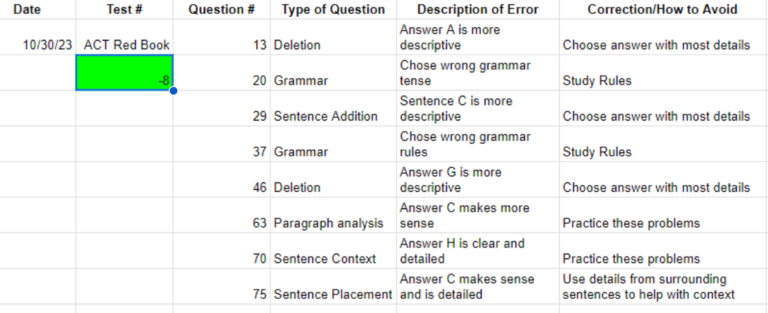
The log is therefore not an archive of embarrassment. It is a working list of unresolved learning decisions. A wrong chronology answer may call for retrieving publication anchors. A wrong assertion–reason answer may call for practising the difference between a true statement and an explanation. Giving both entries the instruction “revise English literature” would discard the diagnosis you worked to make.
Record enough to make the next action clear
Read CollegeNP’s Exam Mistakes Error Log: Reduce Errors, Improve Scores for a concise template, cause-specific fixes, and a manageable retest pattern. Its labels—concept, process, and execution—are broader than the four labels from your previous lesson. Keep using knowledge, reasoning, misread, and time pressure in your own log; translate the resource’s suggested fixes rather than changing your categories.
Exam Mistakes Error Log: Reduce Errors, Improve Scores
CollegeNP’s guide shows how to connect a short entry to a correction and a later, unaided retest.
In “Practical Insight: How to build and run your error log,” begin at “The minimum template.” Read template through retests, continuing through “How to classify mistakes with examples,” “The cause → fix menu,” and “A retest schedule that students maintain.” Focus on how the proposed drill changes with the cause, rather than adopting its category names.
A notebook or spreadsheet will do. One row should let you recover the question without copying its entire text. These fields are sufficient:
| Field | What it should capture |
|---|---|
| Source and location | Exam or practice set, paper or section, and question number |
| Topic and format | For example, “Indian English author–work matching,” not just “literature” |
| Result | Incorrect, unattempted, guessed correctly, or correct but unusually slow |
| Primary cause and evidence | One of the four causes, followed by what you actually thought or did |
| Correct understanding and next action | The fact or method to repair, and a specific retrieval prompt or drill |
| Next date and status | When you will retest; later, whether you passed unaided or still need work |
Include a confidently guessed correct answer if the knowledge behind it was insecure. Conversely, do not turn every slow answer into a time-pressure entry: record that cause only if the timing evidence supports it. The previous lesson’s test still applies—could you solve it unaided with adequate time?
Here is the difference between a record and a usable entry:
Too vague: “Author–work question wrong. Revise Indian literature.”
Usable: “Paper II mock, Q18, author–work matching. I assigned Hullabaloo in the Guava Orchard to Anita Desai; it is by Kiran Desai. Primary cause: knowledge—I conflated two author names. Next action: retrieve the authors of this work, Games at Twilight, and All About H. Hatterr from their titles without options; then answer a new mixed attribution item. Retest in three days.”
The three titles form a small contrast set, not an invitation to memorize every text by every author. Games at Twilight is by Anita Desai; All About H. Hatterr is by G. V. Desani. Putting easily confused names beside one another makes the next recall attempt more diagnostic than rereading the answer to Q18.
For a misread item, the correction would be different: “When a stem says NOT or EXCEPT, mark that word and state the requested set before selecting.” For an assertion–reason error: “For each pair, judge the truth of each statement separately, then ask whether the reason actually explains the assertion.” Both actions can be observed in a subsequent timed set. “Be careful” cannot.
Let patterns, not the latest mistake, choose the topic
After a few practice sets, scan the log by specific topic and cause. Counting everything labelled “knowledge” together is rarely informative: uncertainty about a publication date and confusion between two theories do not necessarily need the same study session. Look instead for a cluster that points to one repairable distinction.
Imagine that a week’s log contains these entries:
| Evidence in the log | What the pattern suggests |
|---|---|
| Two wrong Paper II author–work matches involving Anita Desai and Kiran Desai; one guessed-correct attribution involving G. V. Desani | A recurring, narrow attribution weakness |
| One wrong Paper II assertion–reason item where both statements were true but the second did not explain the first | A reasoning procedure to practise across topics |
| One wrong Paper II item after overlooking NOT | A stem-reading routine to test in the next timed set |
| One wrong GATE passage inference that went beyond the passage’s evidence | A GATE-specific drill to retain in the queue |
If UGC-NET is the nearer exam in your two-phase plan, the attribution cluster is an immediate priority: it has recurred, it affects a tested domain, and a short contrast set can address it. The assertion–reason error also deserves practice, because the same faulty inference can affect questions on many subjects. The single GATE inference error should not vanish from the log, but it need not displace the nearer priorities; give it a future date aligned with your GATE-focused practice.
A practical ordering rule is:
- Attend to due retests first. An entry scheduled for today is a chance to find out whether yesterday’s apparent fix lasted.
- Elevate repeated or high-confidence errors. Repetition suggests an unstable distinction; a confident wrong answer suggests that simply rereading the topic may feel reassuring without correcting the belief.
- Consider exam relevance and transfer. Prioritize a recurring issue on the nearer exam, or a reasoning habit that harms several question formats.
- Choose a bounded next task. “Retrieve three contrasting attributions” or “solve four varied assertion–reason items and explain each relation” is schedulable. “Do literary theory” is not.
Do not use frequency alone. One serious Paper I concept gap may deserve earlier attention than several minor slips if it affects many questions. Likewise, if nearly every missed chronology item depends on the same insecure publication anchors, repairing those anchors is more promising than repeatedly doing full chronology sets.
Space the retest, and match its form to the cause
Correcting an entry on the same day establishes what you now understand; it does not establish what you will recall later. The graph below makes that distinction visible. It plots accuracy during study sessions for different gaps between sessions and separately shows a final test marked “After 30 Days.” Performance during a session and retention at a later test are not the same measurement. The image alone does not specify an ideal interval for your exam schedule.

Use a workable starting schedule, then adjust it using your results:
| When | What to do |
|---|---|
| Same day | Diagnose the cause, check the correct explanation, and write a specific next action. |
| A few days later | Attempt the retrieval prompt or a comparable question without notes or the answer visible. |
| About a week later | Retest again, preferably among other topics or question formats. |
| Every few weeks, while relevant | Include previously troublesome items in a short mixed, timed set. |
These are planning intervals, not a universal memory formula. Write actual next dates in the log. If a retest fails, first determine why: the attribution still cannot be retrieved, the new question exposes a related confusion, or a timed stem was misread again. Repair that cause and schedule another attempt. If a retest succeeds, move it farther out rather than immediately deleting the entry. If an exam is sooner than the next planned interval, bring the check forward.
Crucially, “retest” does not always mean repeat the identical multiple-choice question. You may remember its answer letter without possessing the knowledge it was meant to assess. Match the test to the original cause:
- For a knowledge gap, cover the answers and retrieve the author, text, date, or theoretical distinction from a prompt. Then try a new item with plausible distractors.
- For a reasoning error, explain your decision steps on a different chronology, matching, or assertion–reason item. Success means the method works beyond the example whose explanation you have seen.
- For a misread question, use a short timed set containing both positive and negative stems. Check whether you marked the decisive instruction before choosing, not merely whether you happened to get the answers right.
- For time pressure, use a timed set comparable to the conditions that produced the mistake. Record where time was spent and whether a planned move-on or return decision prevented later omissions.
This is the distinction between spaced retrieval and targeted practice. Retrieval tests whether a fact or procedure remains available after a delay. Targeted practice tests whether you can use it when the form, distractors, or time conditions change. A secure author–text association may need only occasional retrieval; a recurring misread requires evidence from actual question selection under time limits.
Keep the log small enough to use
After each question review, make a brief entry while you still remember your reasoning. At the start of a study session, check what is due; once a week, scan for repeated topics and causes before choosing new practice. Entries can remain marked due, passed once, needs varied practice, or stable after later retest. Those statuses prevent a solved-looking question from disappearing prematurely.
When a retest goes well, ask for a modest standard of proof: could you supply the answer or method without cues, explain why a tempting alternative fails, and repeat the performance on a sufficiently different item? If so, reduce that topic’s share of your next session. The log should release study time as well as claim it.
Key takeaways
An effective error log links evidence of what went wrong, a cause-specific correction, and a dated unaided retest. Scan its rows for narrow, recurring weaknesses; rank them by due date, recurrence, exam relevance, and how widely the fix will transfer. Then choose retrieval for insecure knowledge and varied or timed practice for failures of reasoning, reading, or pacing.
This completes the module’s work on dual-exam strategy and high-retention revision. The next module begins a chronological study of British and Irish literature; your log can now serve as a guide to which authors, texts, periods, and distinctions will need revisiting as that knowledge grows.