Recommended resources
The freely available resources this lesson will direct you to.
- Karl Popper on the Three Worlds (1989)www.youtube.com
- Popper's problem-oriented epistemology (with David Deutsch and Eli Tyre)www.youtube.com
- Karl Popper - Stanford Encyclopedia of Philosophyplato.stanford.edu
- Plato’s Middle Period Metaphysics and Epistemology (Stanford Encyclopedia of Philosophy)plato.stanford.edu
Welcome back. Last lesson separated the question what makes a classification correct? from the question what kinds of things exist? That distinction matters here. Plato and Karl Popper both defend something objective that is not reducible to anyone’s present thoughts, but they mean quite different things by it.
This lesson compares Plato’s Forms with Popper’s World 3 on four points: what each contains, whether it depends on human minds, whether it can change, and how it helps explain objective knowledge. The central question to keep in view is whether an independently assessable idea must also be an independently existing nature.
Plato: what we know is not something we made
Recall the ante rem position introduced earlier: on the familiar reading of Plato, a Form exists apart from the particular things that exemplify it. A beautiful painting can deteriorate, and people can disagree about it. The Form of Beauty, by contrast, is not one more beautiful object that happens to last longer. It is what beautiful things are said to partake in, and what inquiry into beauty ultimately seeks to understand.
Read two short passages from the Stanford Encyclopedia of Philosophy’s Plato’s Middle Period Metaphysics and Epistemology. They establish both the independence of Forms and the epistemic role Plato assigns them.
Plato’s Middle Period Metaphysics and Epistemology (Stanford Encyclopedia of Philosophy)
Read the sections on the separation of Forms and the deficiency of particulars to see why Plato treats Forms, rather than changing examples, as the stable objects of inquiry.
In Section 5, “The Separation of Forms,” read from the opening sentence about each Form being what it is “in its own right” through the claim that a Form is what it is whether or not any particular participates in it: separation of Forms Focus on the direction of dependence. Then, in Section 7, “The Deficiency of Particulars,” read from the opening discussion of copies and originals through the contrast between particulars as objects of perception and Forms as objects of knowledge: Forms and knowledge Stop there; the subsequent scholarly debate is not needed for this comparison.
The direction of explanation is decisive. On this Platonic picture, beautiful things do not collectively bring Beauty into existence, nor do our attempts to define beauty create its nature. Rather, Beauty is prior to—and helps explain—beautiful particulars. Forms are thus mind-independent in a strong sense: their existence and character do not await someone’s conceiving, stating, or discovering them.
Forms are also treated as unchanging. A particular triangle can be drawn badly, erased, or redrawn; the object of an inquiry into what a triangle is does not acquire another side when somebody makes a mistake. Plato’s broader claim is that stable knowledge requires stable objects. There are interpretive disputes about just how sharply he separates knowledge of Forms from knowledge of sensible things, but the role of Forms as stable intelligible objects is enough for our comparison.
Notice what this does not establish. It does not follow that Plato assigns a separate Form to every word we use, or that a Form is equivalent to a sentence defining a word. A Form is supposed to be part of the explanation of what things are. A definition, if successful, is our account of that object.
Popper: an idea can outgrow its author
Popper asks a different question. Suppose someone writes down a mathematical conjecture. The page is a physical object, and writing it involved mental activity. Yet another person can examine the same conjecture, discover an implication its author missed, or show it to be false. What, exactly, is being examined?
Popper distinguishes World 1, physical things and processes; World 2, subjective experiences and acts of thinking; and World 3, the objective contents or products of thought. Hear him make the distinction using a book and its translatable content.
Karl Popper on the Three Worlds (1989)
Watch “Karl Popper on the Three Worlds (1989),” presented by Philosophy Overdose, for Popper’s own account of why a book’s meaning is neither its paper nor a reader’s passing experience.
In the book example, attend to the difference between printed marks and what readers understand. Then watch content and translation: focus on why a proposition can retain its content and truth or falsity when expressed in another language.
A useful qualification to the supplied diagram is that its label “objective virtual knowledge” should not make World 3 sound like computer memory or an unreal simulation. A stored file has a physical embodiment; its interpretable content is what matters to Popper. Nor is everything in World 3 true: a false theory can be stated, translated, criticised, and refuted.
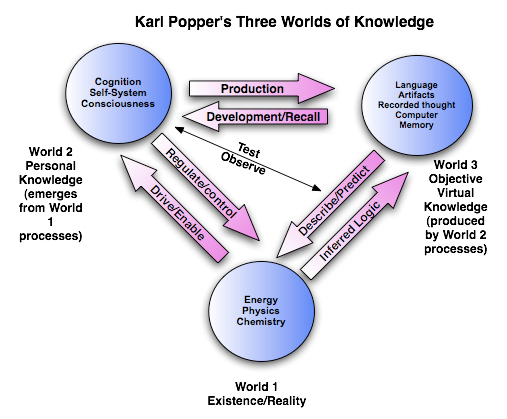
Primary-source stop — about 9 minutes. In your copy of Objective Knowledge, open “Epistemology Without a Knowing Subject.” Rather than reading the whole chapter, locate and read two connected discussions: first, where Popper distinguishes the subjective sense of knowledge from the objective sense and characterises the latter through problems, theories, and arguments; second, where he argues for the relative autonomy of this third world, especially the possibility of discovering problems or consequences that no creator foresaw. Use those two passages to ask: What depends on thinkers for its creation, and what does not depend on any particular thinker’s awareness once created? Chapter pagination varies by edition.
For a compact guide to those passages, read Section 7 of the Stanford Encyclopedia of Philosophy’s Karl Popper. It also makes explicit a distinction crucial to this lesson: thought processes belong to World 2; assessable thought contents belong to World 3.
Karl Popper - Stanford Encyclopedia of Philosophy
Read Section 7 of the Stanford Encyclopedia of Philosophy entry to connect Popper’s distinction between subjective and objective knowledge to his three-worlds account and its claim of relative autonomy.
In Section 7, “Objective Knowledge and The Three Worlds Ontology,” begin with the paragraph opening “In some of his later works in the field” and read through the paragraph explaining objective thought content across translations: three worlds Then read the following paragraph, from the objection that World 3 objects are merely abstractions from mental processes through the importance of their logical relations: relative autonomy Focus particularly on implications the author of a theory did not anticipate.
Popper’s independence claim is therefore qualified. World 3 products originate in human activity; in that respect, they are unlike Plato’s Forms. But their contents are not identical to private mental episodes. Once a conjecture has been formulated, whether it contradicts another conjecture is not decided by its author’s intentions. A proof can reveal a consequence nobody noticed at first. The content is available for public criticism and can present its creators with new problems.
There are two senses of change here worth keeping apart. A particular proposition does not silently alter its content each time someone reads it. Yet people continually add theories, arguments, and works to World 3; they also revise formulations and reject theories. Popper’s account is historical and open-ended even though a fixed claim remains answerable to logical scrutiny. Plato’s Forms, by contrast, are not products entering an expanding collection through human invention.
Where the resemblance ends
Both philosophers resist reducing the object of knowledge to a feeling of certainty in someone’s head. But their accounts of objectivity answer different explanatory demands.
| Question | Plato’s Forms | Popper’s World 3 |
|---|---|---|
| What does it contain? | Forms such as Beauty or Justice: intelligible natures invoked to explain what particulars are or exemplify. | Human-produced thought contents and cultural works, centrally problems, conjectures, theories, and arguments—including false ones. |
| Does it depend on human minds? | Not for its existence or character, on the familiar ante rem reading. | Yes for its origin as a world of human products; no particular person’s current awareness fixes all its implications or merits. |
| Can it change? | Forms themselves are unchanging. | The stock of products grows and formulations are revised, while the content and logical relations of a given formulated claim can be examined independently of its author. |
| How does it explain objective knowledge? | Stable Forms are the objects that intellect seeks to know; they help explain what changing particulars are. | Publicly expressible contents can be compared, criticised, tested, and improved without treating anyone’s conviction as the measure of their validity. |
Consider a theory claiming that a particular material has a certain structure. For Plato, the relevant philosophical question would be whether inquiry grasps a stable nature rather than resting with shifting appearances. For Popper, the stated theory is a World 3 object whether it succeeds or fails: other people can derive consequences from it and test it against the physical world. Being an objective object of criticism is not the same as being an eternal, true object of knowledge.
This difference bears directly on the earlier debate about concepts. You can grant Popper that the content of a definition is more than the private act of thinking it, without granting that the definition names a Platonic Form—or even an Aristotelian nature in the things defined. Conversely, recognising that people produce definitions does not show that the world lacks objective structures for those definitions to get right or wrong. Popper’s World 3 is therefore not simply Platonism renamed, and its human origins do not make it a theory that truth is whatever a community chooses.
The cleanest formulation is this: Plato locates objectivity principally in what inquiry seeks to discover; Popper emphasises the public, criticisable contents through which inquiry proceeds. Those contents may concern mind-independent reality, but their own independence is relative, not the independence Plato attributes to Forms.
Conclusion
Plato’s Forms are independent, unchanging natures that ground an account of what particulars are and provide stable objects for knowledge. Popper’s World 3 consists of products of thought—including fallible theories—that originate with people but have publicly assessable contents and consequences beyond any individual’s intentions. Both oppose the reduction of knowledge to subjective experience; they disagree about what the relevant objective objects are and how they come to exist.
Next, the course turns from these metaphysical and epistemological accounts to psychology. Rosch’s prototype research asks how people actually categorise instances, and whether their judgments show sharp boundaries or degrees of typicality.