Recommended resources
The freely available resources this lesson will direct you to.
- GCSE Maths - How to Rearrange Formulas (2026/27 exams)www.youtube.com
- Rearrange formulas to isolate specific variables | Linear equations | Algebra I | Khan Academywww.youtube.com
- 1.9.3 Writing and Rearranging Equations in Two Variables - Algebra 1 | OpenStaxopenstax.org
- 2.4: Solving Formulas for a Specific Variable - Business LibreTextsbiz.libretexts.org
Good to see you again. In the previous lesson, you solved linear equations by keeping both sides balanced, undoing operations in reverse order, and checking a numerical solution by substitution. Those same principles now let you do something more flexible: rewrite a formula so that any chosen variable is alone.
This matters whenever a model is given in a form that is inconvenient for the value you need. A cost relationship may be written to calculate total cost, but you may need output; a trade-price formula may be written in terms of a tariff rate, but you may need to infer that rate. By the end of this lesson, you should be able to rearrange common linear and multiplicative formulas reliably, retain necessary parentheses, and check your result symbolically. Plan for about 30 minutes.
A formula is an equation that works generally
A formula states a relationship among quantities. For example,
might describe total cost, where:
- is total cost,
- is fixed cost,
- is variable cost per unit,
- is the number of units produced.
If you know , , and , this version calculates . But suppose you instead know total cost and want to infer output . You must solve the formula for .
Unlike last lesson’s equations, we are not usually seeking one numerical answer. We are producing a new formula that works for all permissible values of the remaining variables. This is sometimes called solving a literal equation: the final answer still contains letters.
The goal is always precise: put the requested variable alone on one side, with coefficient 1.
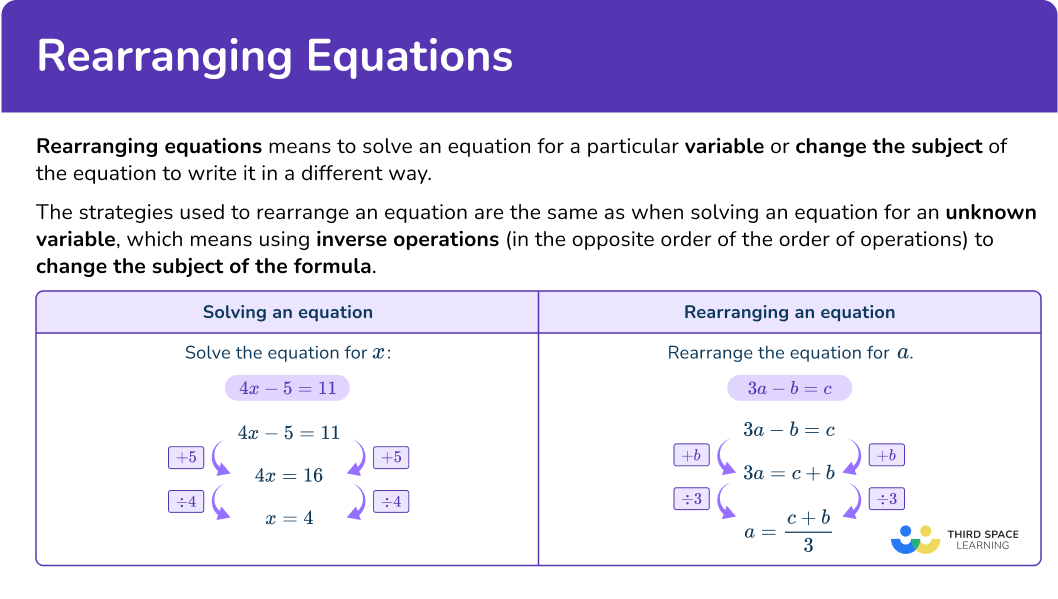
The visual’s example
is solved for by adding to both sides and then dividing both sides by 3:
Notice that is entirely in the numerator. Division by 3 applies to the whole right-hand expression.
The same balance principle, with letters treated as known quantities
When solving for one variable, temporarily treat every other symbol as a known number. The algebra does not change.
For the cost formula,
suppose the target is . The target is currently multiplied by , and then has been added to that product. Undo those operations in reverse order.
First subtract from both sides:
Then divide both sides by :
Conventionally, put the requested variable on the left:
This formula says that output equals the amount of total cost remaining after fixed cost is removed, divided by variable cost per unit.
The last division assumes that
If variable cost per unit were zero, you could not divide by . More importantly, the original model would become , which contains no information about .
A useful working rule is:
- Identify the target variable.
- Treat all other variables as constants.
- Remove additions or subtractions around the target first.
- Remove multiplication or division affecting the target next.
- Preserve grouping with parentheses or a fraction bar.
- State any condition required for division.
GCSE Maths - How to Rearrange Formulas (2026/27 exams)
Watch Cognito’s “GCSE Maths – How to Rearrange Formulas.” It reinforces that formula rearrangement uses the same inverse operations as ordinary equation solving, while making especially clear why an entire expression—not just one term—must be divided or multiplied.
Watch isolating x for a subtraction-then-division example. Then watch clearing a denominator, focusing on why multiplying by 3 applies to every term in the expression a+5.
Preserve the whole expression when you divide
A common source of errors is forgetting that division applies to everything on one side of an equation.
Consider the linear market relationship
where is quantity, is price, and and are model parameters. To solve for price:
Therefore,
The incorrect expression
does not divide by , so it is generally wrong. A fraction bar avoids ambiguity:
means the complete difference is divided by .
This rearranged form is practically useful. A supply relationship might take the form
If a producer supplies units, then the rearranged formula gives
and substitution yields
The symbolic formula is the reusable part; the numerical substitution is simply one use of it.
Products, fractions, and reciprocal operations
Formulas often contain a product of several variables. For example, triangle area is
To solve for height , remove the factor by multiplying both sides by 2:
Then divide both sides by :
Here the reciprocal of is 2. The result requires
because a triangle with zero base cannot provide a meaningful nonzero area-height relationship.
Rearrange formulas to isolate specific variables | Linear equations | Algebra I | Khan Academy
Khan Academy’s “Rearrange formulas to isolate specific variables” gives a compact visual derivation of the triangle-height formula. It is useful for seeing reciprocal operations applied to an entire equation rather than treating the fraction as a special trick.
Watch the setup to identify the target and the factors multiplying it. Continue with the rearrangement, noting that multiplying by 2 removes the factor \frac{1}{2}, after which division by b isolates h.
The same logic appears in economic formulas. Suppose a domestic price is modeled as world price plus an ad valorem tariff:
where is the consumer price, is the world price, and is the tariff rate expressed as a decimal.
To solve for , first divide by :
Then subtract 1:
This requires
If the world price is and the consumer price is , then
So the implied tariff rate is .
This structure is worth remembering: when a variable is inside a multiplicative factor such as , divide first to expose the whole factor, then use addition or subtraction to isolate the variable within it.
Check a rearrangement by substitution
A numerical answer can be checked by substituting a number into the original equation. A rearranged formula can be checked in a stronger way: substitute the rearranged expression back into the original formula and simplify.
Take
and substitute it for in the original cost equation:
The right-hand side becomes
As long as , the factors cancel:
The original equation is recovered, confirming the rearrangement.
For the tariff formula,
substitution into gives
The and cancel, leaving
Again, the original relationship is recovered.
A symbolic check is especially valuable in modeling. It confirms the formula before you begin substituting datasets, building a spreadsheet, or writing the calculation in Python.
A compact error checklist
When rearranging a formula, pause before accepting the final expression and check for these issues:
| Check | Why it matters |
|---|---|
| Is the requested variable alone? | The target must have coefficient 1. |
| Did every operation occur on both sides? | Otherwise the equation may no longer be equivalent. |
| Is a multi-term numerator grouped? | differs from . |
| Did you undo operations in reverse order? | In , remove before dividing by . |
| Did you divide by a variable? | State that it must be nonzero. |
| Does substitution reproduce the original formula? | This detects sign, grouping, and factor errors. |
A final light check comes from units. In
both and are measured in currency, so is also currency. If is currency per unit, then dividing currency by currency per unit produces units—exactly what should measure. In the next lesson, this type of dimensional check will become a formal tool.
Key takeaways
Rearranging a formula means creating an equivalent formula in which a specified variable is isolated. The method is identical to solving a one-variable equation: preserve equality by applying inverse operations to both sides.
For the key patterns in this lesson:
Keep complete expressions together when multiplying or dividing, and check a rearrangement by substituting it back into the original formula. Next, you will build on this skill by checking whether the units in a quantitative equation are dimensionally consistent.