Recommended resources
The freely available resources this lesson will direct you to.
Hello! Last lesson, you wrote a measurable objective by naming what a child would do and what would count as success. Now comes the design decision: what kind of visual activity will let the child practise that action—and let you see whether they can do it?
This lesson is about choosing a format, not building the finished page. You’ll compare options for printable English and maths activities, including graphic organisers, picture-supported writing, arrays, and number models. The aim is to choose visuals that carry the thinking, rather than simply make a worksheet look lively.
Let the objective govern the format
A useful activity has three parts that agree with one another: the intended learning, what the child does, and the response you inspect afterward.

Recall the context-clues objective from last lesson: given four short extracts, the learner writes a plausible meaning for at least three underlined words and records a relevant clue for each. A picture-matching page might test whether the child recognises those words, but it would not show whether they used the surrounding sentences. A better format pairs each short extract with two response spaces: “My meaning” and “Words that helped me.” The visual structure keeps the answer and its evidence together.
The distinction is easy to miss because both pages could be attractive and both could contain the same four words. Only one makes the target skill visible.
A quick way to choose a format is to ask:
- What must the child do? Sort, locate evidence, compare, represent a quantity, compose a sentence, or explain?
- What relationship should the visual reveal? Groups, order, parts of a story, contrasting ideas, or a link between a claim and its evidence?
- What will the child leave on the page? A marked passage, labelled diagram, completed organiser, equation, or original writing?
- Could a child complete it without using the target skill? If so, reconsider the format.
That last question catches many mismatches. A child might complete a context-clues matching task from prior vocabulary knowledge. Their correct answers would not necessarily demonstrate inference from context.
Choose a structure that holds the thinking
A graphic organiser gives information a spatial structure. Its boxes, columns, or regions can make a relationship easier to see than an unstructured list of questions. Read the short explanation below for a range of possible organisers; you do not need to use every type it names.
Cognitive strategies – let’s have a think | EEF
Read the Education Endowment Foundation’s explanation of graphic organisers to see how a visual structure can support understanding, rather than merely decorate information.
Under “Graphic organisers,” begin with the sentence about organising information visually. Read the explanation through the paragraph listing examples, ending with the child who “has a delay in language.” Notice that the examples offer different structures; the objective determines which, if any, is useful.
The formats are not interchangeable. A two-column organiser makes a comparison visible; a timeline makes order visible. Neither is automatically helpful for a child who needs to justify an inference with a phrase from a story. For that objective, paired inference and text evidence spaces give the child a more direct place to show their reasoning.
Consider a different reading objective: Given a short story, the learner will identify its setting, central problem, and resolution. Here a story map is a good candidate because its labelled regions reflect the elements the learner must find.
Read Reading Rockets’ account of story maps to see why even versions of the same visual format serve different reading goals.
In “What is a story map?”, start at the definition beginning “A story map is a graphic organizer.” Read the description to the end of that paragraph. Focus on the distinction between maps for beginning–middle–end and maps for more developed story elements.
A beginning–middle–end map fits retelling events in order. A map with setting, problem, and resolution fits identifying story elements. If the objective is to explain why a character acted as they did, neither map by itself guarantees an evidence-based answer. You might instead pair a character’s action with a supporting detail and an explanation. The story supplies the content; the objective determines the spaces you provide.
The guiding principle: choose the simplest visual structure that makes the required thinking possible and the response inspectable.
Match the response to the English skill
For capable eight-year-old readers and writers, a visually designed page need not reduce the task to recognition. It can give enough structure for a demanding response without doing the thinking for the child.
Suppose your objective is: Given two related sentences, the learner will combine them into one sentence that clearly shows the intended relationship. A page of coloured boxes asking children to circle conjunctions is visually organised, but it assesses identification. A more suitable printable shows each starting sentence in its own box, states the relationship to express—perhaps reason or contrast—and leaves room for the child’s new sentence. The boxes separate the material they have been given from the writing they must produce.
Susan Jones Teaching’s video makes this distinction between spotting a feature of language and using it in writing. Her examples concern younger children; watch for the design principle, then apply it to the more advanced writing expected here.
How to Teach Sentence Writing & Syntax in Kindergarten, First, and Second Grade
Watch selected parts of Susan Jones Teaching’s How to Teach Sentence Writing & Syntax in Kindergarten, First, and Second Grade. They contrast identifying grammar with applying it and show how prompts can support sentence expansion.
In recognition versus use, notice the difference between spotting a word type and producing language in context. Then watch sentence expansion, focusing on how question prompts help children add meaningful details. The sample sentences are intentionally basic; your takeaway is how the activity format follows the writing goal.
This distinction also helps you judge whether an illustration is doing useful work. If the objective is write a detailed narrative sentence from a scene, a picture can provide material to write about, and a few prompts can direct attention to relevant details. If the objective is revise an existing sentence to show cause, an unrelated picture may consume space without helping. Put the original sentence and the child’s revision where they can be compared instead.
For the earlier context-clues objective, a decorative image of each unfamiliar word could even weaken the task: it might reveal the meaning before the child reads the clue. The better visual aid is the arrangement of text and evidence spaces, not necessarily an illustration.
Match the model to the maths idea
Visual maths requires the same discipline. First ask which mathematical relationship the learner needs to see. Counters can show individual objects. A ten-frame makes groups relative to ten easy to notice. Base-ten blocks represent place-value groupings. A number line shows numbers as positions and distances.
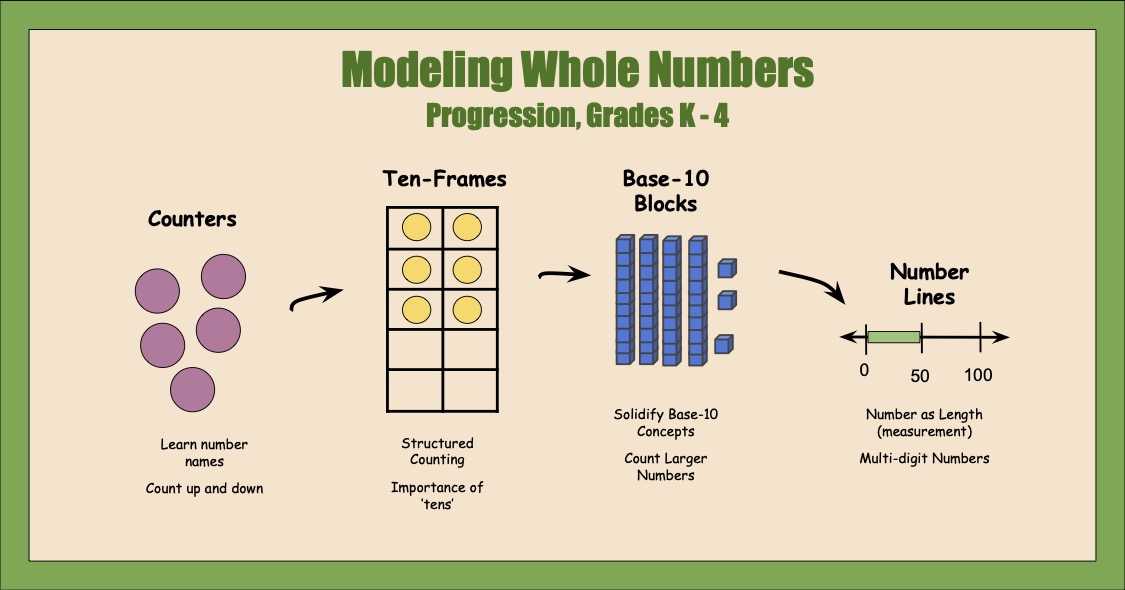
The picture shows a broad progression, not a rule that every child must use the models in that order. Choose according to the task and what the child already understands. If the objective concerns how many more are needed to make ten, a partly filled ten-frame makes the missing spaces visible. If it concerns where numbers belong between marked values, a number line is a closer fit. Putting a number line on a page about making ten does not automatically make that task clearer.
Return to the array objective from last lesson: Given six dot arrays, the learner will write a multiplication equation matching the rows and total for at least five. Arrays with equation spaces fit because the arrangement displays equal rows, and the child’s equation shows whether they connected those rows to the total. A decorative group of twelve stars would show a quantity, but not necessarily the row structure the objective asks about. Likewise, a page containing only equations would remove the pictured model the child is meant to interpret.
One caution matters when you check the result: an array with three rows of four also has four columns of three. If you want an equation specifically describing rows as groups, make that convention clear in the task. The visual and your expected response must agree.
Make the choice before designing the page
Before opening a design tool, state the objective and decide what evidence a completed page must contain. Then choose a format that helps generate that evidence.
| If the child must… | A promising visual format is… | Check that it shows… |
|---|---|---|
| Retell a story in order | A beginning–middle–end story map | The sequence, not just isolated details |
| Infer a word’s meaning from context | Short extracts with paired meaning and clue spaces | A meaning supported by text |
| Connect equal rows to multiplication | Dot arrays beside equation spaces | The pictured groups and a matching equation |
Treat these as matches to particular objectives, not fixed recipes. “Reading comprehension” is too broad to dictate a single organiser; “maths practice” is too broad to dictate a single model. A format becomes suitable when you can explain both how it supports the action and how you will check the result.
You can also choose not to add a visual organiser. If the child simply needs room to write a coherent paragraph, a dense arrangement of arrows, boxes, and pictures may divide their attention. Visual design includes deciding when clear writing space is the best support.
Takeaway
Start with the measurable objective, identify the thinking it demands, and select a visual format that makes that thinking possible and visible in the child’s response. Graphic organisers are useful when their structure reflects the relationship being learned; illustrations and models are useful when they supply information the child must interpret. Neither helps merely by being present.
Next, you’ll work on the child-facing instructions for an activity, adapting the wording for different age groups while keeping the learning objective intact.