Recommended resources
The freely available resources this lesson will direct you to.
- 5 Ways First Principles Thinking Helps You Code Betterwww.youtube.com
- Translating Business Requirements into Technical Requirements | Troy Martin | WLPC Phoenix 2020www.youtube.com
- The Power of First Principles Thinking in Coding: Solve ...algocademy.com
- The Single Responsibility Principle Revisited - The Valuable Devthevaluable.dev
Introduction
Welcome to the first lesson in our module on "Architecting for Business Impact." In the previous module, we assembled the fundamental technical building blocks of scalable systems: caching, scaling strategies, and load balancing. These are the "what" and "how" of implementation. Now, we pivot to the "why." Your journey toward becoming a senior developer and manager hinges on your ability to move beyond implementing pre-defined tasks to architecting solutions that solve core business problems.
This lesson introduces a powerful mental model for this purpose: First Principles Thinking. You will learn how to apply this technique to deconstruct complex business problems into their fundamental truths, and from those truths, reason your way up to the essential technical requirements. This skill is the bridge between a business need and a technical blueprint, and mastering it is a significant step in your transition from developer to architect.
1. What is First Principles Thinking?
At its core, First Principles Thinking is a method of problem-solving that involves systematically breaking down a complex problem into its most basic, foundational elements—the "first principles"—and then reassembling them from the ground up to create a new solution. This stands in contrast to reasoning by analogy, where we base our solutions on what has been done before. While analogy can be efficient, it rarely leads to innovation and can trap us in outdated assumptions.
The infographic below, "First Principles Thinking," provides a superb overview of the concept, its historical roots with figures like Aristotle, and its modern application by innovators like Elon Musk.
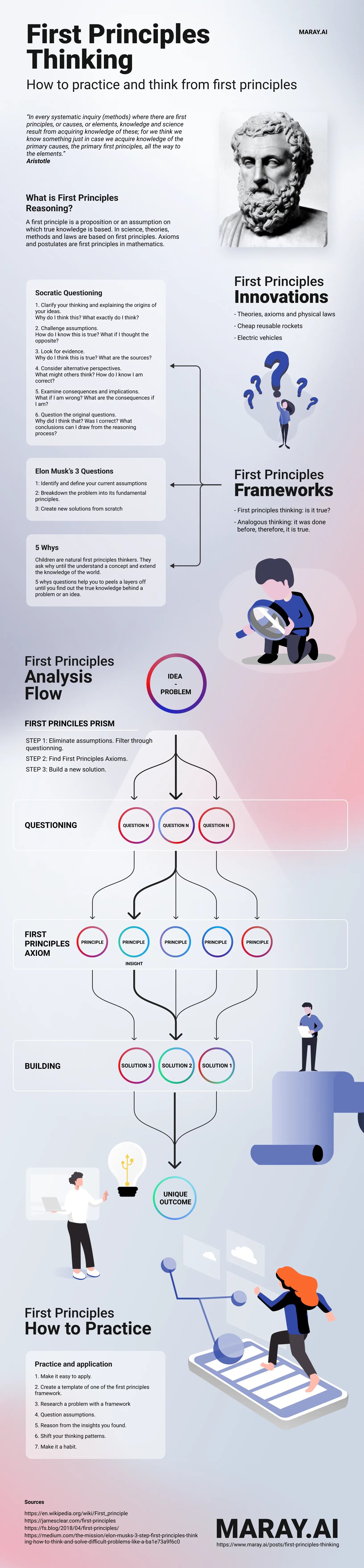
To formalize this definition and see how it applies directly to programming, let's turn to a short article from AlgoCademy.
The Power of First Principles Thinking in Coding: Solve ...
This article provides a concise definition of First Principles Thinking and outlines a clear, five-step process for applying it in a coding context.
Please read the first two main sections of the article: What is First Principles Thinking? - Focus on the core definition and how it contrasts with reasoning by analogy. How First Principles Thinking Applies to Coding - Pay close attention to the five-step process presented.
The process described—identify, break down, question, identify truths, and build—is the intellectual framework we will follow to translate ambiguous business goals into concrete technical plans.
2. The First Principle of Architecture: Start with "Why"
Before we write a single line of code or design a single database table, we must understand the fundamental business purpose. A failure to grasp the "why" behind a request often leads to building a technically sound solution to the wrong problem. Engineers often jump to the "how" (the implementation) because it's comfortable, but a senior contributor starts by relentlessly asking "why."
This short talk by Troy Martin provides a brilliant illustration of this concept. He uses the story of the Michelin Guide to show how a tire company, by focusing on its core business purpose (encouraging people to drive more to sell tires), ended up creating one of the world's most prestigious restaurant guides—a solution that had nothing to do with tires on the surface.
Translating Business Requirements into Technical Requirements | Troy Martin | WLPC Phoenix 2020
This video brilliantly explains the process of starting with the business purpose ("Why") before moving to business requirements ("What") and finally to technical requirements ("How").
Please watch the following segments: The Michelin Story: Notice how the ultimate business goal drove an unconventional solution. Ask Why: Understand why this is the most overlooked but crucial question. Business Purposes: Internalize the idea that customers buy benefits and solutions, not just products. The Workflow: Focus on the clear hierarchy: Why -> What -> How.
As the video makes clear, a customer asking for "fast Wi-Fi" isn't asking for a specific signal strength like -65 dBm; they are expressing a need for a seamless online experience. Our job is to translate that qualitative need ("fast") into a set of quantifiable technical requirements that deliver the desired outcome. The Why -> What -> How flow is the first and most critical step in decomposing any business problem.
3. Decomposing the "How": Cohesion and Coupling
Once we have a clear understanding of the "Why" (the business purpose) and the "What" (the business requirements), we can begin to tackle the "How" (the technical implementation). This is where first principles thinking meets software design. The act of breaking down a large problem is known in software engineering as decomposition.
How we decompose our system is not arbitrary. The goal is to create components that are internally consistent and externally independent. These two concepts, cohesion and coupling, are the first principles of good modular design.
The following reading explains these concepts masterfully. While the article's title mentions the Single Responsibility Principle (which we'll cover later), its foundational sections on decomposition are exactly what we need.
The Single Responsibility Principle Revisited - The Valuable Dev
This article from The Valuable Dev explains how decomposition, cohesion, and coupling are the fundamental tools for structuring software.
In the article, please read the following parts: Under the "Decomposition" subheading, read the paragraphs that explain why we break down problems, from the core idea to its benefits for human cognition. Next, read the "Cohesion" section, focusing on the definition and the real-world analogy of organizing cutlery. Pay attention to the core concept. Finally, read the "Coupling" section to understand interdependence between modules, starting from the definition and its relationship to cohesion and information hiding.
To summarize:
- Decomposition is breaking the problem into smaller, manageable sub-problems.
- High Cohesion is our goal when grouping things back together. It means that all the elements inside a module (like a Spring Boot service or a React component) are strongly related and serve a single, well-defined purpose.
- Low Coupling is our goal for the relationships between modules. It means that modules are as independent as possible, so a change in one module has minimal or no impact on others.
Thinking in terms of cohesion and coupling allows you to reason about your system's structure from first principles, rather than just copying a pattern you've seen before.
4. A Practical Framework for First Principles Design
Let's now synthesize these ideas into a structured process you can apply to your work. The "First Principles Analysis Flow" infographic provides a great visual model for this.
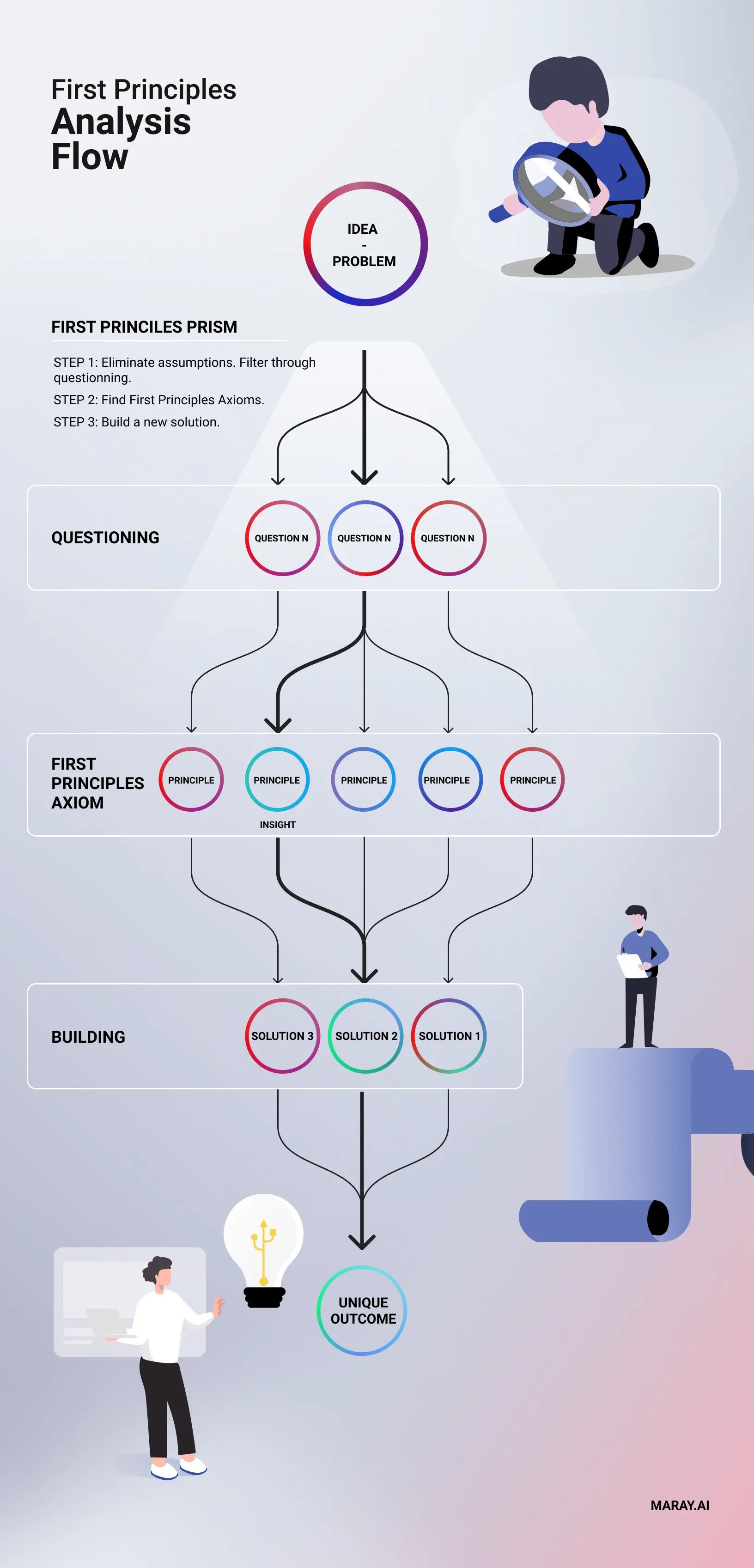
This flow—Questioning -> First Principles Axiom -> Building—is a practical representation of what we've discussed. To make this even more actionable, here is a set of guiding questions and practices.
Step 1: Identify the Fundamental Problem
Before anything else, get to the root of the problem. As developer and educator Arjan van der Velde explains, this means understanding the user needs, the software's purpose, and the limitations of your tools.
5 Ways First Principles Thinking Helps You Code Better
This video from the ArjanCodes channel provides five concrete ways that First Principles Thinking improves your coding, starting with problem identification and decomposition.
Watch these two key segments: Identify fundamental truths: Focus on the importance of optimizing for problem clarity before you start solving. Break down problems to their core: The example of reframing a "stock portfolio analyzer" as a "data pipeline" is a powerful illustration of identifying a problem's fundamental nature.
Step 2: Ask Deconstructive Questions
With the core problem in mind, use a structured questioning process to break it down. The following questions, adapted from "The Single Responsibility Principle Revisited," are an excellent starting point for any new project or feature.
The Single Responsibility Principle Revisited - The Valuable Dev
This section provides a list of powerful questions to guide your design process, starting from the business problem.
Please review the list of questions in the section What’s the alternative to SRP?
These questions force you to move from the business domain down to the technical details of module design, cohesion, and coupling.
Step 3: Build from the Ground Up and Validate
Once you've identified the first principles (the core sub-problems and their relationships), you can begin to assemble a solution. This is the "Building" phase of the analysis flow. A key part of this phase is to constantly challenge your own design.
- Start Simple: Don't introduce complexity unless it solves a proven need. A simple function is often better than a complex class hierarchy if it gets the job done.
- Validate Assumptions: The "truths" you identify are initially assumptions. Validate them continuously. A great way to do this in code is by writing tests. A unit test is a concrete validation of an assumption about a piece of code's behavior.
Conclusion
In this lesson, you have learned to wield First Principles Thinking as a tool for architectural design. By moving beyond surface-level requests and decomposing problems into their fundamental truths, you can bridge the gap between business ambiguity and technical clarity. This is a hallmark of a senior engineer.
Key Takeaways:
- First Principles Thinking involves breaking down problems to their core truths and reasoning up, rather than relying on analogy.
- The process starts with understanding the business "Why" (Purpose), then defining the "What" (Business Requirements), before ever touching the "How" (Technical Design).
- When designing the "How," use the principles of Decomposition, aiming for High Cohesion within your components and Low Coupling between them.
- A practical framework involves identifying the core problem, asking deconstructive questions, building the simplest possible solution, and continuously validating your assumptions.
In our next lesson, we will build directly on this foundation. You will learn how to translate a complete business problem into a set of formal functional and non-functional requirements, which are the essential inputs for designing a full system architecture.