Recommended resources
The freely available resources this lesson will direct you to.
Hello! Welcome back to our module on practical fine-tuning.
In the last lesson, we established a clear architectural framework for deciding when fine-tuning is the right choice compared to prompt engineering or RAG. We concluded that fine-tuning is the best tool for teaching a model a new skill or behavior, rather than new knowledge.
However, fine-tuning large models traditionally comes with a prohibitive cost in terms of computation, memory, and storage. This lesson introduces the modern solution to that problem. Our learning outcome is to describe Parameter-Efficient Fine-Tuning (PEFT) methods like LoRA and their benefits.
We will explore how these techniques make it possible to adapt multi-billion parameter models on consumer-grade hardware, a task that was once the exclusive domain of large research labs. You'll learn the core concepts behind LoRA, understand its significant practical advantages, and see why it has become a cornerstone of modern LLM customization.
The Problem: The Prohibitive Cost of Full Fine-Tuning
Before we dive into the solution, let's clarify the problem. "Full fine-tuning" means updating every single weight in the neural network. For a model with billions of parameters, this is an immense undertaking.

Full fine-tuning presents several major challenges for a practical software project:
- Massive VRAM Requirements: A 7-billion parameter model can require over 28 GB of GPU memory just to store the model, its gradients, and optimizer states during training. This often necessitates expensive, enterprise-grade multi-GPU setups.
- Huge Checkpoint Files: Each time you save a fine-tuned model, you create a complete copy of all its weights. For a 7B model, this is about 14 GB. Storing and managing multiple versions for different tasks becomes a significant storage and operational burden.
- Slow Task Switching: If you have different fine-tuned models for different customers or tasks, deploying them means loading gigabytes of data into GPU memory, which is slow and inefficient.
These challenges led researchers to develop a more intelligent approach: Parameter-Efficient Fine-Tuning, or PEFT.
The Solution: Parameter-Efficient Fine-Tuning (PEFT)
The core idea of PEFT is simple but powerful: freeze the vast majority of the pre-trained model's parameters and only train a very small number of new or existing parameters. This dramatically reduces the computational and memory footprint while often achieving performance comparable to full fine-tuning.
There are several PEFT methods, each with a slightly different strategy:
- Adapters: These are small neural network layers inserted between the existing layers of the transformer model. Only the adapters are trained.
- Prefix Tuning: This method keeps the model entirely frozen and learns a small, continuous "prefix" vector that is fed as input to each transformer layer to steer the model's behavior.
- LoRA (Low-Rank Adaptation): This is currently one of the most popular and effective methods. It doesn't add new layers but instead learns a low-rank "update" to the existing weight matrices.
We will focus on LoRA, as it offers an excellent balance of performance, efficiency, and ease of use.
Deep Dive: LoRA (Low-Rank Adaptation)
LoRA was developed by researchers at Microsoft to address the challenges of fine-tuning massive models like GPT-3. There's no better way to understand the motivation and core idea than hearing it from one of its inventors.
What is Low-Rank Adaptation (LoRA) | explained by the inventor
The video 'What is Low-Rank Adaptation (LoRA)' is presented by Edward Hu, who led the invention of LoRA. It provides a fantastic conceptual overview of why LoRA was created and how it works.
Please watch from the beginning to 02:57. Focus on: The Problem (00:37): The issues Microsoft faced with fine-tuning GPT-3 for production (cost, checkpoint size, deployment speed). The Core Idea (01:26): How LoRA is a generalization of full fine-tuning and the concept of controlling the 'expressivity' of the update via matrix rank.
How LoRA Works: The Concept of Low-Rank Updates
As you heard in the video, LoRA is based on a key insight from linear algebra. The hypothesis is that the change needed to adapt a pre-trained model to a new task is of a "low intrinsic rank." In simpler terms, you don't need to adjust every single parameter in a complex way; a simple, coordinated adjustment is often enough.
LoRA implements this by approximating the weight update matrix (ΔW) as a product of two much smaller, "low-rank" matrices (A and B).
So, instead of learning a large ΔW, we learn A and B, where ΔW ≈ A ⋅ B.
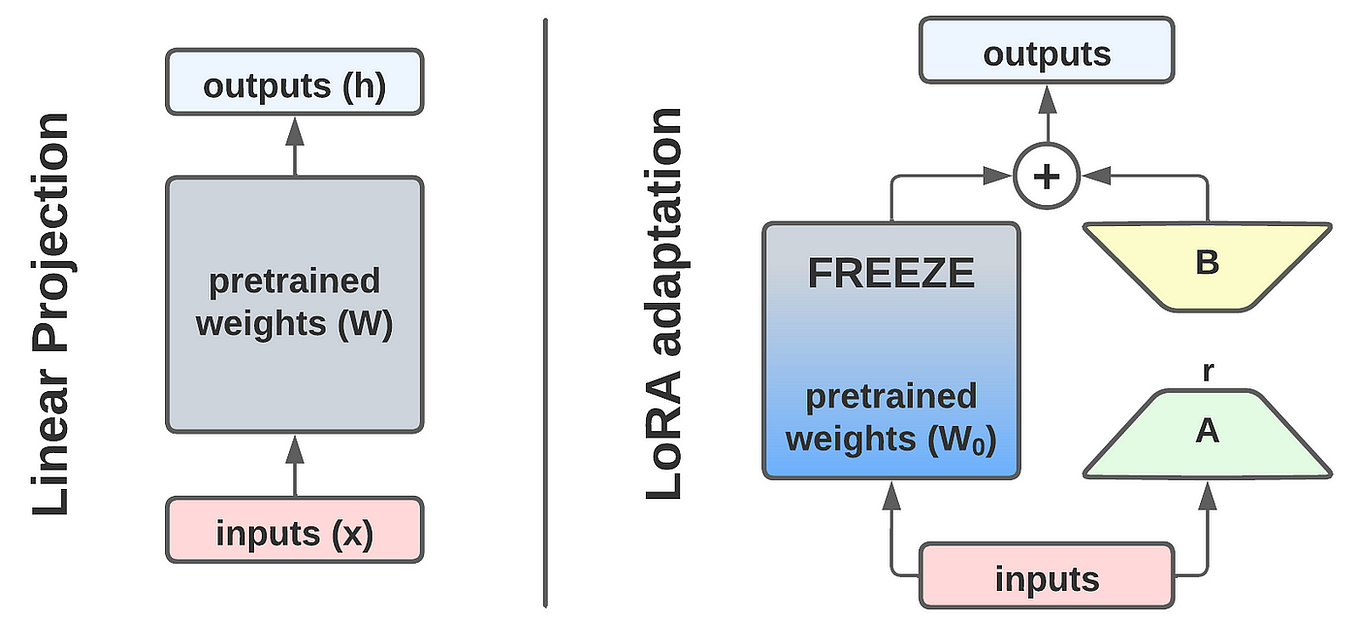
Let's break down this diagram:
- The large, pre-trained weight matrix
W₀is frozen. No gradients are computed for it, which is where most of the memory savings come from. - Two new, small matrices,
AandB, are added. These are the only parameters that are trained. - The dimension
r(the "rank") is a hyperparameter you choose. It's typically very small (e.g., 8, 16, 64), which is whyAandBare so small. - The final output is the sum of the original path (
W₀ ⋅ x) and the new, adaptive path ((B ⋅ A) ⋅ x).
To reinforce this concept, the following article provides a concise technical explanation.
What is Lora Fine Tuning? The Definitive Guide - TrueFoundry
The article 'What is Lora Fine Tuning? The Definitive Guide' from TrueFoundry clearly breaks down the technical foundations and advantages of LoRA.
Please read the first three sections: 'What is LoRA?', 'What is LoRA Fine-Tuning?', and 'Technical Foundations of LoRA'. Focus on how the math (ΔW = A·B) translates to the practical implementation within a transformer layer.
The Practical Benefits of LoRA
Understanding the mechanism is one thing, but as an engineer, the practical benefits are what truly matter. LoRA delivers significant advantages that make it ideal for real-world applications.
Let's return to Edward Hu's video to hear about these benefits.
What is Low-Rank Adaptation (LoRA) | explained by the inventor
Now, let's watch the rest of the video, where the practical engineering advantages of LoRA are explained.
Please watch from 04:25 to the end (07:15). Pay close attention to these key benefits: Checkpoint Size Reduction (04:25): Note the staggering difference in size between a full model and a LoRA adapter. Zero Inference Latency (04:54): This is a crucial point. Understand how the adapter can be 'merged' back into the base model to eliminate any runtime overhead. Engineering Ideas (05:56): Think about how these ideas, like caching adapters or training them in parallel, enable new kinds of system architectures.
To summarize, the key benefits of LoRA are:
- Drastically Reduced VRAM: By training only a tiny fraction of parameters (e.g., ~0.01%), fine-tuning becomes feasible on much smaller, more affordable GPUs.
- Tiny Checkpoint Size: LoRA adapters are typically only a few megabytes. This makes it trivial to store, share, and manage dozens of task-specific adapters for a single base model.
- No Inference Latency: This is a critical advantage for production systems. After training, the weights of the LoRA adapter (
AandB) can be mathematically merged into the base model's weights (W). The deployed model is architecturally identical to the original, so there is no extra computation and thus no added latency. - Modular and Scalable: You can treat adapters as plug-and-play modules. A single deployed base model can serve multiple tasks by dynamically loading the appropriate LoRA adapter, which is much faster than swapping out entire multi-gigabyte models.
- Preserves Pre-trained Knowledge: Since the original weights are frozen, LoRA is less prone to "catastrophic forgetting," where a model loses its general capabilities after being fine-tuned on a narrow task.
Pushing Efficiency Further: QLoRA
Just when LoRA made fine-tuning seem accessible, researchers pushed the boundaries even further with QLoRA.
QLoRA combines LoRA with quantization. Quantization is the process of reducing the precision of a model's weights (e.g., from 16-bit floating-point numbers to 4-bit integers). This dramatically shrinks the memory required to load the model.
QLoRA's innovation was to figure out how to fine-tune a quantized model using LoRA without a significant loss in performance.
The impact is astounding: QLoRA allows you to fine-tune massive models (e.g., 65-billion parameters) on a single GPU. This technique has truly democratized the ability to customize state-of-the-art LLMs.
LoRA & QLoRA Fine-tuning Explained In-Depth
For a quick, clear explanation of QLoRA, let's watch a segment from Mark Hennings' video.
Watch the segment from 08:04 to 09:24. Focus on the core idea: combining quantization (making the base model smaller in memory) with LoRA (efficiently training on top of it).
Conclusion
In this lesson, we demystified the process of efficient fine-tuning. You've learned that the prohibitive costs of full fine-tuning can be overcome using Parameter-Efficient Fine-Tuning (PEFT) methods.
Key Takeaways:
- Full fine-tuning is impractical for most teams due to its massive computational, memory, and storage requirements.
- PEFT methods solve this by freezing the base model and training only a small fraction of parameters.
- LoRA is a leading PEFT technique that learns a low-rank update to the model's existing weights.
- The primary benefits of LoRA include dramatically smaller memory and storage footprints, faster training, and zero added inference latency when merged.
- QLoRA combines LoRA with quantization to achieve even greater efficiency, enabling the fine-tuning of very large models on single GPUs.
You now understand when to fine-tune and how to do it efficiently with LoRA. The next logical step is to prepare the data needed for this process.
In our next lesson, we will get hands-on and learn how to format a dataset into a structured format suitable for supervised fine-tuning. This is a crucial data preparation step before you can train your own LoRA adapter.