Recommended resources
The freely available resources this lesson will direct you to.
- Adding and Subtracting Negative Fractions | Math with Mr. Jwww.youtube.com
- Adding and subtracting fractions with negatives | 7th grade | Khan Academywww.youtube.com
- 5.12: Fundamentals 11B - Fractions–Adding and Subtracting - Mathematics LibreTextsmath.libretexts.org
- Multi-Step Addition & Subtraction Problems Involving Rational Numbersflexbooks.ck12.org
Hello, and welcome. This short module builds a reliable method for expressions that mix fractions, positive integers, and negative integers. By the end of this lesson, you will be able to evaluate expressions with several additions and subtractions without losing track of signs.
The main idea is simple but powerful: turn every subtraction into addition of the opposite. Once an expression is made entirely of additions, you can group convenient terms, find common denominators for the fractional terms, and simplify.
1. Signed numbers: movement and opposites
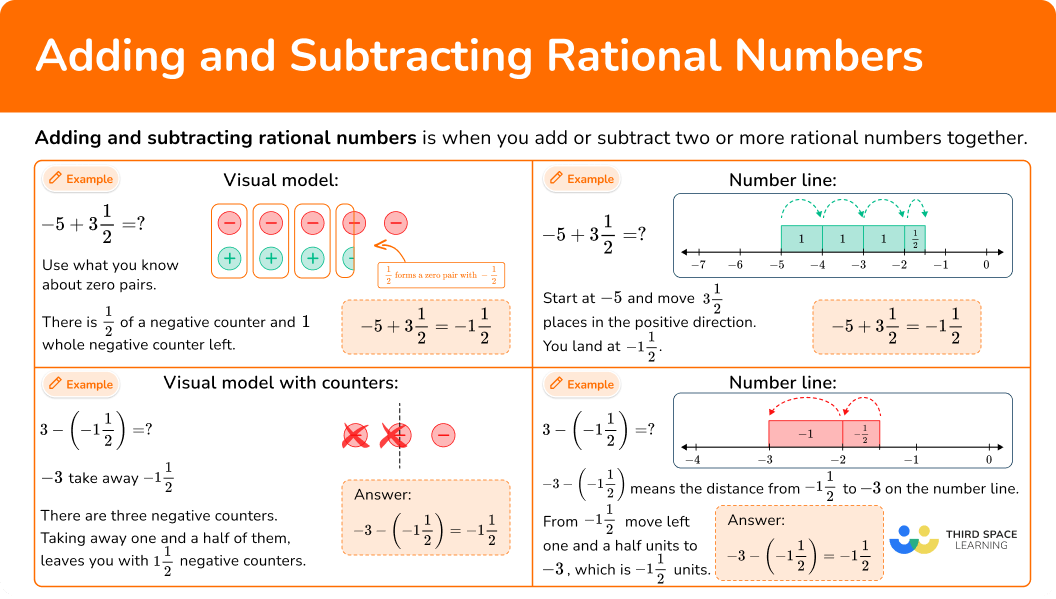
A positive number represents movement to the right on a number line; a negative number represents movement to the left. Adding a positive moves right, while adding a negative moves left.
Subtracting is best understood as adding the opposite:
This rule works for integers and fractions alike.
For example:
The second example is especially important: subtracting a negative increases the value because you are adding its opposite.
The same applies to fractions:
A negative fraction can be written in several equivalent ways:
For clear work, it is usually easiest to place the negative sign in front of the fraction or in the numerator.
Adding and subtracting fractions with negatives | 7th grade | Khan Academy
Watch Khan Academy’s “Adding and subtracting fractions with negatives.” It demonstrates the key habit for multi-term expressions: rewriting subtraction as addition of the opposite before grouping terms.
Watch rewrite subtraction to see why subtraction signs should be converted carefully. Continue with grouping terms, where compatible fractions are combined, and then watch common denominators for the final fraction calculation. Notice that reordering is safe only after every term is written as addition.
2. The method for multi-term expressions
Use this four-step method every time.
-
Rewrite subtraction as addition of the opposite.
Keep parentheses around negative quantities until the signs are clear. -
Group convenient terms.
You may group integer terms together and fraction terms together because addition can be reordered and regrouped. -
Add or subtract the fractions.
Find a common denominator, rewrite each fraction as an equivalent fraction, then combine the signed numerators. -
Combine the integer and fractional results.
If needed, write the integer using the common denominator. Simplify the final answer.
A useful caution: you may not casually rearrange subtraction. For instance,
does not mean that you can switch the and without thinking. First rewrite it:
Now every operation is addition, so grouping is safe.
The Commutative and Associative Properties of Addition justify this:
They apply to the addition form of the expression.
3. Worked example: integers, fractions, and a double negative
Evaluate:
Step 1: Rewrite subtraction
Subtracting a negative fraction means adding the positive fraction:
Step 2: Group integers and fractions
The integer part is:
For the fractions, the least common denominator of and is :
So:
Now combine:
Step 3: Write the integer with denominator
Therefore:
So the final answer is:
A quick reasonableness check helps: is a little greater than , so makes sense.
4. Adding fractions with different signs
When fractions have a common denominator, keep that denominator and combine the numerators, including their signs.
For example:
If the denominators differ, find a least common denominator first.
Adding and Subtracting Negative Fractions | Math with Mr. J
Math with Mr. J’s “Adding and Subtracting Negative Fractions” gives a careful visual walkthrough of common denominators and sign changes in subtraction.
Watch signed addition for an example with unlike denominators. Then watch subtracting positive to see subtraction rewritten as addition of a negative. If double negatives are still unfamiliar, watch subtracting negatives and focus on why the second negative changes to a positive term.
Here is the most common sign pattern to remember:
| Original operation | Rewrite as addition |
|---|---|
Do not treat two minus signs as automatically becoming a plus. They become a plus only when the second minus belongs to the number being subtracted, such as in:
5. Worked example: several subtractions
Evaluate:
Step 1: Convert all subtraction
Step 2: Group the integer terms and fractions
The integers give:
The least common denominator of and is :
Add the signed numerators:
Now combine:
Write in twenty-fourths:
Then:
As a mixed number:
Notice that the final answer is positive. Although the expression contains several subtractions, the term contributes .
6. A clear written layout prevents sign errors
For expressions with many terms, write one transformation per line. Avoid doing several sign changes mentally at once.
For example, begin with:
First rewrite:
Then find a common denominator for the fractions. The least common denominator of , , and is :
Combine the fractional terms:
Rewrite the integer in twelfths:
So:
The intermediate line is not “extra work”; it is how you make the signs visible and checkable.
5.12: Fundamentals 11B - Fractions–Adding and Subtracting - Mathematics LibreTexts
Read the negative-fraction explanation and selected practice from Mathematics LibreTexts. It reinforces the common-denominator process and includes expressions that combine fractions with integers.
In the “TRY THESE” part of the page, read the negative-fraction introduction. Focus on the worked example that changes fractions to a common denominator before combining their signed numerators. Then continue through the listed calculations, especially the items that involve an integer or subtracting a negative fraction; use the four-step method from this lesson rather than attempting to combine terms in one jump.
7. Final checklist
Before accepting an answer, check these five points:
- Did I rewrite each subtraction as addition of the opposite?
- Did I keep negative numbers in parentheses while rewriting?
- Did I find a common denominator before combining unlike fractions?
- Did I add the numerators with their signs?
- Is the final fraction simplified?
The central habit is:
This lesson established the full process for multi-term expressions involving integers and fractions: translate subtraction, group addition terms, use common denominators, and simplify. In the next work on this skill, focus on applying the same method efficiently and accurately across a wider range of practice expressions.