Recommended resources
The freely available resources this lesson will direct you to.
- Master AI Prompting: Zero-Shot, Few-Shot & Chain of Thought Explainedwww.youtube.com
- Prompt engineering essentials: Getting better results from LLMs | Tutorialwww.youtube.com
- What is Zero Shot Prompting? Complete Guide - Articsledgewww.articsledge.com
- Prompt Engineering Across the OpenAI, Anthropic, and Gemini APIsstevekinney.com
Introduction
In our last lesson, we concluded our tour of LLM fundamentals by confronting their inherent limitations: the inevitability of hallucinations, the deceptiveness of large context windows, and their brittle reasoning capabilities. We established that these are not just temporary flaws but deep-seated characteristics of the current technology. This understanding is the critical first step for any serious practitioner.
This lesson marks our pivot from theory to practice, kicking off the module on Advanced Prompting Techniques. If LLMs have inherent weaknesses, prompting is the art of skillfully navigating them. It is our primary interface for guiding the model's behavior, mitigating its flaws, and eliciting reliable, useful outputs. We begin with the most fundamental technique of all: zero-shot prompting. Your goal in this lesson is to learn how to write effective zero-shot prompts by structuring clear instructions, providing necessary context, and defining explicit constraints. This skill forms the foundation for all other prompting strategies you will learn.
What is Zero-Shot Prompting?
At its core, zero-shot prompting is the practice of asking an LLM to perform a task without providing it with any examples of how to do it. The model must rely entirely on its vast pre-trained knowledge and its ability to understand the instructions you provide.
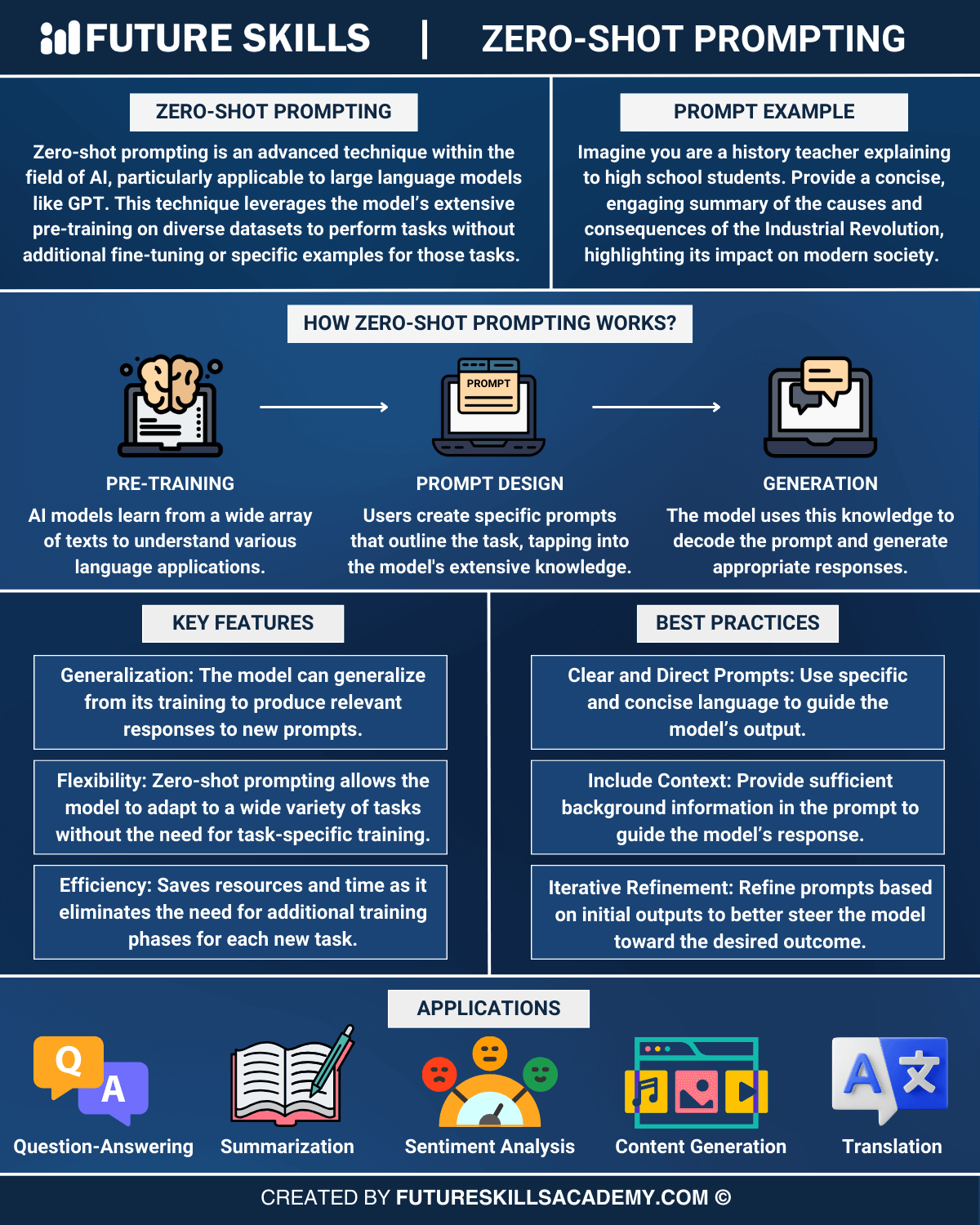
The power of this approach lies in its speed and flexibility. For an enormous range of tasks, a well-constructed zero-shot prompt is all you need. For you as a software professional, this means you can often build a feature or automate a workflow in minutes without the need for custom training data or complex fine-tuning.
To get a more formal definition and understand the core mechanics, let's turn to a couple of resources.
What is Zero Shot Prompting? Complete Guide - Articsledge
This article from Articsledge provides a solid background on zero-shot prompting, including its academic definition and the technical mechanisms that make it possible.
Please read the first two main sections. Start with "Background & Core Definitions" to grasp the concept and its significance. Then, continue with the section on how it works to understand the role of pre-training, instruction following, and model architecture.
As the article explains, zero-shot capabilities are an "emergent" property of large-scale models. The same architectural features we've discussed—the Transformer architecture and its attention mechanisms—are what enable the model to deconstruct your prompt and apply its generalized knowledge to your specific task.
The Anatomy of an Effective Prompt
A common mistake is to treat prompting like a casual conversation. While that works for simple queries, building reliable AI-driven workflows requires a more disciplined, structured approach. A useful mental model, especially given your software engineering background, is to think of a prompt not as a single string of text, but as a "prompt stack" or an "interface contract" between your deterministic code and the probabilistic model.
The most critical principle is to separate your instructions from your data.
Prompt Engineering Across the OpenAI, Anthropic, and Gemini APIs
This excellent article by Steve Kinney frames prompting in a way that resonates with software development principles, introducing the concept of a "prompt stack".
Read the introductory section titled "The Mental Model". Pay close attention to the core principle of separating instructions from data and the diagram illustrating the layers of a prompt stack.
This layered structure—instructions, context, query, and output constraints—is a powerful template for building robust prompts. Let's formalize these components.
A well-structured prompt typically contains four key elements. The following video breaks them down clearly.
Master AI Prompting: Zero-Shot, Few-Shot & Chain of Thought Explained
In this video, Prof. Ryan Ahmed provides a simple yet powerful framework for structuring any prompt.
Watch the segment from "key prompt components", which details the four main parts of a well-structured prompt: context, instructions, input data, and output indicator.
Let's synthesize what we've learned from these resources into a practical framework:
- Role/Context: Sets the stage and tells the model what persona or expertise to adopt (e.g., "You are a senior backend engineer").
- Instructions: The specific, unambiguous command telling the model what task to perform (e.g., "Classify the following log message").
- Input Data/Context: The information the model needs to work with. This should be clearly demarcated from the instructions, often using delimiters like
###,""", or XML-style tags. - Output Indicator/Constraints: Defines the structure, format, and rules for the response (e.g., "Return the answer as a JSON object with 'level' and 'summary' keys").
Crafting High-Impact Prompt Components
Knowing the components is one thing; writing them effectively is another. Let's dive into best practices for each part, focusing on how to avoid the ambiguities that lead to the failures we discussed in the last lesson.
1. Instructions: Be Clear and Precise
Vague instructions lead to vague, inconsistent, or incorrect results. Your goal is to eliminate ambiguity.
Prompt engineering essentials: Getting better results from LLMs | Tutorial
This tutorial from GitHub uses a practical coding example to show how refining a prompt's specificity dramatically improves the output.
Watch the segment from "key components of effective prompting". Notice how the initial prompt "Write a function that will square numbers in a list" is refined to specify the language, input type, error handling, and return behavior.
This principle extends beyond just code generation. Instead of "Summarize this," a better prompt is "Summarize this text in three bullet points, focusing on the financial implications."
2. Context: Use Structure and Delimiters
Remember the "lost in the middle" problem? Models can struggle to distinguish instructions from the data they are supposed to process, especially in long contexts. The solution is to use explicit structure.
Prompt Engineering Across the OpenAI, Anthropic, and Gemini APIs
This article again provides excellent, developer-centric advice on structuring prompts.
Read the two short subsections on "Role Prompting" and "Structured Prompting". The use of XML tags like <instructions> and <context> is a particularly robust method for creating a clear separation of concerns that the model can easily parse.
Using these tags makes your prompt more machine-readable and less prone to misinterpretation. It's the prompt engineering equivalent of using a well-defined data schema instead of parsing a messy text file.
3. Constraints: Guide, Don't Just Prohibit
Defining constraints, especially for the output format, is essential for building predictable systems. If your code expects JSON, the prompt must enforce that. A key insight is that it's more effective to tell the model what to do rather than what not to do.
For example, "Return the classification as one of the following: 'critical', 'warning', or 'info'" is much more reliable than "Don't use any classification other than critical, warning, or info."
Prompt Engineering Across the OpenAI, Anthropic, and Gemini APIs
Here we'll look at best practices for constraints and the consequences of being too vague.
Read the short section on "Constraint Prompting" for the principle of positive constraints. Then, jump down to the "Anti-Patterns" section and read the paragraph on "Underspecification", which reinforces the need for measurable constraints.
From Brittle to Hardened: A Practical Example
Let's put all these principles together. The difference between a simple, "brittle" prompt that works only on happy-path examples and a "hardened" prompt that is robust enough for production can be dramatic.
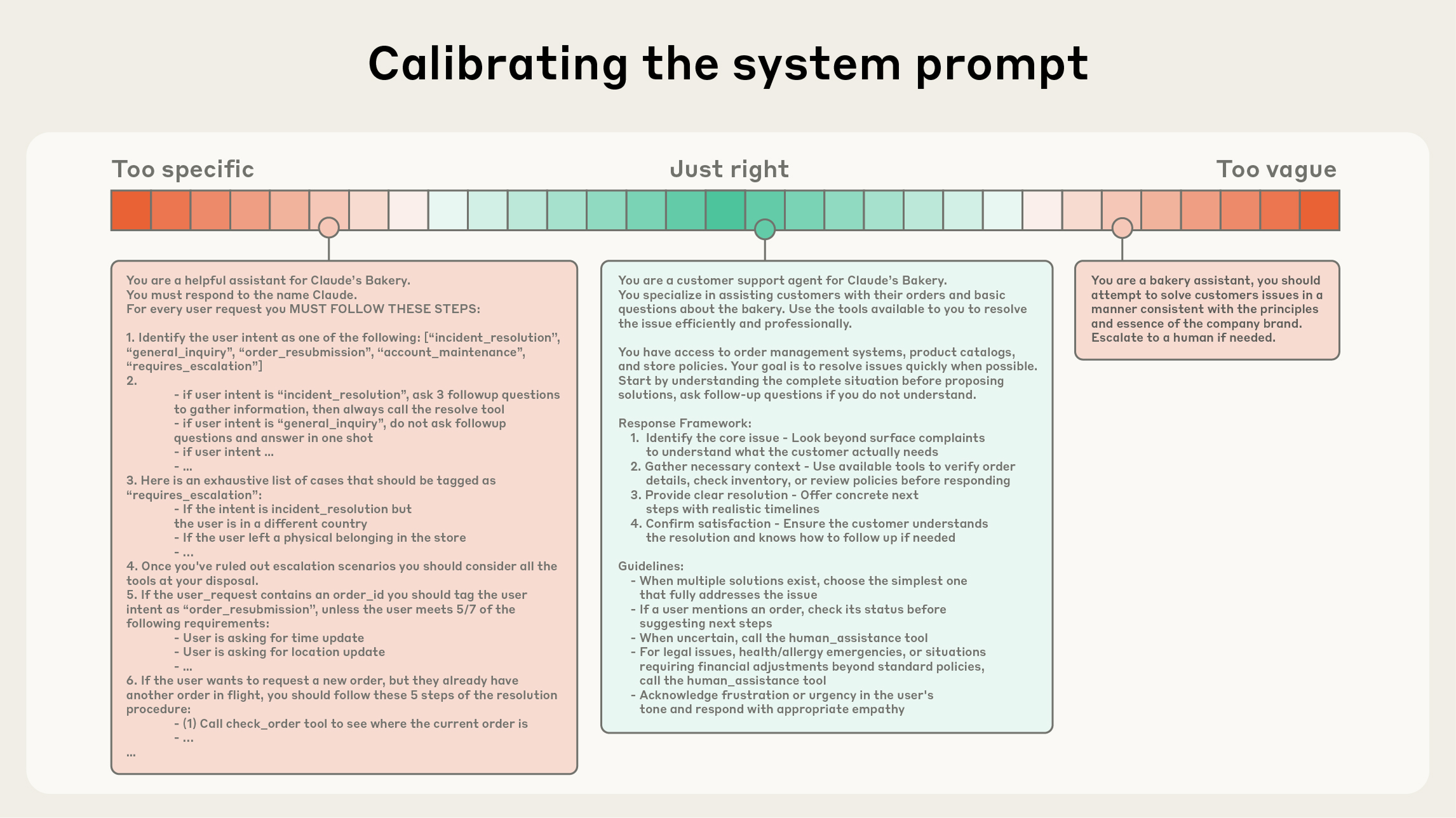
The following example for a document Q&A task is a masterclass in applying our principles.
Prompt Engineering Across the OpenAI, Anthropic, and Gemini APIs
This section contrasts a weak, brittle prompt with a robust, hardened version for a realistic task.
Read the entire section "Two Workflows, Brittle to Hardened". Analyze the "brittle version" and identify its weaknesses. Then, carefully study the "much better version" and see how it applies: Role Prompting: "You are a policy analyst." Clear Instructions & Constraints: The list of "Rules" provides explicit, positive instructions, including a specific command for the failure case ("If the documents do not contain sufficient information..."). Structured Context: The documents are nested within <documents> and <document> tags, with clear IDs. Output Enforcement: The prompt is combined with a JSON schema to guarantee a valid output structure.
The hardened prompt is longer, but it's not more complicated; it's more explicit. It leaves far less room for the model to guess, thereby reducing the likelihood of hallucination, context-blending, or formatting errors. This is the essence of effective zero-shot prompting.
Conclusion
In this lesson, we transitioned from understanding LLM limitations to actively managing them through disciplined prompting. We've established that effective zero-shot prompting isn't about finding "magic words," but about applying systematic software engineering principles to your communication with the model.
Here are your key takeaways:
- Zero-Shot Prompting is Fundamental: It allows models to perform tasks without examples, leveraging their pre-trained knowledge. It's fast, flexible, and powerful when used correctly.
- Structure is King: A robust prompt has a clear anatomy: Role, Instructions, Context/Data, and Constraints.
- Separate Instructions from Data: Use delimiters like XML tags or Markdown to create a clean "interface contract" that the model can easily parse, reducing ambiguity and error.
- Be Explicit and Positive: Give clear, specific, and measurable instructions. Tell the model what to do, including how to format the output and how to behave when it can't complete the task.
By treating prompt creation as a deliberate design process, you can move from getting occasionally impressive results to building reliable and predictable AI-powered features.
In our next lesson, we will build upon this foundation by exploring few-shot prompting. You'll learn how to provide specific examples within your prompt to guide the model on more complex, nuanced, or novel tasks where simple instructions are not enough.