Recommended resources
The freely available resources this lesson will direct you to.
Hello! Your public repository is now a safe place to publish work, but its README correctly says the portfolio is in progress. The next step is to define the first project tightly enough that you can finish it, show it to a recruiter, and explain every claim in an interview.
Today you will create a short project brief: who the first case is for, what files it will contain, and what must be true before you call it complete. You do not need to choose a company yet. Allow about 35–40 minutes; if you prefer, split the work across two 30-minute sessions.
Start with the interview, not the spreadsheet
Your first case has to serve several possible audiences, but it should not try to be four different projects at once. Make consulting and business-research interviewers the primary audience. They should be able to see how you framed a business question, compared evidence, and reached a qualified conclusion. Make M&A interviewers the secondary audience: the same case can demonstrate that you understand a company’s growth, economics, and risks before undertaking transaction analysis.
PE and VC are relevant to the wider portfolio, but they do not need dedicated models in this first release. A focused, finished company study is more useful than a partly built company study, DCF, acquisition model, and cap table.
A good interview test is: What decision could someone make more intelligently after reading this case? For example, a company brief might examine whether reported revenue growth has coincided with improving operating performance relative to relevant peers. That question calls for evidence and a conclusion; “analyze a company” does not tell you when the work is finished.
Watch how the candidate in Case Structure: Walkthrough Video by Management Consulted clarifies both the decision and the measure of success before outlining the analysis. The car-launch example is not your research topic; pay attention to the scoping move.
Case Structure: Walkthrough Video
Management Consulted’s case walkthrough shows how a broad business prompt becomes a decision with criteria, then an analysis plan.
Watch the clarification for the distinction between “should we do it?” and “how would we do it?”, and for the need to consider both growth and profitability. Then watch the structure to see how the candidate selects analysis areas that serve the decision rather than listing every possible topic.
For your project brief, phrase the intended output as a decision-oriented assessment, not an investment recommendation or a claim that you can predict a stock price. You can change the exact question once you have selected a company and checked its disclosures.
Specify outputs that a reviewer can open
A deliverable is an output, such as a report or spreadsheet. “Learn valuation” is a worthwhile course goal, but it is not a file a recruiter can inspect. For the first company case, set this minimum package:
- A two-page company research brief that states the question, summarizes the evidence, reaches a qualified conclusion, and names important limitations.
- A source-linked Excel analysis showing the historical figures, calculations, and references behind the brief.
- Three decision-relevant charts with clear periods, units, labels, and sources. They should answer parts of the research question, not merely decorate the report.
- A direct link from the repository README to the finished case, plus a resume bullet that describes only work actually completed.
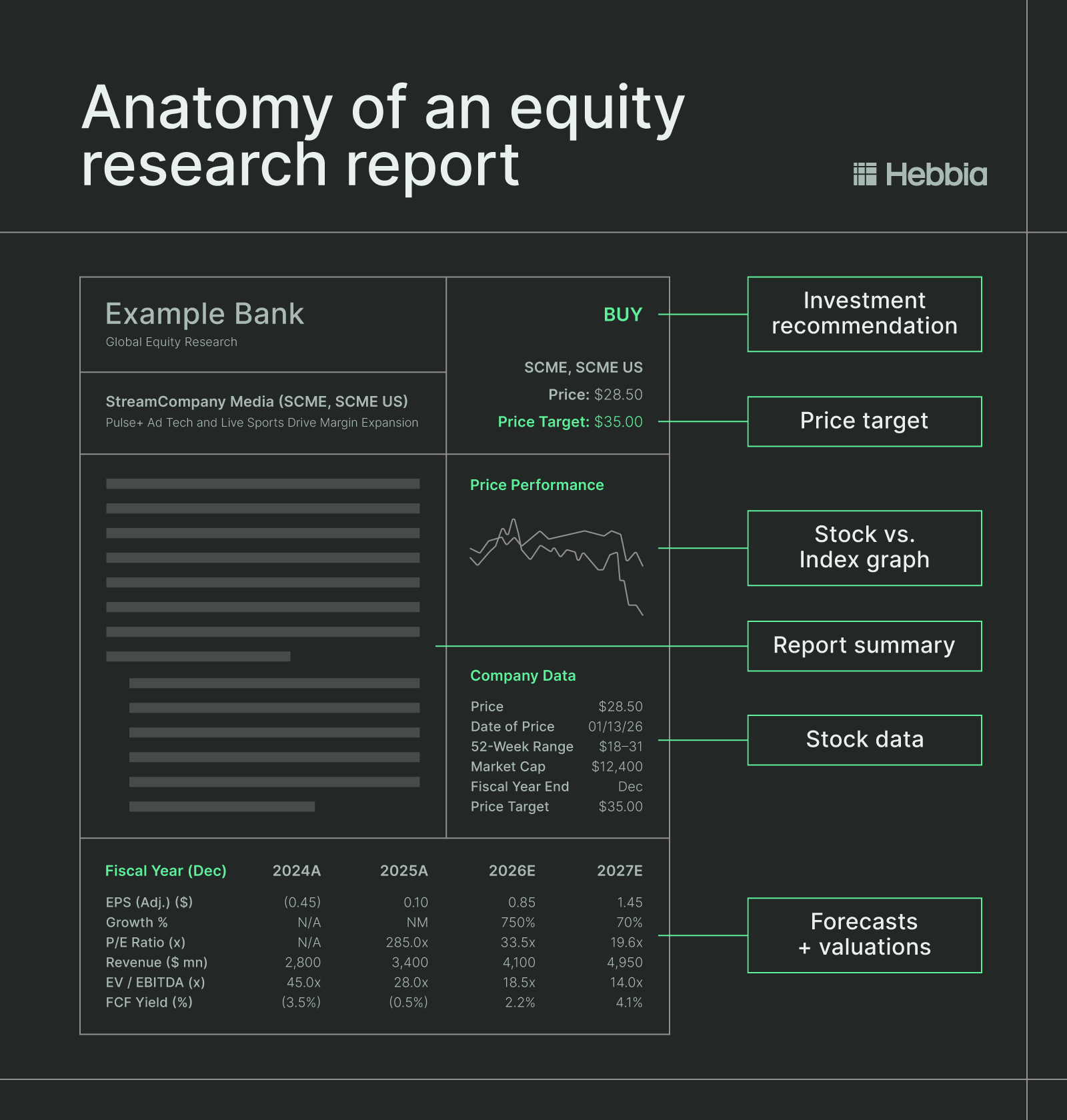
These are the planned outputs, not files you need to produce today. The image below shows how a different format—an equity research report—puts a recommendation, supporting data, and forecasts within easy reach of its reader. It is a layout illustration, not a template for your first case: you do not need a price target or forecasts to publish credible company research.
The distinction between an output and its acceptance criteria matters. “Excel analysis” names a deliverable; “each material figure can be traced to a dated source or an explained calculation” tells you whether it is ready. Read the short scoping method and checklist in Consulting SOW template: scope, deliverables, KPIs, and exit criteria from NMS Consulting. You are borrowing its outcome-to-deliverable logic, not writing a commercial consulting contract.
Consulting SOW template: scope, deliverables, KPIs, and exit criteria
Read NMS Consulting’s method for working backward from a decision to outputs, then its advice on checks a reviewer can apply.
Under “How do you create a SOW document?”, read the seven-step method, from the paragraph beginning “The simplest way” through step 7. Focus on outcomes, scope, deliverables, and exit criteria; client governance and pricing do not apply to your solo portfolio. Then go to “Deliverables list, KPI pack, and acceptance criteria.” Read the opening explanation. Under “Consulting acceptance criteria (fast checklist),” read the first three checks. Adapt their ideas of objective checks, named formats, and completeness to your report and workbook.
Define “ready to show” before you begin
Use two different gates. Project complete means you have produced the promised analysis. Resume-ready means a stranger can access it, check its evidence, and understand what you personally did. A polished PDF with unexplained numbers does not pass the second gate.
For this first case, use the following completion criteria:
| Check | Pass condition |
|---|---|
| Decision | The brief states one bounded question and gives a qualified answer, including what the evidence cannot establish. |
| Evidence | Material factual claims point to identifiable public sources; estimates, assumptions, and calculations are distinguishable from reported facts. |
| Analysis | The workbook exposes inputs and formulas, uses consistent units and periods, and supports the numbers quoted in the brief. |
| Communication | All three charts address the question and have readable labels, periods, units, and source notes. |
| Publication | A visitor who is not signed in can reach the case from the repository README and open the report and workbook. |
| Defense | You can explain the principal finding, one calculation, a competing interpretation, and a material limitation without relying on notes you have not published. |
These are checks, not a demand for certainty. Public disclosures may leave genuine gaps. Labeling a gap and narrowing your conclusion is better research than filling it with an unsupported estimate.
Also set an exclusion now: a DCF, three-statement forecast, M&A accretion model, and interactive app are not required for this first release. You will build valuation and transaction skills later in the course. Excluding them here protects the near-term goal of publishing one complete case.
Write the one-page project brief
In your repository, use Add file → Create new file to create PROJECT_BRIEF.md. This is a planning document, not the finished case. Paste and adapt the text below; keep the company field open until the selection lesson.
# First company case: project brief

## Intended interview audience
Primary: consulting and business-research interviewers.
Secondary: M&A interviewers assessing company analysis and commercial judgment.
Later portfolio releases will address PE and VC in greater depth.

## Decision the case will support
Assess a bounded question about a publicly listed company's growth,
operating performance, and competitive context.
Exact question and company: to be finalized after source availability is checked.

## In scope
- Publicly sourced company and relevant peer research
- Historical performance analysis in Excel
- Three charts selected to answer the research question
- A qualified conclusion, alternative explanation, and limitations

## Out of scope for this first release
- A price target or investment recommendation
- A DCF, full three-statement forecast, or acquisition model
- Unsupported estimates of undisclosed company or peer figures

## Deliverables
- Two-page company research brief
- Source-linked Excel analysis
- Three decision-relevant charts in the brief
- Repository link to the case and an accurate resume bullet

## Completion criteria
- The brief answers its stated question and distinguishes facts,
  calculations, interpretations, and uncertainty.
- Material figures and claims can be traced to public sources.
- Workbook calculations reconcile with figures used in the brief.
- Charts show units, periods, labels, and sources.
- An unsigned-in visitor can open the published outputs.
- I can explain the main finding, a calculation, an alternative
  interpretation, and a limitation in an interview.

## Publication rule
Do not call this case complete or add it to a resume until every
completion criterion passes. If public evidence is insufficient,
narrow the question or scope rather than inventing data.
Commit the file. The best output from today is not a long document: it is a brief whose promised files and pass conditions are unambiguous. If a prospective task does not help answer the case question or satisfy a completion criterion, defer it. That rule will help you protect your 30-minute study sessions from scope creep.
Takeaway
You now have a definition of the first project that separates audience, deliverables, and completion criteria. It prioritizes a finished, defensible company brief while leaving room for the more advanced valuation and deal cases you want in the same portfolio.
Next, you will select a publicly listed company whose business and disclosures make this plan achievable. That is when you can replace the brief’s provisional question with one tailored to real evidence.