Recommended resources
The freely available resources this lesson will direct you to.
- What Are RESEARCH ETHICS? The 4 Ethical Considerations Explained Simply (With Examples)www.youtube.com
- Scientific Conduct | Intellectual Honesty | Research Integrity | Scientific Research | L - 03www.youtube.com
- What is Research Integrity? - UK Research Integrity Officeukrio.org
- Read "Integrity in Scientific Research: Creating an Environment That Promotes Responsible Conduct" at NAP.eduwww.nationalacademies.org
Hello, and welcome. This first module builds a foundation for the rest of the course: before examining plagiarism, data practices, authorship, or AI tools, you need a way to recognize what good research practice is trying to protect.
In this lesson, you’ll examine five connected principles—honesty, accuracy, transparency, accountability, and respect. They apply across disciplines and throughout a project, from the first research question to the final report. The aim is not to memorize five labels, but to understand what each contributes to a trustworthy research record.
What does research integrity protect?
Research produces claims that other people may use, question, or build upon. Those people usually cannot witness every decision the researcher made. They rely on the research record—such as methods, data, analysis, and reporting—to understand how a conclusion was reached. Research integrity is the set of commitments and practices that makes that reliance reasonable.
Read the UK Research Integrity Office’s What is Research Integrity? for its definition and its account of five core principles.
What is Research Integrity? - UK Research Integrity Office
The UK Research Integrity Office explains why integrity concerns the whole research process, then describes the principles that guide it.
On the “What is Research Integrity?” page, begin with the definition. Read the next paragraph, from the lifecycle, to see why integrity is not limited to publication. Then find the paragraph introducing “The UK Concordat to support Research Integrity” and read its five named principles. Start with Honesty; continue through Rigour, Transparency and open communication, and Care and respect; finish with Accountability. As you read, notice that each principle concerns decisions made during research, not just the wording of a final report.
The diagram below gives you a compact view of the same framework. It uses rigour, which includes the pursuit of accuracy through appropriate methods and careful interpretation. We will make accuracy explicit because an honest intention alone does not ensure that a claim is well supported.
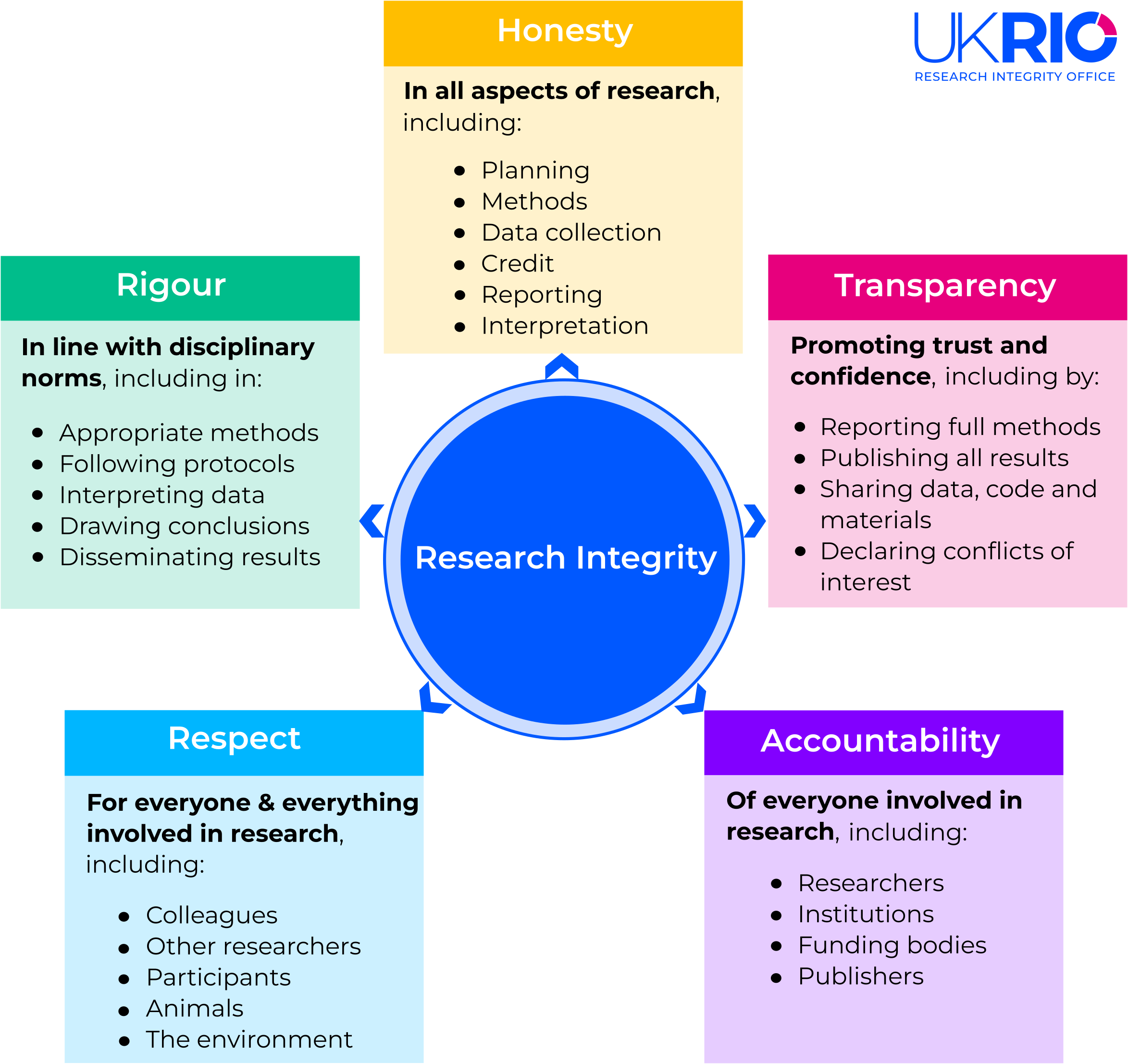
These principles reinforce one another, but they are not interchangeable. A researcher might describe a flawed method honestly; that satisfies part of honesty but does not make the method sound. A team might use an excellent method but omit an inconvenient result; methodological care does not excuse misleading reporting. Integrity requires attention to both the quality of the work and the conduct of the people responsible for it.
Honesty and accuracy: telling the truth, and getting it right
Honesty means representing research as it actually was, rather than as you wish it had been. It applies to plans, procedures, observations, contributions, and conclusions. If a researcher changed a method halfway through a project, honesty calls for describing that change where it matters. If findings do not support the original expectation, honesty calls for reporting that too.
Accuracy asks a related but different question: does the record faithfully represent what was observed, measured, calculated, and concluded? Accuracy depends on care with methods and records, as well as on claims that do not reach beyond the evidence. The UK Research Integrity Office discusses these demands under rigour: choosing appropriate methods, following relevant procedures, and drawing conclusions carefully.
Consider a study comparing two versions of written instructions to see which helps people complete a task. The researchers might sincerely report that one version “works better.” Yet if they counted incomplete tasks inconsistently, their comparison could be inaccurate despite their sincere belief. Conversely, they might count everything correctly but knowingly describe a small, uncertain difference as decisive. In that case, the numbers may be accurate while the claim is not honest.
This distinction matters because research can go wrong without deception. Methods can have limitations; people can make mistakes; evidence can be ambiguous. Integrity does not require infallibility. It requires care in producing the record, proportionate claims about what it shows, and a willingness to address problems when they become apparent. The next lesson will examine why an honest error, a questionable practice, and research misconduct must not automatically be treated as the same thing.
Transparency and accountability: making research answerable
Even accurate results can be difficult to trust if readers cannot tell how they were obtained. Transparency means making relevant choices and limitations visible enough for others to understand and evaluate the work. Depending on the project, that may mean explaining how observations were gathered, which results were included, how an analysis was performed, what changed from an initial plan, and whether competing interests could have influenced decisions.
Transparency is not a demand to publish every piece of information without restriction. Participant privacy, confidentiality agreements, and other legitimate obligations may limit what can be shared. A researcher can still explain a method, report a restriction, and describe how evidence was handled without disclosing protected information. The governing idea is to be as open as is appropriate without breaching other responsibilities.
Accountability concerns who takes responsibility for the work. Researchers should be able to explain their own contributions and decisions, respond to well-founded questions, and help correct the record when necessary. Responsibility also extends beyond an individual: organizations shape the conditions in which researchers work, including expectations, training, and processes for addressing concerns.
The National Academies’ Integrity in Scientific Research is useful here because it places individual responsibilities alongside institutional ones. Although it discusses science, the distinction applies broadly to research.
Read this National Academies excerpt to see how intellectual honesty, accuracy, respect, and accountability depend on both researchers’ actions and the environment supporting their work.
In “FINDINGS AND RECOMMENDATIONS,” under “Integrity in Research,” read the opening discussion. Focus on its distinction between an individual’s responsibility and an institution’s responsibility. Then find “BOX 1 — Integrity in Research.” In its “Individual Level” part, read individual practices, noticing accuracy in representing contributions and transparency about conflicts of interest. Continue to “Institutional Level,” from institutional practices. The page may display the box as a table and repeat it as text below; either presentation is sufficient.
Return to the instructions study. If a reader asks why some responses were excluded, transparency means the report should make the exclusion rule clear enough to evaluate. Accountability means the researchers can identify who made and checked that decision, answer the question, and address an error if they find one. Transparency makes scrutiny possible; accountability makes a response to that scrutiny someone’s responsibility.
Respect: the people and things research affects
Research integrity is not only about whether a conclusion is correct. Respect requires care for people and other subjects involved in producing knowledge, and fairness toward those whose work makes a project possible.
For human participants, respect includes taking their rights, welfare, and privacy seriously. For collaborators, it includes fair treatment and appropriate recognition of contributions. It also extends, where relevant, to animals, the environment, cultural objects, and the communities affected by research. A project cannot claim integrity solely because its measurements are precise if it treats participants carelessly or takes credit for others’ work.
Respect can place a useful boundary on another principle. Transparency may favor sharing information so that others can examine a result. Respect for participants may require withholding identifying details. The sound response is not to abandon transparency or privacy; it is to report the research clearly while protecting information that should not be disclosed.
The principles therefore work as a set of obligations to balance, not five independent boxes to tick. Honesty prevents a misleading account of what happened. Accuracy and rigour strengthen the connection between evidence and claims. Transparency lets others examine that connection. Accountability ensures that questions and corrections are taken seriously. Respect limits avoidable harm and requires fair treatment throughout the process.
A framework to carry into the rest of the course
When you encounter a research decision, it helps to look at it from several angles rather than asking only, “Was a rule broken?” For the instructions study, you could ask whether the report truthfully describes the procedure; whether responses were counted carefully; whether exclusions and uncertainty are visible; whether someone can explain and correct decisions; and whether participants’ information and collaborators’ contributions were treated appropriately. Each question illuminates something the others might miss.
The later modules will give these principles more specific form. Careful records help support accuracy and accountability. Proper citation supports honesty and respect. Authorship and conflict-of-interest decisions test fair credit and transparency. Responsible AI use raises questions about what was done, what can be verified, what must be disclosed, and who remains responsible.
Conclusion
Research integrity is a continuing commitment to trustworthy work, not merely the absence of a prohibited act. Honesty keeps the account truthful; accuracy keeps observations and claims faithful to the evidence; transparency makes consequential choices visible; accountability makes people and organizations answerable; and respect protects those involved in and affected by research.
In the next lesson, you’ll use this foundation to distinguish honest error from questionable practice and misconduct under a stated policy—and consider why the appropriate response depends on that distinction.