Recommended resources
The freely available resources this lesson will direct you to.
नमस्कार! In the previous lesson, you practised making careful claims about a passage without overstating its evidence. Today the focus shifts from what an English answer says to how clearly its sentences say it. You will learn to correct common errors in grammar, sentence structure, punctuation, and formal usage—skills useful for both objective English questions and later descriptive answers.
Allow about 40–45 minutes. This lesson teaches a practical editing method, not a list of rules to memorise without context.
First, find the complete thought
Before changing a comma or a verb, identify the sentence’s subject and verb. In “The office receives applications,” the office is the subject and receives is the verb. The sentence also expresses a complete thought: it is an independent clause.
Compare: “Although the office receives applications.” This has a subject and verb, but although makes the thought dependent. The reader is still waiting to hear what happened despite that fact. It becomes a complete sentence when another clause supplies the main point: “Although the office receives applications, some residents still need assistance.”
Read Purdue OWL’s explanation before applying this distinction. In Nepali, the useful check is वाक्य पूरा छ?—does the thought stand on its own?
Identifying Independent and Dependent Clauses - Purdue OWL
Read Purdue OWL’s “Identifying Independent and Dependent Clauses” to establish what can stand alone as a sentence and what needs to be attached to one.
Under “Independent Clause” and “Dependent Clause,” read the definitions and their Jim examples. Under “Dependent Marker Word,” read the explanation, then continue through the list of common markers ending with “while.” Finally, under “Connecting independent clauses” and “Connecting dependent and independent clauses,” read the connection rules. Focus on how the punctuation changes when a clause begins with a word such as when or although.
A fragment is an incomplete thought presented as a sentence. Some fragments are missing a subject (“Submitted the report.”); others lack a complete verb (“The officer reviewing the report.”). Add what is missing: “The officer submitted the report” and “The officer is reviewing the report.” The image below is a quick check for these two cases.
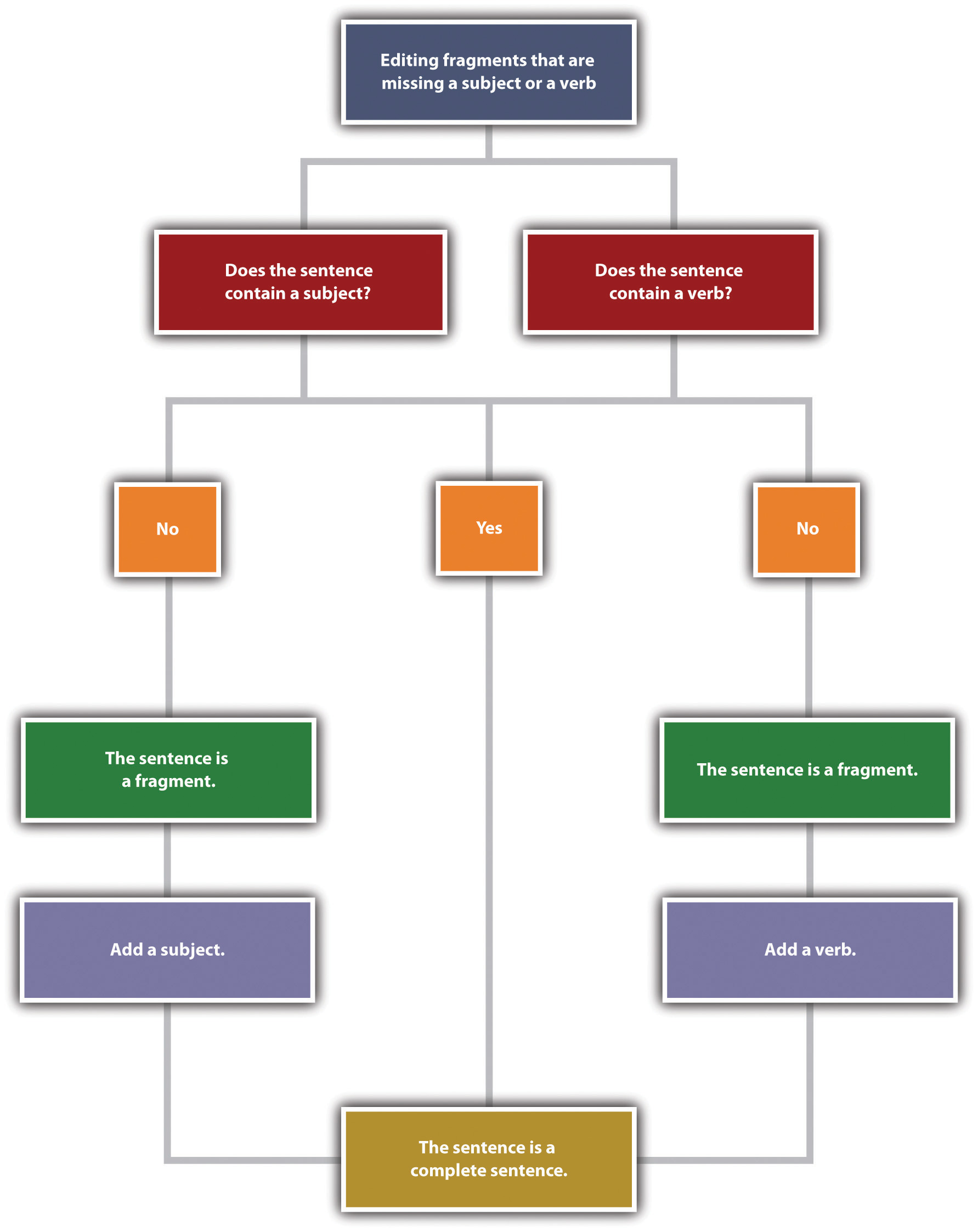
The chart is a starting point, not the whole test. “Because the officer reviewed the report” has both a subject and a verb, yet it is still dependent. Either attach a main clause—“Because the officer reviewed the report, the figures were corrected”—or remove because if you simply mean “The officer reviewed the report.”
Give each clause a clear boundary
The opposite problem occurs when two complete thoughts are joined incorrectly. Consider: “The portal opened residents submitted applications.” Both parts could stand alone, but there is no boundary between them. This is a fused sentence, often called a run-on.
A comma by itself does not solve the problem: “The portal opened, residents submitted applications” is a comma splice. Khan Academy’s short video shows how to recognise both errors and repair them.
Run-ons and comma splices | Syntax | Khan Academy
Watch Khan Academy’s “Run-ons and comma splices” for a visual explanation of what happens when two independent clauses are joined incorrectly.
Watch run-ons and repairs for the two-clause test and the first corrections. Continue with comma splices to see why a comma alone is insufficient and how a conjunction or semicolon changes the sentence.
There are several sound ways to edit the portal example, depending on the relationship you intend:
- Two sentences: “The portal opened. Residents submitted applications.”
- Comma plus a coordinating conjunction: “The portal opened, and residents submitted applications.”
- Semicolon: “The portal opened; residents submitted applications.”
- A dependent clause: “After the portal opened, residents submitted applications.”
A semicolon joins closely related independent clauses; it cannot rescue a fragment. Notice also that however is not interchangeable with but for punctuation purposes. Write “The portal opened, but some residents still needed help,” or “The portal opened; however, some residents still needed help.” In a timed answer, two clear sentences are often safer than a complicated connection you cannot readily check.
Commas have other jobs, but do not insert one simply because you pause while reading. After an opening dependent clause, use a comma: “Although applications increased, access remained uneven.” When the dependent clause follows the main clause, a comma is usually unnecessary: “Access remained uneven although applications increased.” Punctuation should help the reader see the grammatical relationship.
Check the grammar inside the sentence
A sentence can be complete and properly punctuated but still contain errors. Purdue OWL’s proofreading guide offers a useful way to inspect subjects, lists, pronouns, and apostrophes.
Proofreading for Errors - Purdue OWL
Read selected parts of Purdue OWL’s “Proofreading for Errors” as an editing checklist rather than trying to memorise every example.
Under “Subject/Verb Agreement,” read the checking method and the example correcting students ... is to students ... are. Under “Parallelism,” read the rule and its following listening / being / having examples, stopping before “Pronoun Reference/Agreement.” In that next subsection, read the pronoun check and the examples showing when her is ambiguous. Under “Apostrophes,” read the rules, then the examples distinguishing it’s from its.
For subject–verb agreement, find the actual subject, not just the noun nearest the verb. “The number of applications has increased” uses has because number is singular; the nearby plural applications does not control the verb. By contrast, “Applications have increased” has a plural subject. In the present tense, “This does not prove access has improved” is correct, not “This don’t prove …”.
For pronouns, ask what each one refers to. “The office sent the ministry its report” could leave a reader unsure whose report is meant. If it is the office’s report, say “The office sent its report to the ministry.” A repeated noun can be better than a short but ambiguous pronoun.
A parallel list gives similar items similar grammatical forms. “The team will record delays, review complaints, and assist applicants” is easier to read than “The team will record delays, reviewing complaints, and assistance to applicants.” Parallelism is not decoration: it makes each responsibility equally clear.
A few additional checks catch frequent mistakes in formal answers:
- Articles: Use a before a consonant sound and an before a vowel sound: “a report,” “an application.” Use the when the reader can identify the particular item: “Officials received an application. They reviewed the application.”
- Prepositions: Learn useful combinations as phrases: “responsible for recording delays,” “access to services,” and “depend on evidence.”
- Tense: Let time determine the verb. “The office introduced the portal last year; it now receives online applications.” A change of tense is appropriate when the time changes.
- Apostrophes and capitals: It’s means it is or it has; its indicates possession. Begin a sentence with a capital letter, and capitalise proper names, but do not add capitals to ordinary words merely to make them look important.
Make the corrected sentence suitable for a formal answer
Grammatical correctness is necessary, but a Lok Sewa descriptive answer also needs language that is precise and appropriately formal. Watch these selected parts of Interactive English’s writing lesson for two useful editing principles: remove unnecessary words and replace casual expressions with exact ones.
1-HOUR LESSON - Improve Your Writing ✍️ (Academic, Professional, & Descriptive)
Watch selected parts of Interactive English’s “1-HOUR LESSON - Improve Your Writing” for practical guidance on concise and formal wording; there is no need to watch the full hour.
Watch concise wording, especially the change from a noun-heavy phrase to a direct verb. Then watch formal language for the discussion of contractions, idioms, and colloquial expressions. Focus on replacing vague or casual language without changing the claim.
For example, “The committee made an assessment of the proposal” can usually become “The committee assessed the proposal.” “The project will be a piece of cake” is both informal and imprecise; “The project is expected to be straightforward” states the idea more suitably. In a formal answer, prefer “do not” to “don’t,” and name the actor where that improves clarity: “Officials reviewed the complaints” is clearer than “The complaints were reviewed” if who reviewed them matters. Passive voice remains useful when the actor is unknown or less important.
Most importantly, editing must preserve the intended meaning and its limits. Do not change “The records may reveal delays” into “The records prove the cause of delays” just to make a sentence sound stronger. Your earlier work on evidence and implication applies to writing as well as reading.
A proofreading pass from start to finish
Here is an illustrative draft, not a report of an actual office:
Although applications have increased. This don't prove that access has improved, the office should check completion rates. It's staffs is responsible of recording delays and to assist applicants. We can't just brush off problems.
A corrected version reads:
Although applications have increased, this does not prove that access has improved. The office should check completion rates. Its staff members are responsible for recording delays and assisting applicants. Officials should not dismiss reported problems.
The first edit attaches the dependent although clause to a main clause. The next replaces don’t with does not and ends the sentence before a comma splice. In the third sentence, its shows possession, staff members are agrees in number, responsible for uses the appropriate preposition, and recording matches assisting. Finally, “Officials should not dismiss reported problems” replaces a casual expression with a specific formal statement. The central claim remains cautious: an increase in applications alone does not establish improved access.
When reviewing your own answer, make separate passes. First check whether each sentence has a complete main thought and whether two main thoughts have a proper boundary. Next check subjects and verbs, tense, articles, prepositions, pronouns, and parallel lists. Last, inspect capitals, apostrophes, commas, and formal word choice. Reading one sentence at a time can help you notice errors that disappear when you read only for meaning.
The key is to edit from the sentence outward: establish a complete thought, mark clause boundaries, check the grammar within them, and then make the wording precise and formal. Clear English helps an examiner follow an argument without having to repair its sentences while reading.
In the next lesson, you will use these habits to write a short evidence-led descriptive answer with a clear introduction, organised analysis, and concise conclusion.