Recommended resources
The freely available resources this lesson will direct you to.
Welcome back. In our previous lesson, you mastered the process of preparing a bank reconciliation statement. You learned how to compare your company's cash book with the bank statement to identify discrepancies and calculate the true, adjusted cash balance.
As we concluded, the bank reconciliation statement is an internal working document. It shows us what's wrong, but it doesn't fix our accounting records on its own. The adjustments made to the "Balance per Bank" will typically resolve themselves over time as outstanding checks are cashed and deposits are processed. However, the items on the "Balance per Books" side represent transactions and errors that your company's records are currently unaware of.
Today's lesson is the crucial final step in the reconciliation process. Our learning outcome is to record the adjusting and correcting entries identified during the bank reconciliation process. By the end of this 60-minute session, you will be able to prepare the formal journal entries needed to update your general ledger, ensuring your cash account reflects its true and accurate balance.
1. The Golden Rule: Only Adjust Your Own Books
The most important principle to remember is that you only prepare journal entries for the items on the "Adjustments to Balance per Books" side of the reconciliation. You have no control over the bank's records, so you don't make entries for items like deposits in transit or outstanding checks. Those items are already correctly recorded in your books.
The goal of the journal entries we will prepare is to make the balance of your general ledger Cash account (Account 512, Banque) equal to the adjusted cash balance you calculated.
To reinforce this fundamental point, let's start with a short video.
Bank Reconciliations: Journal Entries
This clip from TLC Tutoring clearly explains why journal entries are only made for the 'book' side of the reconciliation.
Watch from the beginning to 01:20. Focus on the distinction between the bank's records and the company's records, and why we only have control over our own.
As the video stated, our task is to update our company's records to reflect the reality that the bank statement has revealed. Let's systematically go through the types of entries you will need to make.
2. Crafting the Journal Entries
Each adjustment on the "book" side of your reconciliation will require a specific journal entry. These entries will always involve the Cash account (512 Banque), either as a debit (to increase the balance) or a credit (to decrease it).
The resource we used in the last lesson from AccountingCoach provides an excellent, detailed walkthrough of this process. We will refer to it as our main guide.
Bank Reconciliation: In-Depth Explanation with Examples
This comprehensive guide from AccountingCoach explains the various items that require adjusting entries and provides a step-by-step example.
First, quickly review 'Step 5' in the section 'Company’s Process for Preparing its Bank Reconciliation' to confirm the purpose of these entries. Then, carefully study the section 'Sample of a Company’s Bank Reconciliation with Amounts'. Focus on the journal entries (labeled E, F, B, D, G, C, K) that correspond to the items on the 'Balance per BOOKS' side of the sample reconciliation. Notice how each entry adjusts the Cash account and another relevant account.
Let's break down the common adjustments you just saw in that reading.
A. Entries for Additions to the Book Balance
These are items the bank has added to your account that you haven't recorded yet. The journal entry will always involve a Debit to Cash (512 Banque).
- Interest Earned (Intérêts et produits assimilés): The bank pays you interest on your balance.
- Journal Entry:
- Debit: Cash (512)
- Credit: Interest Income (e.g., 738)
- Journal Entry:
- Notes Collected: The bank collects a payment from a customer on your behalf (e.g., an effet de commerce).
- Journal Entry:
- Debit: Cash (512)
- Credit: Notes Receivable (e.g., 3425 Clients - effets à recevoir)
- Journal Entry:
B. Entries for Deductions from the Book Balance
These are items the bank has deducted from your account that you haven't recorded yet. The journal entry will always involve a Credit to Cash (512 Banque).
- Bank Service Charges (Services bancaires et assimilés): Monthly fees, check printing costs, transfer fees, etc.
- Journal Entry:
- Debit: Bank Charges Expense (e.g., 6147)
- Credit: Cash (512)
- Journal Entry:
- NSF Check (Chèque sans provision or impayé): A customer's check you deposited has "bounced." The bank reverses the deposit. Your entry must reverse the payment you thought you received and re-establish the debt.
- Journal Entry:
- Debit: Accounts Receivable (e.g., 3421 Clients)
- Credit: Cash (512)
- Journal Entry:
C. Entries for Correcting Company Errors
Correcting errors requires careful analysis of what was done incorrectly versus what should have been done. There is no single formula; you must craft the entry to fix the specific mistake.
Let's say your company wrote a check for 450 DH to pay the electricity bill. However, the bookkeeper accidentally recorded the transaction as 540 DH.
- Incorrect Entry made: Debit Electricity Expense (6135) 540 DH, Credit Cash (512) 540 DH.
- Correct Entry should be: Debit Electricity Expense (6135) 450 DH, Credit Cash (512) 450 DH.
Your cash account was credited by 90 DH too much (making the balance too low), and the expense account was debited by 90 DH too much. The correcting entry must reverse this difference of 90 DH.
- Correcting Journal Entry:
- Debit: Cash (512) ........................................ 90 DH
- Credit: Electricity Expense (6135) ......... 90 DH
- To correct error in recording check #XXX.
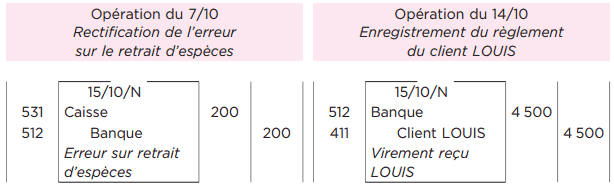
The image below shows two typical entries you might make after a reconciliation, presented in a standard French/Moroccan journal format. The first is an error correction, and the second is recording a client payment received via bank transfer (an item you might discover on the bank statement).
Test your understanding!
After preparing its May bank reconciliation, "Fès Distribution SARL" identified the following items requiring adjustment in its books:
- Bank service charges for May: 250 DH.
- The bank collected a note receivable on their behalf: 5,000 DH.
- Interest earned on the bank balance: 75 DH.
- A check from a customer, "Client Karim," for 1,200 DH, was returned NSF (sans provision).
Prepare the necessary journal entries to adjust the company's books. You can prepare a separate entry for each item.
Show answer
Here are the four required journal entries for "Fès Distribution SARL":
1. To record bank service charges:
- Debit: Bank Charges Expense (6147) ....... 250 DH
- Credit: Cash (512) .................................... 250 DH
- Pour constater les frais bancaires de Mai.
2. To record the collection of a note receivable:
- Debit: Cash (512) ....................................... 5,000 DH
- Credit: Notes Receivable (3425) ............ 5,000 DH
- Pour constater l'encaissement de l'effet N°...
3. To record interest earned:
- Debit: Cash (512) ....................................... 75 DH
- Credit: Interest Income (738) ................... 75 DH
- Pour constater les intérêts créditeurs de Mai.
4. To record the NSF check:
- Debit: Accounts Receivable - Karim (3421) ..... 1,200 DH
- Credit: Cash (512) ............................................ 1,200 DH
- Pour constater le retour du chèque impayé du client Karim.
3. Practice: A Complete Walkthrough
Now that you understand the individual components, let's see them all come together in a complete example. You have the choice of recording each adjustment as a separate journal entry (as we did above, and as shown in the AccountingCoach article) or combining them into two compound journal entries: one for all cash additions and one for all cash deductions. The compound method is often more efficient.
The following video demonstrates this compound entry approach.
Bank Reconciliations: Journal Entries
This video from TLC Tutoring provides a practical walkthrough of creating compound journal entries for all the 'book' side adjustments from a sample bank reconciliation.
Watch from 01:20 to 07:35. Pay attention to how the presenter groups all the 'additions' into one entry with a single debit to Cash, and all the 'deductions' into another entry with a single credit to Cash.
Whether you use separate or compound entries is a matter of preference and company policy. The end result on the account balances is identical. The key is that after you post these entries, the balance in your general ledger Cash account will exactly match the adjusted balance from your reconciliation worksheet.
Conclusion
You have now completed the bank reconciliation cycle. This is a critical monthly task for an accountant. It's not just about finding a number; it's about ensuring the integrity of the company's most liquid asset and the accuracy of its financial records.
Key Takeaways:
- Journal entries are required only for the adjustments on the "Balance per Books" side of the reconciliation.
- These entries bring the general ledger Cash account balance to its true, corrected amount.
- Every entry will debit or credit the Cash account (512 Banque).
- Additions to cash (like interest earned) are debited to Cash.
- Deductions from cash (like bank fees or NSF checks) are credited to Cash.
- Correcting entries must be crafted to fix the specific error that occurred.
Preview of the Next Lesson:
Our focus on cash control continues. While the bank account manages large transactions, companies also need a system for handling small, day-to-day cash payments like office supplies or minor reimbursements. In the next lesson, you will learn how to establish and manage a petty cash fund using the imprest system, another essential skill for maintaining control over all company cash.