Recommended resources
The freely available resources this lesson will direct you to.
Hello! Welcome to the first lesson in our new module, Building a Token Sale Contract.
In the previous modules, you've mastered the essentials of Solidity development, built a standard ERC-20 token, and learned how to secure your contracts against common threats. You are now well-equipped to start building the core components of your token ecosystem.
Our goal in this module is to create a smart contract that allows the public to purchase your token, a process often called a crowdsale or token sale. But before we write the first line of code for the sale, we must make a fundamental design decision about the token itself: its supply model. This choice is a cornerstone of your project's economic design, or tokenomics.
Your learning outcome for this lesson is to compare different token supply models (fixed, mintable, and deflationary). Understanding these models will enable you to make an informed decision for your own token, directly impacting its value, utility, and long-term sustainability.
1. What are Tokenomics and Why Does Supply Matter?
In software development, you design the architecture of a system. In the world of crypto, you design the economy of a token. "Tokenomics" is a blend of "token" and "economics," and it describes the set of rules that govern a token's creation, distribution, and overall supply.
The supply mechanism is arguably the most critical part of tokenomics. It defines the scarcity of your asset. As in any market, the relationship between supply and demand is a primary driver of price. A well-designed supply model aligns the incentives of the project, its team, and its community.
To get a high-level overview of this concept, let's watch a brief introduction.
What is Tokenomics? Understanding Crypto Fundamentals (Supply, Market Cap, Utility)
The following video from CoinGecko, titled "What is Tokenomics? Understanding Crypto Fundamentals", provides a great introduction to the key elements of a token's economic design.
Watch from 01:22 to 03:44. Focus on how the video introduces tokenomics and the three types of supply it highlights: circulating, total, and maximum.
The video introduced a few key terms that are crucial to understand precisely. Let's clarify them.
2. Defining Key Supply Terminology
When discussing token supply, three terms are often used, and it's vital to know the difference.
How to Structure Initial Token Supply for DeFi Projects
This article, "How to Structure Initial Token Supply for DeFi Projects" from ChainScore Labs, provides excellent, clear definitions in its FAQ section.
Read the first question in the FAQ section, titled 'What is the difference between totalSupply, maxSupply, and initialSupply?'. This will give you precise definitions.
To summarize and reinforce these concepts:
- Total Supply (
totalSupply): The number of tokens that exist right now. This is a dynamic value that changes whenever new tokens are created (minted) or destroyed (burned). It's a live reading from the blockchain. - Maximum Supply (
maxSupply): The absolute maximum number of tokens that can ever exist. This is a hard-coded limit in the smart contract and cannot be changed. Not all tokens have a maximum supply. - Circulating Supply: The subset of the total supply that is publicly available and traded on the market. It excludes tokens that are locked, reserved for the team, or held in a treasury.
With these terms in mind, we can now explore the three primary supply models.
3. Comparing Token Supply Models
The choice of supply model dictates how totalSupply can change over the lifetime of your project. Each model presents a different set of trade-offs between predictability, flexibility, and value accrual.
Tokenomics 101: How to Spot Cryptocurrencies Built to Last
The ChainUP article, "Tokenomics 101", offers a concise breakdown of the three main supply models.
Read the section titled 'Token Supply: The Economics of Scarcity'. It clearly outlines the fixed, inflationary, and deflationary models with well-known examples.
Let's break down these models further, looking at their pros and cons.
a) Fixed Supply Model
A fixed supply token has a hard cap (maxSupply) that can never be exceeded. Once this cap is reached, no new tokens can be created.
- Mechanics: The
maxSupplyis defined in the contract at deployment. Often, the entire supply is minted at once and distributed according to a plan. Bitcoin is a famous example, with its immutable cap of 21 million coins that are released over time through mining. - Pros:
- Predictable Scarcity: Creates a clear and easy-to-understand model of scarcity.
- Investor Confidence: The absence of future inflation can be attractive to investors.
- Cons:
- Inflexible: Cannot create new tokens to fund future development, reward users, or adapt to new needs.
- Initial Allocation is Critical: The project's entire future funding and distribution must be planned from day one.
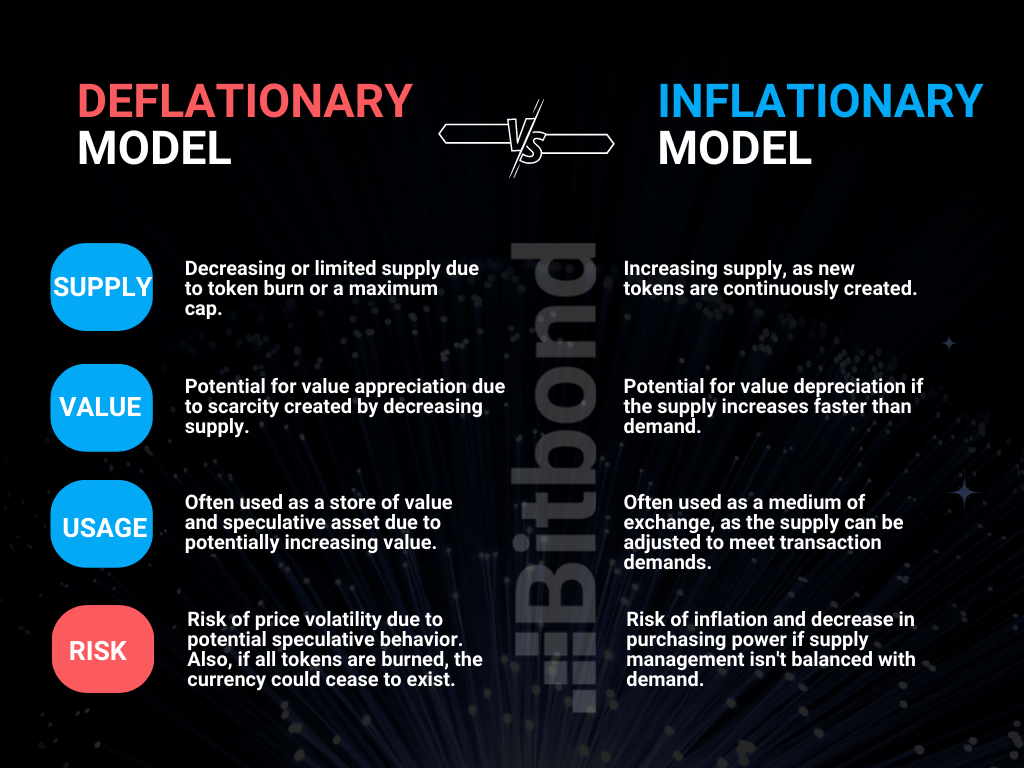
b) Mintable (Inflationary) Model
An inflationary token does not have a fixed maxSupply. New tokens can be created ("minted") over time by a designated authority (like the contract owner or a DAO).
- Mechanics: The contract includes a function to mint new tokens. Access to this function is typically restricted. This is often used to pay for network security (like in Ethereum) or to fund community initiatives. This is why we often refer to it as a mintable model from a technical perspective.
- Pros:
- Flexibility: Allows for ongoing funding for development, marketing, and user incentives (like staking rewards).
- Incentive Alignment: Can be used to reward network participants and encourage long-term engagement.
- Cons:
- Dilution Risk: If not managed carefully, the creation of new tokens can devalue existing ones.
- Governance Overhead: Requires a trusted entity or a robust governance process to manage the minting process responsibly.
c) Deflationary Model
A deflationary token is one where the totalSupply decreases over time.
- Mechanics: This is achieved by "burning" tokens—permanently removing them from circulation by sending them to an unspendable address (like
address(0)). Burns can be triggered by transaction fees (as with Ethereum's EIP-1559) or through periodic buy-back-and-burn events. - Pros:
- Increasing Scarcity: Can drive up the value of the remaining tokens by making them more scarce.
- Positive Market Signal: Can be perceived as a commitment to returning value to token holders.
- Cons:
- Can Discourage Usage: If a portion of every transaction is burned, it effectively acts as a tax, which might discourage the token's use as a medium of exchange.
- Potential for Centralization: Decisions about burn mechanics can be centralized.
The following images provide a great visual summary of these concepts.

4. Implementation in Solidity
Given your backend and programming experience, it's helpful to see how these economic models translate into code.
-
Fixed Supply: In the ERC-20 token you built in Module 4, you likely minted an initial supply in the
constructor. To make it a truly fixed supply model, you would simply ensure there are no other functions that can call the internal_mintfunction.constructor() ERC20("MyToken", "MTK") { _mint(msg.sender, 1_000_000_000 * 10**18); // Mint total supply to deployer } // No other minting functions are exposed. -
Mintable Supply: To implement this, you add a public or external function that calls
_mint. Crucially, you must protect this function using an access control modifier, likeonlyOwner, which you learned about in the security module. For our project, we will be building a mintable token to allow for future flexibility in funding rewards.function mint(address to, uint256 amount) public onlyOwner { _mint(to, amount); } -
Deflationary Supply: This requires exposing the
_burnfunction. You could, for example, create a function that allows users to burn their own tokens.function burn(uint256 amount) public { _burn(msg.sender, amount); }
Test your understanding!
You are designing a token for a play-to-earn game. The game needs a way to continuously reward new players for completing quests over the next several years. Which supply model would be most appropriate, and why? What is the main risk you would need to manage?
Show answer
A mintable (inflationary) supply model is the most appropriate choice.
Why? The game has a long-term need to generate new tokens to reward an ever-growing base of players. A fixed supply model would eventually run out of rewards, while a deflationary model works against the goal of distributing tokens. A mintable model provides the flexibility to create new tokens as needed to sustain the game's reward economy.
Main Risk: The primary risk is inflation and value dilution. If too many tokens are minted too quickly without a corresponding increase in demand (e.g., more players joining or more ways to use the token in-game), the token's value could collapse. This requires a carefully balanced "emission schedule" that manages the rate of new token creation.
Conclusion
You now have a clear framework for thinking about one of the most important decisions in your token's design.
Key Takeaways:
- Tokenomics is the economic policy of your token, with the supply model as its foundation.
- Fixed Supply offers predictability and scarcity but is inflexible.
- Mintable (Inflationary) Supply offers flexibility for ongoing incentives and funding but carries the risk of dilution.
- Deflationary Supply aims to increase value by reducing supply over time but can discourage use if implemented as a transaction tax.
- The choice of model is a strategic one that should align with your project's long-term goals. For our course project, a mintable token provides the necessary flexibility to create a token sale, a staking system, and other reward mechanisms.
Preview of the Next Lesson:
Now that we've decided on a supply model, we can begin designing the contract that will sell our token to early investors. In the next lesson, you will design the state variables and logic for a crowdsale contract. We'll map out the data we need to track (like who bought what) and the core functions the contract will need to operate.