Recommended resources
The freely available resources this lesson will direct you to.
- What exactly is AI - Narrow AI, General AI and Super AI explained.www.youtube.com
- AGI vs Generative AI: What's the Difference? (Complete 2025 Guide)www.youtube.com
- AI Vs AGI Vs ASI Vs ANI Vs OI Explained: Complete 2026 Guidetechcaffeine.com
- The AI Revolution: The Road to Superintelligence - Wait But Whywaitbutwhy.com
In our last lesson, we established that "artificial intelligence" is a broad and often loosely used term, which can lead to confusion and marketing hype. To cut through that ambiguity and build a clearer mental model of AI, we need a better way to categorize it.
This lesson provides that clarity by distinguishing between the different "calibers" of AI. We will explore the crucial difference between the AI that exists today, which is highly specialized, and the more powerful, human-like AI envisioned for the future. You'll learn the precise definitions of Artificial Narrow Intelligence (ANI), Artificial General Intelligence (AGI), and Artificial Superintelligence (ASI), and be able to identify them using real-world and hypothetical examples. This framework is essential for understanding discussions about AI's current capabilities and its future potential.
The Two Calibers of AI: Specialists vs. Generalists
A great way to frame this distinction is with an analogy. Imagine you have two tools in a kitchen: a high-end blender and a master chef.
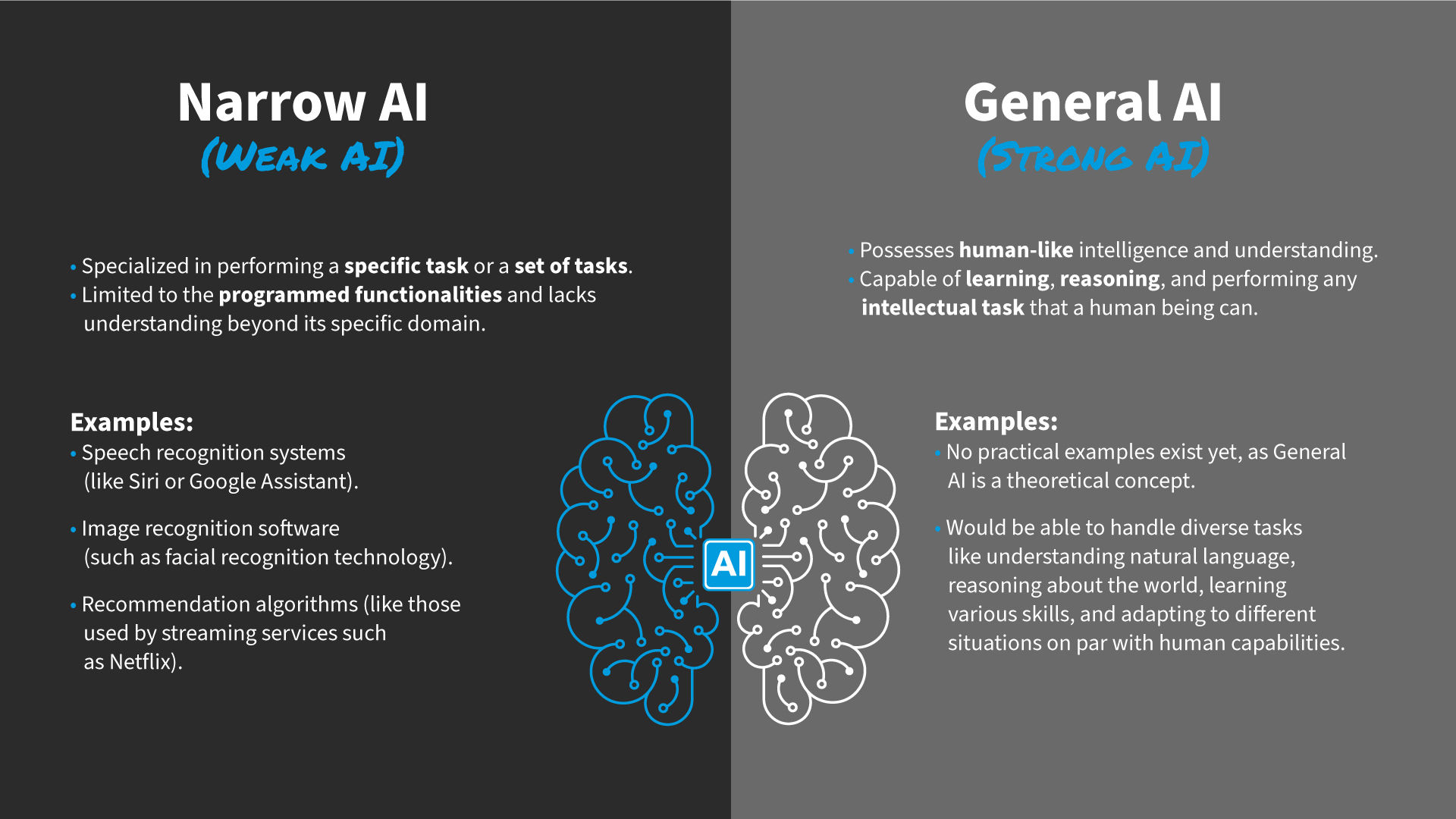
The blender is a specialist. It's incredibly good at a few specific tasks: making smoothies, puréeing soups, and creating sauces. In these domains, it far surpasses a human's ability to do the same task by hand. But if you ask it to bake bread or roast a chicken, it's useless. This is Narrow AI.
The master chef, on the other hand, is a generalist. They can perform almost any task in the kitchen. They can bake, fry, sauté, and invent new recipes. They can adapt to unfamiliar ingredients and learn new techniques just by watching someone else. This is the aspiration for General AI.
Let's look at these concepts in more detail.
Artificial Narrow Intelligence (ANI)
Artificial Narrow Intelligence (ANI), also known as Weak AI, refers to AI systems that are designed to perform a single specific task or a narrow set of related tasks. This is the only type of AI that has been successfully created so far. Every AI application you use or hear about today—from your smartphone assistant to the most complex scientific tools—is a form of ANI.
The term "narrow" refers to the scope of the AI's intelligence, not its power. An ANI can be vastly more capable than a human within its specific domain. A calculator is a simple ANI that's better at arithmetic than any person, and DeepMind's AlphaFold is a complex ANI that can predict the structure of proteins, a task that has stumped human scientists for decades. But AlphaFold can't give you a weather forecast, and your calculator can't recognize a picture of a cat.
You are surrounded by ANI systems every day. The following article from the blog Wait But Why offers an excellent, non-technical overview of the different calibers of AI and provides numerous examples of the narrow AI that powers our world.
The AI Revolution: The Road to Superintelligence - Wait But Why
This article by Tim Urban is famous for making complex AI topics accessible. It clearly defines the three calibers of AI and illustrates how deeply embedded ANI is in our daily lives.
Please read two parts of the article: First, read the section that starts with the heading "What Is AI?" and continue until you reach the next major heading, "Where We Are Currently." This will introduce you to the three categories: ANI, AGI, and ASI. Next, read the section "Artificial Narrow Intelligence..." for a comprehensive list of everyday examples. Focus on how many of these you already use without necessarily thinking of them as "AI."
As you can see, from spam filters and Google Search to music recommendations and navigation apps, our modern world runs on a vast, interconnected ecosystem of ANI.
Artificial General Intelligence (AGI)
Artificial General Intelligence (AGI), also known as Strong AI or Human-Level AI, is the hypothetical intelligence of a machine that has the capacity to understand or learn any intellectual task that a human being can. An AGI would be the "master chef" from our analogy—a single system with the same kind of flexible, adaptable, and general cognitive abilities that we possess.
Crucially, AGI does not exist yet. It is the primary goal for many leading AI research labs like OpenAI and Google DeepMind, but creating it remains one of the most significant challenges in science and engineering.
An AGI would need to demonstrate capabilities that are far beyond today's systems. This includes:
- Common-sense reasoning: Understanding the unwritten rules of the physical and social world.
- Transfer learning: Applying knowledge learned in one domain (like physics) to solve problems in another (like engineering).
- Causal understanding: Knowing why something happens, not just that it's correlated with something else.
- Learning from few examples: Acquiring a new skill from a handful of examples, not millions of data points.
The following video provides a concise explanation of the key differences between the generative AI tools we have today (like ChatGPT) and the theoretical concept of AGI.
AGI vs Generative AI: What's the Difference? (Complete 2025 Guide)
This video from the Security Privacy Risk channel uses the chef-and-blender analogy to clearly distinguish between generative AI (a type of ANI) and AGI.
Please watch from the beginning of the analogy at the analogy. Then, continue with the section that defines AGI, from this part. Pay close attention to the three fundamental capabilities that would distinguish AGI from the AI we have now.
A common point of confusion is whether highly capable systems like ChatGPT are a form of AGI. They are not. While they can perform a wide variety of language-based tasks, they are still fundamentally narrow. They operate by matching patterns in data, without any genuine understanding, physical grounding, or ability to reason beyond their training.
AI Vs AGI Vs ASI Vs ANI Vs OI Explained: Complete 2026 Guide
This article from TechCaffeine directly addresses and corrects common myths about AI types, which is essential for developing true AI literacy.
Please read the sections titled "Common Myths" and the FAQ section (questions 1-3). This will reinforce the distinction and directly tackle the misconception about ChatGPT being AGI.
Artificial Superintelligence (ASI)
If researchers succeed in creating AGI, it's unlikely to remain at human-level intelligence for long. The next theoretical stage is Artificial Superintelligence (ASI).
ASI is defined as an intellect that is much smarter than the best human brains in virtually every field, including scientific creativity, general wisdom, and social skills.
The primary theory for how ASI might emerge is through an "intelligence explosion." An AGI, with its ability to learn and reason, could be directed to work on the problem of improving AI. Because it would operate at computer speeds and could edit its own source code, it could rapidly improve itself. Each improvement would make it better at making further improvements, leading to a recursive cycle of accelerating intelligence that could quickly leave humanity far behind.
This concept of ASI is what fuels many of the most dramatic conversations about AI's future, including both utopian hopes and concerns about existential risk, which we will explore in detail later in the course.

Conclusion
In this lesson, we've replaced the vague, all-encompassing term "AI" with a much more precise three-tiered framework. This is a critical step toward AI literacy.
Here are the key takeaways:
- Artificial Narrow Intelligence (ANI) is AI that specializes in one task. It can be superhuman in its domain, and it is the only type of AI that exists today. All the AI tools you use are ANI.
- Artificial General Intelligence (AGI) is a theoretical AI with human-level intelligence across all intellectual domains. It would be a true generalist, able to learn and adapt like a person. It does not exist yet.
- Artificial Superintelligence (ASI) is a speculative form of AI that would be vastly more intelligent than humans. It's theorized to emerge from an AGI that rapidly improves itself.
Now, when you hear someone talk about "AI," you can mentally ask: are they referring to the narrow AI of today, or the general/superintelligence of the future? Making this distinction is the foundation for clear thinking about this technology.
In our next lesson, we will introduce another way of classifying AI systems: by the techniques used to build them. We will explore the relationship between the broad field of AI, the dominant technique of Machine Learning, and its most powerful subfield, Deep Learning.