Recommended resources
The freely available resources this lesson will direct you to.
Hello! Welcome back.
In our last lesson, we established that resistors are components where electrical energy is converted into heat, and we quantified this rate of energy conversion using the power formulas , , and . We saw that in a simple circuit, the power dissipated by the resistor was equal to the power supplied by the battery.
Today, we're going to formalize this idea of energy flow. Our goal is to explain power in a circuit element and distinguish between energy delivery and energy dissipation. You'll learn a universal convention for determining whether any component in a circuit is acting as a source (supplying energy) or a load (consuming energy). This is a fundamental concept for tracking how energy moves through a system.
1. Power as the Rate of Energy Transfer
Before we distinguish between delivery and dissipation, let's solidify our physical intuition for what the power formula, , truly represents. Power isn't just a number; it's the rate at which energy is being transferred or transformed.
A simple analogy can clarify the difference between energy and power.
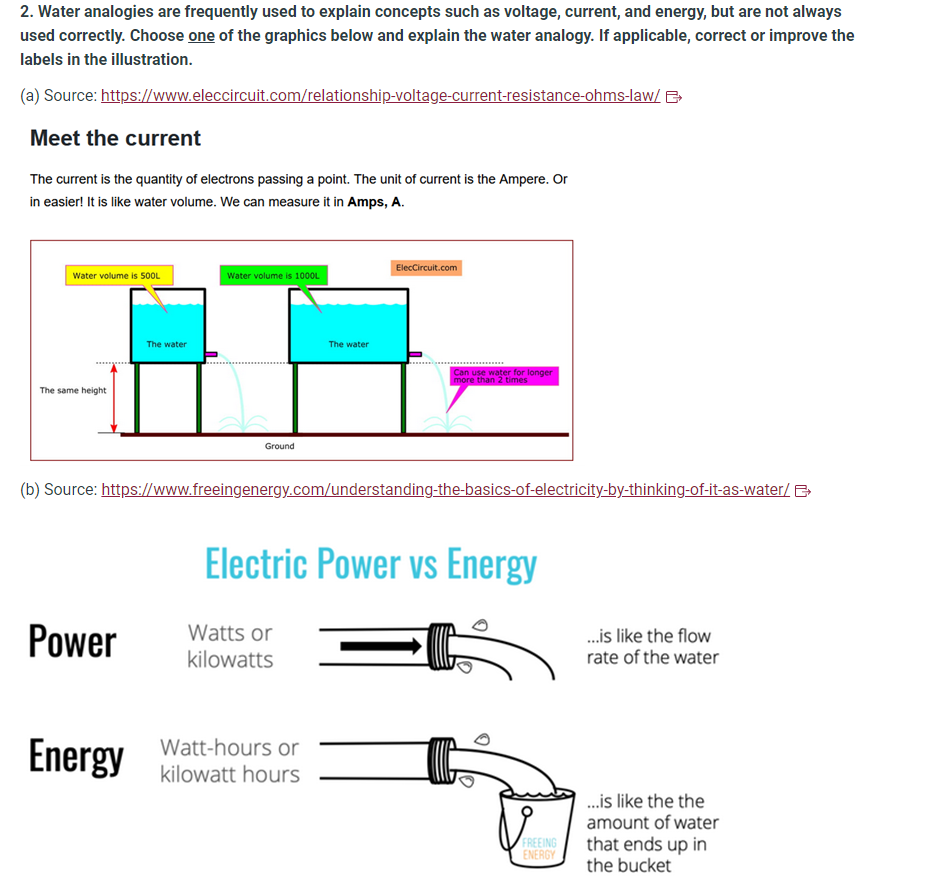
To understand why power equals voltage times current, it's helpful to look at their fundamental units, which connects directly to the physical definitions of voltage and current you've already learned.
P=VI Explained | Electrical Power | Why P=VI ? - Simplified
This video provides an excellent breakdown of the P=VI formula by analyzing the physical meaning of its constituent parts.
Watch from 01:43 to 04:29. Focus on how Voltage (work done per charge, or Joules/Coulomb) and Current (charge flow per second, or Coulombs/second) multiply to give Power (work done per second, or Joules/second), which is the definition of a Watt. This dimensional analysis is the key to understanding power as a rate of energy transfer.
As the video explains, the relationship is:
This confirms that power quantitatively measures how quickly energy is being moved or converted in a circuit element.
2. Sources vs. Loads: The Direction of Energy Flow
Every circuit has elements that supply energy and elements that consume it.
- Sources (like batteries, power supplies) do work on charges to increase their potential energy. They are the "pumps" of the circuit.
- Loads (like resistors, motors, LEDs) are where charges lose this potential energy, which is converted into another form (heat, mechanical work, light). They are the "destinations" where the work gets done.
Let's use the 'hill' analogy for voltage to visualize this. A power source pushes charges "uphill" to a higher potential. A load provides a path for the charges to travel "downhill," releasing that energy.
An intuitive approach for understanding electricity
This clip from the AlphaPhoenix video we've seen before explains the idea of using energy to create a potential difference—the 'hill'. This is precisely what a power source does.
Watch from 17:17 to 18:18. The video describes using one Joule of energy to push one Coulomb of charge to build a one-volt 'hill'. A power source continuously performs this work, creating the potential that drives the circuit. The loads are where the electrons then 'roll down' this hill.
Now, let's distinguish between different kinds of loads:
- Energy Dissipation: When electrical energy is converted into heat, as in a resistor. This energy is generally not recoverable in the circuit.
- Energy Absorption/Conversion: When electrical energy is converted into a non-thermal form, like mechanical motion in a motor or light in an LED.
The following reading provides a practical example that distinguishes between a power source and multiple components that consume power.
Basics: Power dissipation and electronic components
Let's analyze a slightly more complex circuit from the 'Evil Mad Scientist' blog. This example of a voltage regulator clearly separates the power source, a component that dissipates power, and the load that consumes it.
Read the section titled '— ON BEYOND RESISTORS —'. Notice how it calculates the power input from the 9V supply (energy delivery) and then shows how that power is split between the regulator (dissipation as heat) and the final load (consumption). This perfectly illustrates the distinction we're making.
This example introduces a crucial idea: in the power supply, voltage increases as current passes through it (from low potential to high potential). In the loads (regulator and final circuit), voltage drops as current passes through them. This observation is the key to our next section.
3. The Passive Sign Convention: A Formal Rule
To analyze circuits systematically, we need a formal rule to determine whether power is being delivered or absorbed. This rule is the Passive Sign Convention (PSC). It's a standard used everywhere in electrical engineering.

Here is the rule, which is based on the direction of current flow relative to the voltage polarity of an element:
-
Power Absorbed (P > 0): If positive current flows into the positive (+) voltage terminal of an element, that element is absorbing or dissipating power. The calculated power, , will be a positive value. This is the case for passive elements like resistors.
-
Power Delivered (P < 0): If positive current flows out of the positive (+) voltage terminal of an element, that element is delivering or generating power. The calculated power, , will be a negative value. The negative sign signifies delivery. This is the case for active elements like batteries.
Let's apply this to a simple circuit to see it in action.
Consider a 9V battery connected to a 100 resistor.
- First, find the current using Ohm's Law: .
- The current flows out of the battery's positive terminal, through the resistor, and back to the negative terminal.
Now, let's calculate the power for each element using the PSC:
-
Resistor: The current enters the side of the resistor connected to the battery's positive terminal. This is the resistor's positive voltage terminal. Since current enters the (+) terminal:
The result is positive, so the resistor is absorbing (or dissipating) 0.81 Watts.
-
Battery: The current leaves the battery's positive terminal. According to the PSC, this means the battery is delivering power.
The result is negative, so the battery is delivering 0.81 Watts.
4. Conservation of Energy and Power Balance
Notice the results from our calculation: and . This leads to a profound and useful principle in circuit analysis: the conservation of energy.
In any complete circuit, the total power delivered by the sources must equal the total power absorbed by the loads. Expressed using the passive sign convention, this means the sum of the power for all elements in the circuit must be zero.
In our example:
This principle of power balance is an excellent way to check your work when solving circuit problems. If the sum of all power values doesn't equal zero, there is likely a mistake in your calculations.
Conclusion
In this lesson, we established a formal framework for understanding energy flow in a circuit.
- Power () is the rate of energy transfer, measured in Watts (Joules per second).
- Energy Delivery is performed by sources (like batteries), which do work on charges to increase their potential energy.
- Energy Dissipation/Absorption occurs in loads (like resistors or motors), where this potential energy is converted into other forms like heat or mechanical work.
- The Passive Sign Convention provides the rule for telling them apart:
- Power is absorbed (+P) if current enters the positive terminal.
- Power is delivered (-P) if current leaves the positive terminal.
- The principle of Conservation of Energy requires that the total power in a circuit sums to zero ().
Next up: We will look at how to describe circuit elements not by their resistance or power, but by their fundamental current-voltage relationship, known as the I-V characteristic. This will provide a powerful graphical tool for understanding how resistors, voltage sources, and current sources behave.