Recommended resources
The freely available resources this lesson will direct you to.
- Sociology in 10 minutes | Ep1 Modernity & Social Change | Optional | StudyIQ IASwww.youtube.com
- Emergence of Sociology | Role of Enlightenment, French Revolution & Industrial Revolutionwww.youtube.com
- Unit-1egyankosh.ac.in
- A Historical Sketch of Sociological Theory: The Early Yearscmn-cdn-001.sagepub.com
Hello again. In the last lesson, Mills helped us connect a person’s experience to social structure and historical change. This time we turn the question around: what historical changes made people begin to study society in a distinctly sociological way?
For Sociology Optional, the important answer is not a list of revolutions. It is an explanation of how changes in ideas, political authority, production, and everyday life created both new questions about society and new ways of investigating them. Allow about 40–45 minutes, including the selected readings.
Modernity made society appear changeable
Here, modernity refers to a set of far-reaching transformations in European societies, rather than a date on which an older world suddenly ended. Expanding commerce, scientific inquiry, challenges to inherited authority, industrial production, and growing cities developed over different periods and at different speeds. Older institutions persisted even as new ones took shape.
That uneven change matters. If property, authority, work, and family life can be reorganised, how is a society held together? Who gains power when old privileges are challenged? Why does increased production coexist with poverty? Such questions concern relationships among institutions and groups, not just the decisions of particular rulers or workers.
The diagram below is a useful map of overlapping influences. Read its petals as contributing conditions, not as a sequence in which each event mechanically produced sociology.
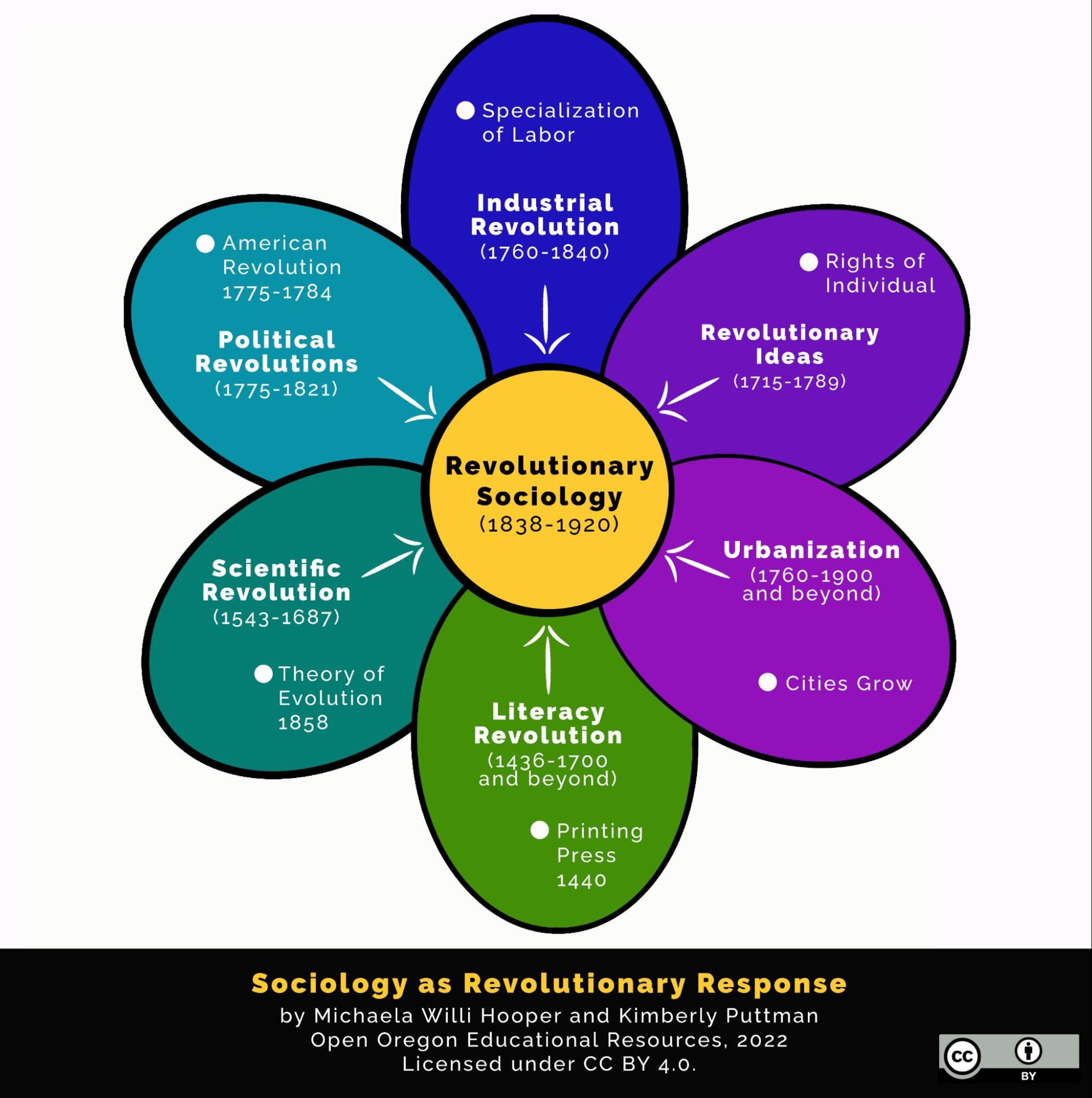
Read the following selected parts of IGNOU’s Emergence of Sociology in Europe. You do not need to memorise the history of inventions or voyages. Concentrate on the contrast between older arrangements and the new questions and methods that arose.
Read this IGNOU unit to see why sociology’s emergence is explained through a relationship between social conditions and ideas, rather than through a single founding event.
In Section 1.2, “Background to the Emergence of Sociology” (printed pp. 15–17), read from society and ideas. Then read Section 1.2.1, “The Enlightenment Period,” from the new outlook, and Section 1.2.2, “Structure and Change in European Society,” from old and new Europe. For the longer Section 1.3 (printed pp. 17–22), select two passages. In Section 1.3.1.2, “Rise of a New Class” (p. 19), read from merchant influence. In Section 1.3.3.1, “Experimental Method in Physics and Mathematics” (p. 21), read from scientific method. Notice that commerce altered who held economic influence, while science altered how claims could be examined.
Commerce did more than increase the quantity of goods traded. Merchants, bankers, and investors acquired influence that did not rest primarily on inherited landed status. Meanwhile, scientific advances strengthened the practice of questioning received explanations and checking claims against observation. Eighteenth-century Enlightenment thinkers extended critical scrutiny to social and political institutions: monarchy, religious authority, rights, and law could be discussed as human arrangements rather than accepted as unalterable facts.
This did not make the study of society identical to physics. It made a different proposition plausible: social arrangements could be investigated systematically, their claims challenged, and their consequences compared. Later sociologists would disagree sharply about how to do that. The change in intellectual outlook supplied a possibility, not a settled method.
Revolution changed authority; industry changed everyday life
Your GS preparation will already have covered the principal events of the French and Industrial Revolutions. For this lesson, focus instead on their sociological consequences.
The French Revolution of 1789 challenged an order in which rank and political privilege were closely tied to inherited estate and monarchy. Ideas of citizenship, rights, and equality raised a difficult question: if authority no longer rests on divine right and hereditary privilege, what makes a new social and political order legitimate and stable? Revolution also exposed conflict over property and power. It did not instantly create an equal or settled society; the distance between proclaimed rights and lived inequalities was itself something to explain.
Industrialization, beginning in Britain, reorganised production around factories, machinery, capital, and wage labour. People moved to growing towns and cities; workers and owners occupied different positions in the new economy. Work increasingly followed the discipline of the factory rather than the rhythms of domestic production. For many, new opportunities existed alongside insecure labour, crowded housing, and stark inequalities. The sociological question was not simply whether machines increased output, but how a new way of producing changed class relations, families, communities, and urban life.
The next IGNOU passages make these concerns explicit. Skip the detailed chronology and individual machines: those facts are less useful here than the passage from historical event to sociological problem.
Return to the IGNOU unit for its account of the two major upheavals and, especially, the themes they left early sociologists to investigate.
In Section 1.4, “The French Revolution” (printed p. 23), read its opening from the turning point. Then go to the final paragraph of Section 1.4.5, “Important Events” (p. 27), beginning sociological themes. In Section 1.5, “The Industrial Revolution” (pp. 28–30), read the opening from domestic production. In Section 1.5.2, “Impact of the Industrial Revolution on Society” (p. 28), read from social consequences. Finish with Section 1.5.3, “Significant Themes of the Industrial Revolution” (pp. 29–30), from four recurring themes. Follow how changes in production became questions about labour, property, cities, and technology.
Notice the distinction between a condition that prompts inquiry and the explanation eventually offered. Industrial poverty prompted investigation, but thinkers did not all explain it alike. Some emphasised ownership and conflict; others worried about how specialised work could coexist with social cohesion. Similarly, political upheaval prompted questions about order without requiring every thinker to favour a return to the old regime.
That distinction prevents a common oversimplification: “There was disorder, so sociology was founded to restore order.” The search for order was influential, but sociology also grew through criticism of inequality, investigation of conflict, and attempts to understand the possibilities opened by change.
A new intellectual response—with wider horizons and blind spots
Early sociology took shape where new social problems met competing intellectual responses. The Enlightenment encouraged reason and the testing of claims against experience. Yet the disruption associated with revolution also led some thinkers to stress the importance of inherited institutions, shared beliefs, and social cohesion. Sociology inherited questions from both currents: How can society change? and How can it endure?
Ritzer’s historical sketch is helpful here because it does not treat European industrialization as the whole story. Read the selected passages for both the intellectual tension and the limits of a narrowly European account.
A Historical Sketch of Sociological Theory: The Early Years
Read this SAGE historical sketch to see how Enlightenment reasoning and concern for social order both shaped early theory, and why colonialism and women’s contributions should not disappear from its history.
In the section “Social Forces in the Development of Sociological Theory,” read the box on Ibn Khaldun (printed p. 8) from an earlier precursor. Under “Colonialism” (p. 9), read from colonial connections. Under “Feminism” (p. 10), start at “All of this had an impact” and read women’s contributions to the end of that paragraph. In “The Enlightenment” (printed p. 12), read from reason and research. Then, in “The Conservative Reaction to the Enlightenment” (p. 13), locate the paragraph beginning “The conservatives turned away” and read the concern for order. Ask how a discipline could draw on critical inquiry while also studying the institutions that bind people together.
This reading supports two qualifications worth carrying into Sociology Optional. First, social thought did not begin in nineteenth-century Europe. Ibn Khaldun, for example, examined causes of social phenomena centuries earlier. What emerged in nineteenth-century Europe was sociology’s development as a distinct, named discipline amid particular transformations—not humanity’s first effort to understand society.
Second, those transformations were not confined within Europe. Colonial relationships connected European capital, raw materials, and power to other societies. At the same time, women contributed to social investigation and theory even when accounts of the discipline later pushed their work to the margins. Neither colonialism nor gender should be treated as an afterthought to a supposedly complete story of “Europe changing by itself.”
The emerging discipline consequently had no single political conclusion. Auguste Comte’s proposal for a science of society is often associated with the problem of order amid change; the term sociology came into use in his nineteenth-century work. Marx made capitalist property and class conflict central to his critique. Durkheim investigated the conditions of social cohesion in changing societies, while Weber examined features of modern social organisation and authority. These are signposts, not theories you need to master today. You will study their arguments in later modules.
The causal explanation to retain
Consider a worker leaving agricultural life for a textile town. A purely chronological account might say that the Industrial Revolution happened and cities grew. A sociological account asks more: what changed in the worker’s relationship to an employer, to property, to fellow workers, and to family or neighbourhood? It then asks whether such changes formed wider patterns. This is where the history in this lesson meets Mills’s concern with biography and social structure.
For a Paper I question on the emergence of sociology, keep three connected claims in view:
- Modern change supplied the subject matter: revolutions, capitalism, industrial labour, urban growth, and altered institutions made the organisation of society an urgent problem.
- Scientific inquiry and Enlightenment criticism supplied intellectual tools: inherited explanations could be questioned, while claims about society could be examined through reason and evidence.
- Disagreement supplied enduring sociological questions: thinkers debated order and conflict, continuity and change, and the promises and inequalities of modern life.
The relationship is reciprocal rather than mechanical. People’s ideas helped challenge institutions; changes in institutions then generated questions that existing ideas could not easily settle. Sociology developed through attempts to answer those questions systematically.
Takeaways
Sociology emerged as a distinct discipline in the context of interconnected, uneven social changes, not as the automatic result of one revolution. Political upheaval challenged inherited authority; industrialization transformed work and cities; scientific and Enlightenment thought encouraged critical investigation. Early thinkers responded in different ways—seeking to explain cohesion, conflict, inequality, and change—and the history of that response extends beyond a few canonical European men.
Next, we will sharpen the boundary of the subject itself: how sociology’s questions about society differ from, and overlap with, those asked by history, economics, political science, psychology, and anthropology.