Recommended resources
The freely available resources this lesson will direct you to.
Bonjour !
In our last lesson, we focused on tracing the plot and motivations of characters in films and short stories. This was a significant step in moving from understanding factual information to interpreting narrative fiction, bringing you closer to your goal of enjoying French books and movies.
Today, we will address the final, and perhaps most crucial, element for understanding authentic French: distinguishing between formal and informal registers. The way people speak and write changes dramatically depending on who they are talking to and the situation they are in. Being able to recognize these shifts is the key to moving beyond "textbook" French and understanding the language as it's truly used.
This lesson will help you identify the markers of formal, neutral, and informal language, from vocabulary and grammar to sentence structure, so you can better understand the nuances of any conversation, film, or novel you encounter.
1. The Three Registers of French
In French, we generally classify language into three main levels, or registres de langue. To get a quick overview, let's watch the beginning of this short, clear video.
This video from 'Skolab Fr' provides a concise introduction to the three main language registers: familier (informal), courant (everyday), and soutenu (formal).
Please watch from the beginning until 01:11. Focus on the names of the three registers and the general context in which each one is used (e.g., with friends, at school, in literature).
To summarize what you just saw, the three registers are:
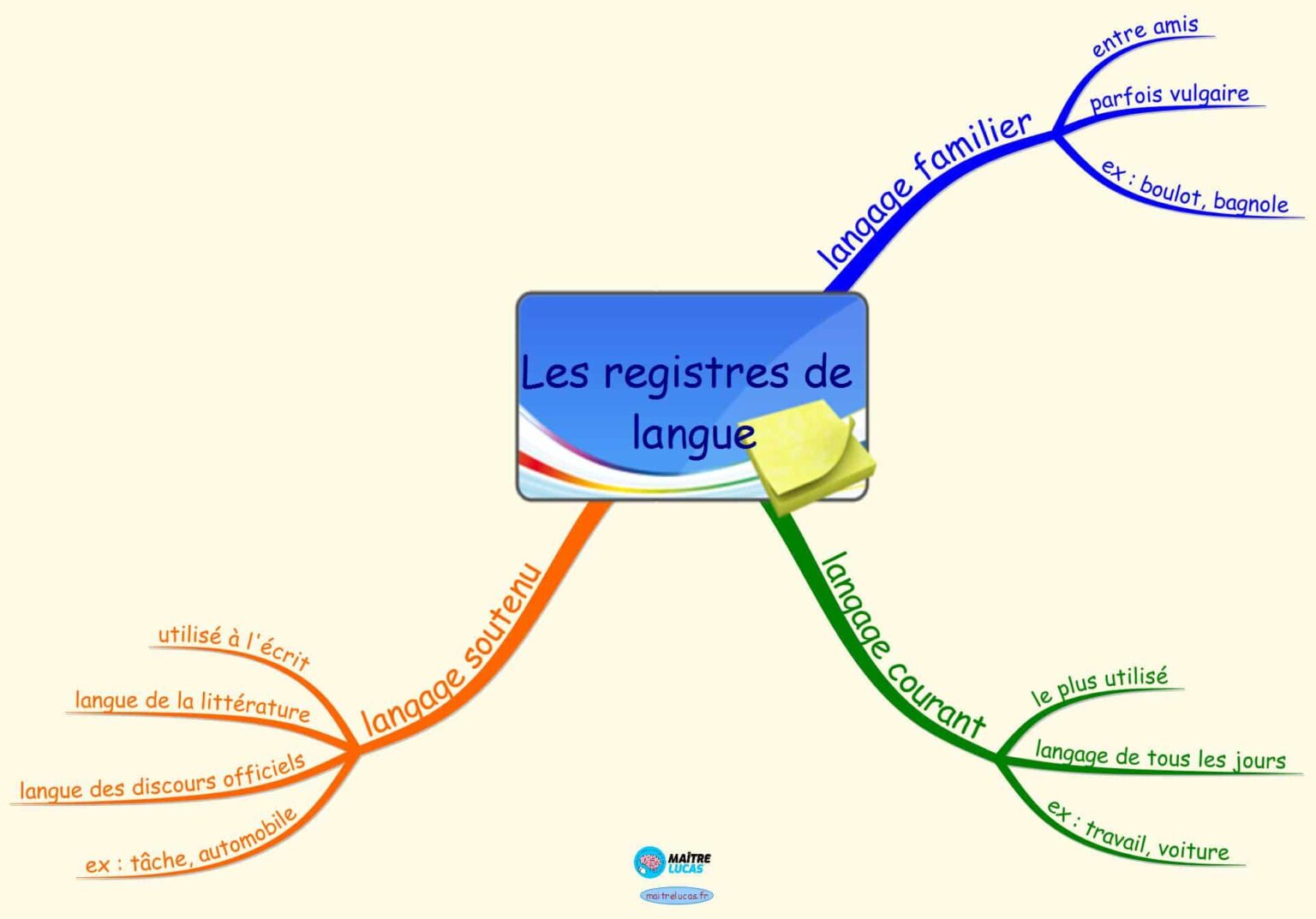
- Le langage soutenu (Formal/Sustained): Used in literature, official speeches, and very formal situations. It is characterized by precise vocabulary and complex grammatical structures.
- Le langage courant (Everyday/Neutral): This is the standard French used in most everyday situations, like at school, at work, or when speaking with people you don't know well. It is grammatically correct and widely understood.
- Le langage familier (Informal/Familiar): Used with close friends and family. It often includes slang (l'argot), grammatical shortcuts, and simplified vocabulary.
This mind map provides a helpful visual summary of these concepts.
2. How to Spot the Differences
Now that you know the categories, how do you distinguish them in practice? The differences go beyond just a few slang words. Let's break down the key markers.
We'll use an article that explains these differences very clearly. It frames the concept not as "good" vs. "bad" French, but as a matter of social distance.
Formal vs Informal French: Stop Speaking Like a Textbook
This article, 'Formal vs Informal French', breaks down the practical differences between registers. It's a great guide for understanding why textbook French can sound so different from what you hear in movies.
Please read the following four sections to understand the core markers of formality: 'What “Formal” and “Informal” Really Mean in French': This introduces the key idea of 'social distance'. 'Tu vs Vous: The First Formality Shock': This covers the most fundamental marker. 'Sentence Structure: Long vs Short': Notice how informal French prioritizes efficiency. 'Negation: Why “Ne” Disappears in Real Life': This addresses a very common feature of spoken, informal French.
As you read, you noticed three fundamental shifts:
- Pronouns: The choice between
tu(informal) andvous(formal) is the most immediate signal of register. - Sentence Structure: Formal French uses complete, grammatically rigorous sentences. Informal French often uses shortcuts, like dropping the
neinne...pas. - Question Forms: In previous lessons, you learned the three ways to ask a question. They map directly to registers:
- Inversion (Venez-vous ?) →
Soutenu(Formal) - Est-ce que (Est-ce que vous venez ?) →
Courant(Everyday) - Intonation (Vous venez ?) →
Familier(Informal)
- Inversion (Venez-vous ?) →
3. Vocabulary in Action
Vocabulary is another major indicator of register. For a single idea, there can be three or more different words, each corresponding to a different level of formality.
The best way to learn these is through examples, which is your preferred approach.
Expressions Françaises dans le Langage Familier, Courant et Soutenu
Let's watch a few segments from 'Français avec Pierre'. The hosts give excellent, contextualized examples of how vocabulary changes across registers. This is exactly what you'll encounter in real conversations and media.
Watch the examples for 'food' (04:31 - 05:57) and 'car' (05:57 - 07:17). Pay attention to how the entire sentence changes to match the register, not just the single word.
Here's a table summarizing the examples you saw, plus a few others:
| Langage Soutenu (Formal) | Langage Courant (Everyday) | Langage Familier (Informal) | English |
|---|---|---|---|
| une demeure | une maison | une baraque | a house |
| se restaurer | manger | bouffer | to eat |
| une automobile | une voiture | une bagnole, une caisse | a car |
| des souliers | des chaussures | des godasses, des grolles | shoes |
| travailler | travailler | bosser, taffer | to work |
| un ouvrage | un livre | un bouquin | a book |
| voler | voler | piquer, chouraver | to steal |
Recognizing this variation is vital. If you're watching a film where a character says "J'ai piqué une bagnole pour aller au boulot," you need to understand they mean "I stole a car to go to work," even though the words are completely different from what a textbook might teach.
4. Registers in Context: Sample Dialogues
Let's conclude by analyzing two short dialogues that clearly illustrate the difference between a formal and an informal situation.
French Conversation Practice: 10 Dialogue Scripts
This resource provides sample dialogues for different real-life situations. We will compare two of them to see the registers in action.
Please read the following two dialogues: '1. Getting to Know Someone': An informal chat between two students. '2. At the Grocery Store': A formal interaction between a customer and a cashier. \nAs you read, try to spot the specific words and structures that signal the register (e.g., use of 'tu' vs. 'vous', politeness formulas).
In the first dialogue, you see tu used immediately, questions are formed with simple intonation (D'où viens-tu ?), and the interaction is direct. This is classic langage familier/courant.
In the second dialogue, vous is used throughout. The cashier uses polite, complete sentences (Vous devez les peser...) and formal address (Madame). The customer responds with formal thanks (Merci pour votre patience). This is a perfect example of langage courant being used to maintain polite social distance.
Conclusion
Congratulations, you have completed the final lesson of this course! By learning to distinguish between formal and informal French, you have unlocked one of the most important skills for understanding the real, living language.
Key Takeaways:
- Register is about context and social distance. The language you use depends on the situation and your relationship with the person you're addressing.
- The three main registers are soutenu (formal), courant (everyday), and familier (informal).
- Key differences appear in pronouns (
tuvs.vous), grammar (negation, question formation), and vocabulary. - Mastering register control is not about memorizing rules, but about recognizing patterns through exposure.
Your Journey Ahead:
You have built a solid B1 foundation, moving from basic comprehension to the ability to analyze grammar, narrative, and now, stylistic nuance. You are incredibly well-prepared to tackle your goal of reading French novels and watching films.
As you dive into this authentic content, don't strive for 100% comprehension. Instead, listen and read for these registers. Notice when a character drops the ne, uses tu with someone unexpectedly, or uses slang like bagnole or bouquin. Each time you spot one of these, you are strengthening your intuitive understanding of the language.
Félicitations pour tout votre travail et votre persévérance. You have the tools you need. Now begins the exciting part: using them. Bonne continuation