Recommended resources
The freely available resources this lesson will direct you to.
- Using context clues to guess unknown words (2/2) — general sense and inferenceswww.youtube.com
- Lire le Français | French Listening Practice (B1-B2) | Intermediate Frenchwww.youtube.com
- DELF B1 Reading and Comprehension: Understanding ...frenchviaskype.com
- French Reading Practice: Free interactive textsfrench.kwiziq.com
Bonjour !
In our last lesson, we explored how logical connectors like donc, parce que, and bien que create a web of meaning in complex sentences. Mastering this was the final step in decoding French sentence structure. Now, we'll use that foundation to tackle one of the most essential skills for any independent reader: figuring out what unfamiliar words mean without immediately reaching for a dictionary.
This lesson is designed to help you become a linguistic detective. Your goal is to read authentic French texts, and you will always encounter words you don't know. The key isn't to memorize every word, but to develop the confidence to infer meaning from the surrounding text. By the end of this lesson, you will be able to apply several practical strategies to infer the meaning of unfamiliar words from context in a B1-level article.
The Mindset: From "Translating" to "Understanding"
Before we dive into techniques, it's important to adopt the right mindset. Your goal when reading is not to translate every single word, but to understand the overall message. This is a skill you've already been building through comprehensible input. Now, we'll make the process more conscious and strategic.
Let's start with a video that explains the benefits of this approach. The video is in French, so it will also serve as a good listening exercise.
Lire le Français | French Listening Practice (B1-B2) | Intermediate French
The video 'Lire le Français' from the French Breakdown channel perfectly explains why reading for context is so powerful. It encourages a shift away from word-for-word translation.
Please watch from 12:39 to 14:14. The speaker discusses the mistake of wanting to understand everything and the importance of focusing on the main idea. Then, watch from 46:12 to 47:20, where this error is revisited and reinforced. Notice the key phrases 'ce n'est pas nécessaire de tout comprendre' (it's not necessary to understand everything) and 'ce qui compte, c'est l'idée principale' (what matters is the main idea).
This idea of accepting ambiguity and focusing on the general sense is fundamental. It frees you from the pressure of knowing everything and allows you to enjoy the flow of reading.
A Toolkit for Inferring Meaning
So, how do you actually guess the meaning of a word? The process isn't random; it relies on specific clues the author provides, often unintentionally.
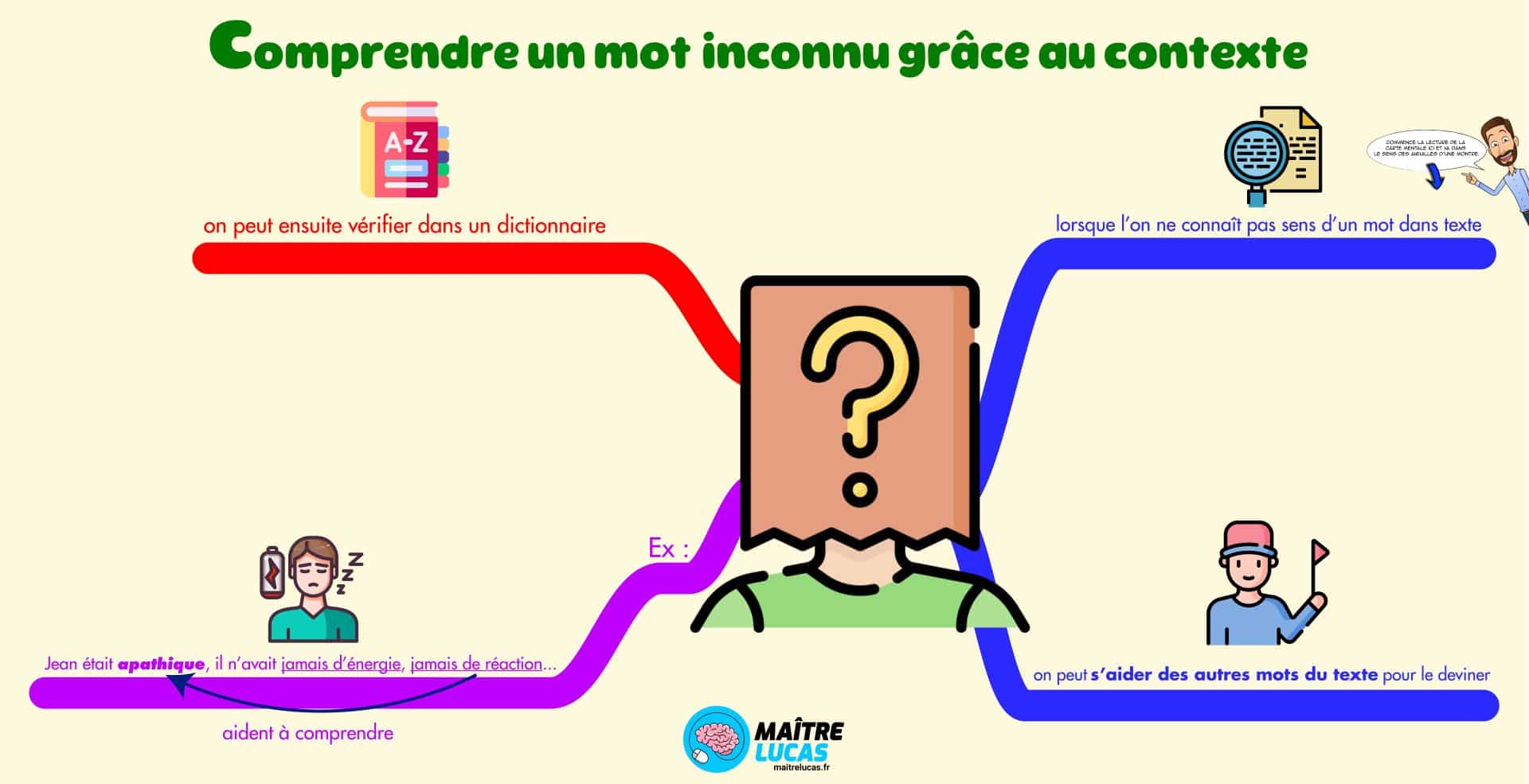
The image below, from a French teaching resource, beautifully illustrates the core two-step process:
- Use the surrounding words to guess the meaning.
- (Later) Verify your guess with a dictionary.
To build our toolkit, let's watch a short, clear video that breaks down the most common types of context clues. The video is in English, which will allow us to focus on the concepts themselves before applying them to French.
Using context clues to guess unknown words (2/2) — general sense and inferences
The Snap Language video 'Using context clues to guess unknown words' provides an excellent, structured overview of the techniques you can use. It's like learning the universal principles of being a text detective.
Watch from 00:39 to 05:18. Pay attention to the three main strategies discussed: The author provides a direct definition or explanation. You can infer the meaning from the 'general sense' of the sentence or paragraph. You can use your 'prior knowledge' of the topic.
These strategies—looking for definitions, using the general sense, and applying prior knowledge—are your primary tools. You'll find that authors often leave a trail of breadcrumbs for you to follow.
From Theory to Practice in French
Let's put these ideas into practice with a real B1-level text. This is an excerpt from a French textbook article about a phenomenon called "le syndrome de Paris."

Read the first paragraph of the article on the right:
Le 'syndrome de Paris', mystérieux mal des Japonais
Le syndrome de Paris est un trouble psychologique qui touche certains touristes japonais en visite dans la capitale française. Il est provoqué par le choc culturel et l'écart entre l'image idéalisée de la capitale française et la réalité parfois brutale de la vie parisienne (stress, pollution, etc.). Ce syndrome peut entraîner des angoisses, des hallucinations ou une sensation de persécution.
Let's be detectives.
-
Word:
mal- Context: "Le 'syndrome de Paris', mystérieux
maldes Japonais". The main title calls it a "syndrome". The text below calls it a "trouble psychologique" (psychological disorder). - Inference:
Malmust mean something negative related to health, like an illness, ailment, or sickness. (Correct!Un malis an ailment or ache).
- Context: "Le 'syndrome de Paris', mystérieux
-
Word:
écart- Context: "Il est provoqué par ... l'
écartentre l'image idéalisée ... et la réalité parfois brutale". The previous lesson's connectors help here! The wordentre ... et ...(between ... and ...) sets up a comparison. We are comparing an "idealized image" with a "brutal reality". - Inference:
L'écartmust be the gap, discrepancy, or difference between these two opposing things. (Correct!Un écartis a gap or discrepancy).
- Context: "Il est provoqué par ... l'
-
Your Turn - Word:
entraîner- Context: "Ce syndrome peut
entraînerdes angoisses, des hallucinations ou une sensation de persécution." - Think: What is the relationship between "this syndrome" and the list of negative symptoms that follows ("anxieties, hallucinations...")? What kind of word would fit here? Does the syndrome help these symptoms? Stop them? Create them?
Analysis: The most logical relationship is one of cause and effect. The syndrome causes or leads to these symptoms. Therefore,
entraînerlikely means to cause, to lead to, or to result in. (Correct!Entraînerin this context means to bring about or lead to).
- Context: "Ce syndrome peut
When Should You Use a Dictionary?
As we've seen, you can understand a lot without a dictionary. But sometimes, a word is essential, and the context isn't enough.
DELF B1 Reading and Comprehension: Understanding French Texts
The guide 'DELF B1 Reading and Comprehension' offers practical advice on this exact problem. It's written for students preparing for the B1 exam, so the advice is very relevant.
Read section 5, 'Common Difficulties — And How to Overcome Them'. Focus on the point: 'I panic when I see a new word.' The advice is to ignore it unless it's needed for the answer. This reinforces the idea that not every word is critical.
The key is to ask yourself: "Can I understand the main point of this sentence or paragraph without knowing this specific word?"
- If yes, keep reading! Make a mental note and look it up later if you're curious.
- If no, the text is incomprehensible without it, then it's time to quickly look it up.
Conclusion
You now have a powerful set of strategies to approach reading with confidence. This skill will accelerate your journey toward reading authentic French novels and articles.
Key Takeaways:
- Mindset is key: Read for the main idea, not to translate every word. Accept a small amount of ambiguity.
- Be a detective: Use context clues like definitions, examples, the general sense of the passage, and your own prior knowledge to infer meaning.
- Leverage grammar: Logical connectors (
parce que,donc,entre...et...) are powerful clues about the relationships between ideas. - Be strategic: Only stop to look up a word if it is absolutely essential for understanding the main point.
Further Practice:
For more practice, the website Kwiziq offers a fantastic collection of B1-level interactive texts. I encourage you to try one.
French Reading Practice: Free interactive texts
This page provides a long list of B1 reading exercises on various topics.
Choose one article that interests you from the 'B1: Intermediate French reading exercises' list. Read it through once, trying to guess the meaning of any unfamiliar words. Then, on a second read, you can click on the words to see if your inferences were correct.
Preview of the Next Lesson:
In our next lesson, we will build on this skill by moving from understanding words to understanding entire arguments. You will learn to follow the main ideas and supporting details in a B1-level French news report or podcast segment, applying your inference skills to the faster pace of spoken French.