Recommended resources
The freely available resources this lesson will direct you to.
- How THE FRAMING EFFECT influences YOUR DECISION MAKING - (Psychology mental model)www.youtube.com
- CRITICAL THINKING - Cognitive Biases: Reference Dependence and Loss Aversion [HD]www.youtube.com
- The Framing Effect in UX design - UX Knowledge Base Sketchuxknowledgebase.com
- The Science of Framing: Losses vs. Gainswww.intermarkgroup.com
Hello! Welcome to the first lesson in our module on "Framing, Priming, and Presentation."
In the previous module, we explored several cognitive biases, including loss aversion—the idea that the pain of losing something is psychologically more powerful than the pleasure of gaining an equivalent thing.
Today, we'll build directly on that concept to explore the framing effect. You'll learn how the way information is presented—specifically as a potential gain versus a potential loss—can dramatically alter perception and choice. For a product designer like yourself, understanding framing is a powerful tool for shaping user experience and guiding user decisions effectively and ethically.
1. What is Framing?
At its core, the framing effect demonstrates that our decisions are influenced by the way information is presented. The same core facts, framed differently, can lead to entirely different conclusions.
Think of it like a frame around a painting. The frame doesn't change the painting itself, but it directs your attention, highlights certain elements, and influences how you interpret the artwork. In decision-making, information can be framed to highlight positive outcomes (gains) or negative ones (losses).
Let's start with a short video that introduces the concept and gives a classic example.
How THE FRAMING EFFECT influences YOUR DECISION MAKING - (Psychology mental model)
This video from AI Alfie provides a great introduction to the framing effect. Pay close attention to the yogurt example, which is a perfect illustration of gain vs. loss framing.
Please watch from the beginning to 0:57, and then from 2:15 to 2:47. The first part defines framing, and the second part discusses 'frame inversion' with the yogurt example.
As the video explains, describing yogurt as "80% fat-free" (a gain frame) is much more appealing to most consumers than calling it "20% fat" (a loss frame), even though both statements describe the exact same product. This simple shift in perspective is the framing effect in action.
2. The Classic Experiment: Saving Lives vs. Losing Lives
The most famous demonstration of gain vs. loss framing comes from a 1981 study by psychologists Daniel Kahneman and Amos Tversky. They presented participants with a hypothetical crisis: an "unusual Asian disease" expected to kill 600 people.
The participants were split into two groups, each presented with the same problem but framed differently.
Group 1 (Gain Frame):
- Program A: "200 people will be saved."
- Program B: "There is a 1/3 probability that 600 people will be saved, and a 2/3 probability that no people will be saved."
Group 2 (Loss Frame):
- Program C: "400 people will die."
- Program D: "There is a 1/3 probability that nobody will die, and a 2/3 probability that 600 people will die."
Notice that Program A and C are identical outcomes (200 live, 400 die), as are Program B and D. Yet the results were starkly different.
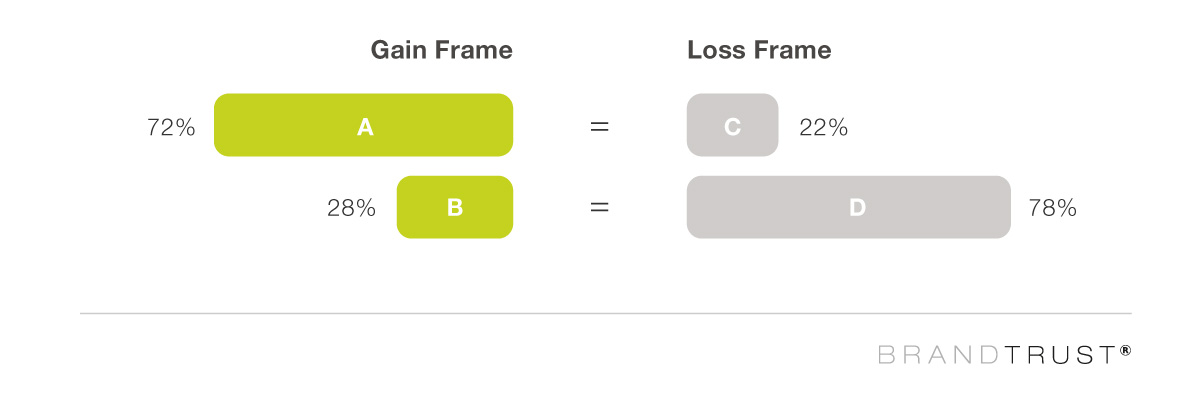
To understand this experiment in more detail, watch this excellent explanation.
CRITICAL THINKING - Cognitive Biases: Reference Dependence and Loss Aversion [HD]
This video from Wireless Philosophy walks through the 'Asian disease problem' step-by-step, showing how the different frames lead to different choices. It clearly explains the paradox.
Please watch from 0:17 to 3:02. The video lays out the two scenarios and then reveals that the options are, in fact, identical.
The key takeaway from the experiment is:
- When choices are framed in terms of gains (lives saved), people become risk-averse. They prefer the certain outcome (saving 200 lives for sure) over the gamble.
- When choices are framed in terms of losses (lives lost), people become risk-seeking. They prefer to take a gamble (a chance that no one dies) to avoid the certain loss.
3. The Psychology Behind Framing: Prospect Theory
So, why does this happen? The answer lies in Prospect Theory, also developed by Kahneman and Tversky. It describes how people make decisions under uncertainty. Two of its core concepts are:
- Reference Dependence: We evaluate outcomes relative to a reference point (often the status quo), not in absolute terms.
- Loss Aversion: As we've discussed, losses loom larger than equivalent gains. The pain from losing $100 feels more intense than the pleasure from gaining $100.
This graph of Prospect Theory's value function makes this clear.
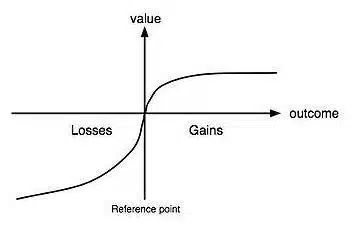
In the "gain frame" of the disease problem, the reference point is zero people saved. Saving 200 people for sure feels like a significant, guaranteed win. In the "loss frame," the reference point is zero people dying. A sure loss of 400 lives is so painful that people are willing to risk a much larger loss (600 deaths) for a chance to avoid any loss at all.
4. Framing in the Wild: A Product and Marketing Case Study
This principle isn't just theoretical; it has huge implications for product design, marketing, and communication strategy. A recent controversy involving the fast-food chain Wendy's provides a perfect case study.
Please read the following article, which analyzes how Wendy's fumbled their announcement of a new pricing strategy and then successfully corrected it by reframing the message.
The Science of Framing: Losses vs. Gains | Intermark Group
This article from the Intermark Group, titled 'The Science of Framing: Losses vs. Gains,' breaks down the Wendy's 'dynamic pricing' incident. It's a fantastic real-world example of loss vs. gain framing in action.
Please read the full article. Pay close attention to how the initial announcement was framed as a loss ('surge pricing') and how they later reframed it as a gain ('discounts' or 'Happy Hour').
As the article highlights, the initial framing of "dynamic pricing" was widely interpreted as "surge pricing"—meaning customers would have to pay more during busy times. This is a classic loss frame, and it triggered a strong negative reaction because it emphasized a potential financial loss and perceived unfairness.
Wendy's course correction was a masterclass in reframing. By clarifying that they intended to offer discounts during slower periods, they shifted the narrative to a gain frame. Instead of losing money, customers now stood to gain value. Same underlying strategy, completely different perception.
Application in UX Design
Your work as a product designer is full of opportunities to apply framing. Consider these examples:
- Pricing Plans: Instead of saying "The Free plan is missing X, Y, and Z" (loss frame), you can say "The Pro plan includes A, B, and C" (gain frame).
- Onboarding: Rather than "Complete these 5 steps to finish setup" (which frames it as a chore), you could try "You're 3 steps away from unlocking your new dashboard!" (which frames it as progress toward a reward).
- CTAs: A button that says "Avoid late fees" (loss frame) might be effective, but one that says "Pay on time and protect your credit score" (gain frame) could be just as powerful by highlighting a positive outcome.
Your Turn: A Quick Reflection
Think of a product or feature you've worked on. How is its value proposition currently framed for users?
- Does it focus on what users gain by using it?
- Or does it focus on what they avoid losing?
- Could you rephrase a key message or CTA to shift from a loss frame to a gain frame, or vice-versa, and what effect might that have on user behavior?
Conclusion
In this lesson, we've unpacked the powerful influence of the framing effect.
Key Takeaways:
- Framing is about presentation: The same information can lead to different choices depending on whether it's framed in terms of gains or losses.
- Gain frames encourage risk aversion: When focused on what they can gain, people tend to prefer a sure thing over a gamble.
- Loss frames encourage risk-seeking: To avoid a certain loss, people are more willing to take risks.
- Loss Aversion is the driver: This behavior is rooted in the psychological principle that losses feel more significant than equivalent gains.
Understanding framing is essential for anyone designing experiences. By consciously choosing how to frame information, you can guide users more effectively, increase comprehension, and build products that feel more intuitive and helpful.
Next Up
Framing is just one tool in the choice architect's toolkit. In our next lesson, we'll explore another incredibly powerful and subtle influencer of behavior: default options. You'll learn how pre-selecting an option acts as a powerful nudge that guides user decisions, for better or for worse.