Recommended resources
The freely available resources this lesson will direct you to.
Introduction
Welcome to a new module in our journey. In the previous module, we delved deep into the science of mantra, culminating in an integrated practice of japa that engaged your mind, body, and intention. We learned how the phonemes of the Namokar Mantra function as vibrational seeds. Now, we shift our focus to a parallel and equally profound system for influencing consciousness: Indian classical music.
This lesson marks our entry into this new domain. If mantras are built from phonemes, music is built from musical notes. Our goal today is to learn the fundamental alphabet of Indian music: the seven swaras or notes. By the end of this lesson, you will be able to identify the seven swaras—Sa, Re, Ga, Ma, Pa, Dha, and Ni—and, most importantly, begin the process of training your ear to distinguish them by sound. This is the first and most crucial step towards understanding how rāgas can evoke specific bhāvas or emotions.
The Alphabet of Music: What is a Swara?
The term swara (Sanskrit: स्वर) is a cornerstone of Indian music. While it can be loosely translated as a "musical note," its meaning is richer. It simultaneously connotes a breath, a vowel, and a specific pitch. Just as a programming language is built from a small set of primitive data types and keywords, the entire edifice of Indian classical music is built from a fundamental set of swaras.
Let's begin by acquainting ourselves with the basic terminology.
This Wikipedia article provides a concise overview of the concept of swara.
Please read the introductory section to understand the basic definition of swara and its comparison to Western solfège. Then, move to the section "Seven svaras and solfège (sargam)" and read about the seven notes, their full Sanskrit names, and their common abbreviations.
As you've just read, the seven swaras form what is called a saptak (literally, "containing seven"), which is the Indian equivalent of an octave. The seven swaras are:
| Full Name | Short Name | Pronunciation |
|---|---|---|
| Shadja | Sa | सा |
| Rishabha | Re | रे |
| Gandhara | Ga | ग |
| Madhyama | Ma | म |
| Panchama | Pa | प |
| Dhaivata | Dha | ध |
| Nishada | Ni | नि |
The Symbolic Nature of Swaras
In Indian thought, these musical notes are not merely abstract frequencies. They are imbued with rich layers of symbolism and are seen as manifestations of cosmic principles. Each swara is traditionally associated with the call of a specific bird or animal, a concept that beautifully illustrates the idea that music originates from nature.
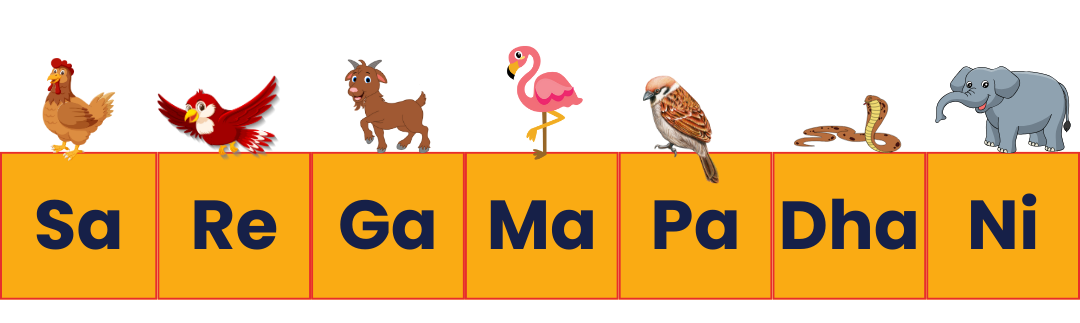
This deep connection between sound, nature, and the cosmos extends further. As you continue your reading, you will see how these notes are also linked to planets, colors, and even the body's energy centers (chakras), echoing the principles of resonance we have discussed in the context of mantras.
This section of the Wikipedia article details the rich symbolic associations of the seven swaras.
Please read the section titled "Cultural, spiritual, and religious symbolism". Pay attention to the tables listing the associations with animals, planets, colors, and chakras.
These associations are not just poetic fancy; they are part of a holistic worldview where the microcosm (the human being) and the macrocosm (the universe) are seen as being interconnected through vibration. The color associations, for instance, are reminiscent of the leśyā dhyāna you practiced in the previous lesson.
Ear Training: Learning to Hear the Swaras
Understanding the swaras intellectually is one thing; learning to distinguish them aurally is the real task. This is a skill that is developed over time through patient listening and practice. Our primary goal today is to begin this process of ear training (swara jñāna).
The Foundation: Shadja (Sa)
The first, and most important, step in ear training is to understand the role of Shadja (Sa). Sa is the foundational note, the tonic. It is the immovable reference point from which all other notes in a performance derive their identity. It is the root of the musical tree.
This next video explains the critical importance of Sa as the constant reference.
Ear Training for Beginners | VoxGuru ft. Pratibha Sarathy
This video, "Ear Training for Beginners" by VoxGuru, effectively demonstrates why internalizing the sound of 'Sa' is the first step in learning to identify other notes.
Watch the segment from "the first and most important aspect". The presenter, Pratibha Sarathy, explains that Sa is the note that "gives birth to all the other notes" and emphasizes the need for a constant reference, like a tanpura drone.
Listening to the Seven Swaras
Now that you understand the importance of Sa as our anchor, let's listen to all seven shuddha (natural) swaras in sequence. The following video provides a clear vocal demonstration.
12 Swara Sthanams in Music | VoxGuru ft. Pratibha Sarathy
In this video, "12 Swara Sthanams in Music", the presenter introduces and sings the notes of the Indian musical scale.
First, listen to the introduction of the seven swaras. Then, focus on the section where she sings the seven shuddha swaras (Sa, Re, Ga, Ma, Pa, Dha, Ni) one by one against a drone. Listen multiple times. Try to hum along. Your goal is not to perfect your singing, but to start building a mental map of the ascending pitches relative to Sa.
An Interactive Exercise
Let's put your listening to the test with a simple exercise. In this final video segment, the presenter will sing different notes against the Sa drone, and your task is to try and feel their relationship to Sa.
Ear Training for Beginners | VoxGuru ft. Pratibha Sarathy
Returning to the "Ear Training for Beginners" video, this section provides a practical listening exercise.
Watch the segment from "A dream of a mother". The presenter sings different swaras (like Pa, Ma, Ga) and returns to Sa. Don't worry about getting the names right just yet. Instead, focus on the feeling of each note. Does it feel close to Sa? Far away? Does it feel very stable, or does it feel like it wants to move back to Sa? This is the beginning of recognizing the unique character of each swara.
A Glimpse into the Full Palette: Komal and Teevra Swaras
So far, we have focused on the seven shuddha or "natural" notes. However, the full musical palette consists of twelve notes. This is because five of the seven swaras (Re, Ga, Ma, Dha, and Ni) can be altered.
- When a
swarais lowered by a small interval, it is calledkomal(soft/flat). - When
Madhyama(Ma) is raised by a small interval, it is calledteevra(sharp).
Shadja (Sa) and Panchama (Pa) are immovable and have no such variations. They are called achal swaras (unmovable notes).
The Hindi resource below provides a very clear, tabular overview of all twelve swaras.
संगीत-परिचय भाग १/२: सप्तक ज्ञान - विकिस्रोत
This text from a Hindi music primer clearly lays out the concept of the twelve notes within a saptak.
Read the initial question-and-answer section to reinforce your understanding. Then, carefully study the table of twelve swaras. Notice which notes have shuddha (pure) and komal (flat) versions, which one has a teevra (sharp) version, and which are achal (immovable).
This brings the total number of swara sthānas (note positions) to 12. It is the specific selection and combination of these twelve tones that forms the basis of the rāga system and gives each rāga its unique emotional landscape—a topic we will explore in great depth.
Conclusion
In this lesson, we have taken our first step into the vast world of Indian classical music. You have been introduced to the foundational alphabet of this system, the seven swaras, and have begun the crucial practice of training your ear to recognize them.
Key Takeaways:
- The seven basic notes of Indian music are Sa, Re, Ga, Ma, Pa, Dha, and Ni.
Sa(Shadja) is the immovable foundational note, or tonic, that acts as a constant reference point.Swarasare not just pitches; they are rich with symbolic meaning, connecting music to nature, cosmology, and the human body.- In addition to the seven
shuddha(natural) notes, there are altered versions: fourkomal(flat) notes and oneteevra(sharp) note, making a total of twelveswarasin an octave. - Ear training (
swara jñāna) is a gradual process of listening intently and learning to recognize the relationship of each note to the tonic,Sa.
In our next lesson, we will continue to build on this foundation. We will explore the psychoacoustic role of Sa in more detail, formally define the shuddha, komal, and teevra swaras we briefly introduced today, and practice identifying them within the context of a scale.