Recommended resources
The freely available resources this lesson will direct you to.
Introduction
Welcome to our final lesson in this module on the foundational language of Indian music. So far, we have built a solid theoretical understanding of the core elements: the seven swaras, the three saptaks or pitch registers, the thaat system for classifying scales, and most recently, the concept of laya or tempo. You now possess the architectural blueprints of Indian music.
Today, we shift from theory to practice, from blueprint to construction. This lesson is dedicated to the experiential skill that underpins all of Indian music: training your ear and voice to recognize and reproduce the notes. The learning outcome is for you to practice using a tanpura drone to identify and vocalize the twelve swaras of the chromatic scale. This is your first major step into sur-sadhana (the disciplined practice of pitch), a crucial skill on your path to understanding how specific notes can be crafted to evoke bhakti bhav.
The Tanpura: Your Sonic True North
Before we begin the practice, we must first understand our most important tool: the tanpura. The tanpura is not a melodic instrument; it does not play a tune. Instead, it provides a constant, unwavering sonic backdrop—a drone.

Think of the tanpura as providing a stable execution environment. In software development, your code runs within the context of an operating system and hardware that provide a consistent foundation. The tanpura serves a similar function for the musician. It provides the fundamental pitch, Sa (the tonic), creating a "true north" or a ground truth against which every other note is measured. Its job is to constantly remind your ear—and your consciousness—of the home base.
The VoxGuru video below provides a wonderful introduction to the tanpura and its primary role.
Basics of Tanpura | Tuning your voice | VoxGuru ft. Pratibha Sarathy
This video by Pratibha Sarathy for VoxGuru clearly explains the fundamental importance of the tanpura in Indian music.
Watch the first three minutes of the video. Pay attention to the explanation of the tanpura as the "backbone" of Indian music and the description of how its four strings are typically tuned to Pa and Sa. The key insight here is that the tanpura makes the two most stable notes, Sa and Pa, constantly audible.
As the video explains, the four strings are typically plucked in a cycle, sounding out the notes Pa - Sa' - Sa' - Sa (where Pa is the lower-octave 5th, and Sa' is the middle-octave tonic). This continuous, rich sound, full of overtones, creates what one musician calls a "colour framework." It is within this framework that we will learn to find the other notes.
The Twelve Tones: Your Palette
As a quick refresher, our goal is to identify all twelve notes of the chromatic scale. These consist of the two immovable (achal) swaras, five natural (shuddha) swaras, and five altered (vikrit) swaras.
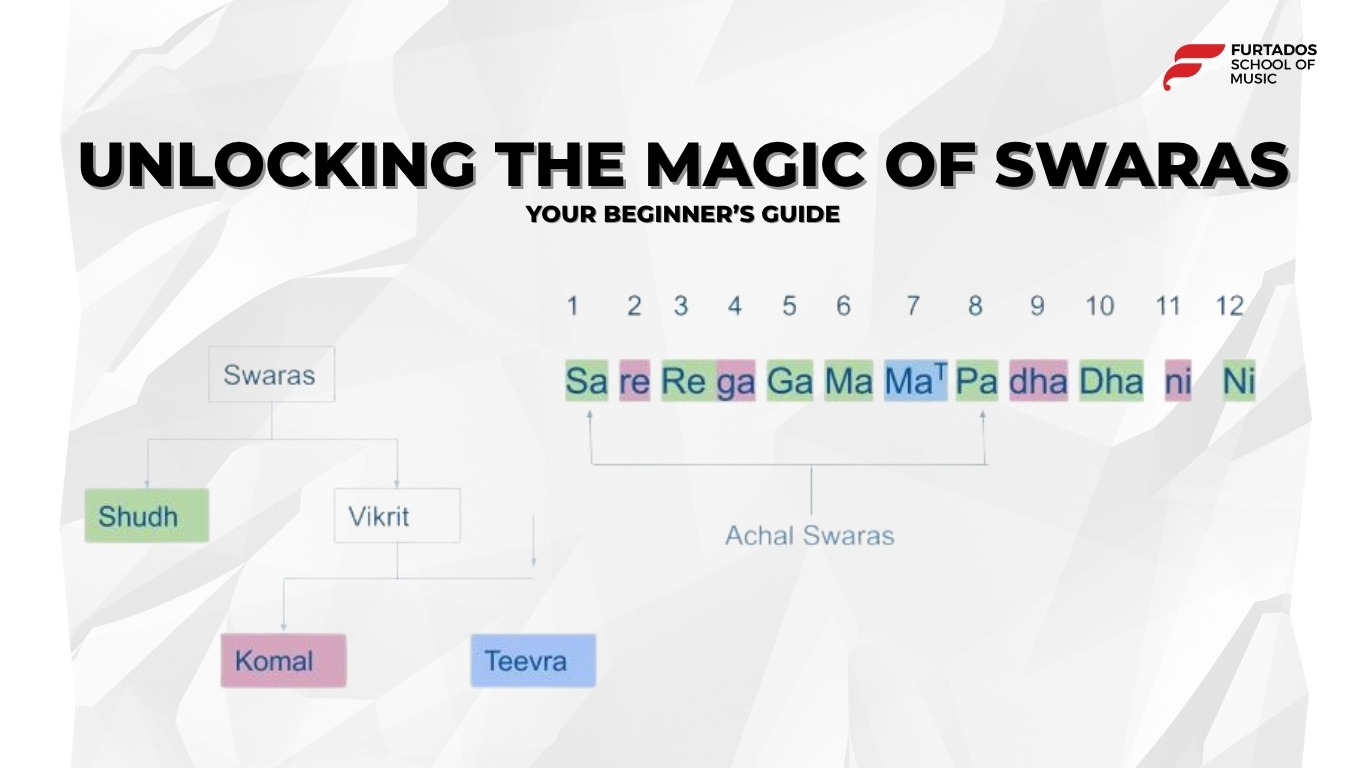
For our practice, it's essential to know their names and order. The Wikipedia article on Svara has a very useful table for this.
This article provides detailed information about the swara system. We will focus on the tables that list the twelve variations.
First, in the section "Seven svaras and solfège (sargam)," locate the table titled "Svara in North Indian system". This shows the full set of 12 notes. Then, scroll down to the "Notation and practice" section and find the larger table, "Comparison between Carnatic, Hindustani, and Western Notations". This table is an excellent reference, showing how the 12 semitones are named in both major Indian systems and their Western equivalents.
The Practice: Sur-Sadhana
Now we begin the core exercise. This process is methodical and requires patience. Think of it as debugging: an iterative cycle of executing (singing), testing (listening), and adjusting. We will be using the excellent Hindi video from Indian Music ART as our guide, supplemented with high-quality tanpura recordings.
Step 1: Set up Your Environment
You will need a tanpura drone. While you can use a mobile app like "Tanpura Droid" (mentioned in the video), the website Rāga Junglism provides high-quality, long-form recordings that are excellent for this purpose.
Tanpura Samples: 26 Divine Indian Drones
This page provides professional-grade tanpura recordings. We will use one of these for our practice.
Go to the section titled "Sa-Pa (Perfect 5th)." You will see a list of keys (C, C#, D, etc.). For a male voice, C# is often a comfortable starting point. For a female voice, G# or A might be suitable. The key itself doesn't matter, only that it's comfortable for you to sing. Click on a key to start the drone. Let it play in the background for the entire duration of your practice.
Step 2: Find 'Sa' (The Tonic)
This is the most critical step. 'Sa' is your home base. The goal is to train your mind and voice to lock onto this fundamental pitch unerringly. The following video explains this process in Hindi.
Tanpura पर Sa Re Ga Ma Pa Dha Ni कैसे पहचानें | Identification of Swaras
The instructor in this Indian Music ART video provides a wonderfully clear and patient guide to identifying swaras with a tanpura. We will use his method.
First, watch the segment on setting your scale. He explains that you must tune the tanpura to your own comfortable vocal range. Next, watch the detailed explanation on finding 'Sa'. His method is: Listen intently to the drone. Try to sing 'Sa' to match the drone's fundamental sound. Check your sung note with an instrument (you can use a free piano/harmonium app on your phone for this). Adjust your voice and repeat until your sung 'Sa', the drone, and the instrument's 'Sa' all feel perfectly merged. He rightly emphasizes that this takes time and concentration. Don't rush.
Practice 'Sa': Spend at least 5-10 minutes on this. Play the drone, close your eyes, and just listen. Hum along until you feel your voice "lock in" with the drone. Then sing a long "Saaaaa". Check with an instrument app. Don't proceed until 'Sa' feels stable and centered.
Step 3: Finding the Shuddha Swaras
Once 'Sa' is your anchor, you can find the other notes by measuring their distance from it. We will start with the seven shuddha (natural) notes. The VoxGuru video provides a great mental model for this.
Basics of Tanpura | Tuning your voice | VoxGuru ft. Pratibha Sarathy
This clip from the VoxGuru video explains the concept of finding notes relative to 'Sa'.
Watch the section from "what about the other notes?" The analogy of a measuring scale, where 'Sa' is the starting point and every other note is at a specific distance, is perfect.
Now, let's apply this methodically, as guided by the Indian Music ART video.
Tanpura पर Sa Re Ga Ma Pa Dha Ni कैसे पहचानें | Identification of Swaras
The instructor now demonstrates how to find the other swaras, always returning to 'Sa' as the home base.
Watch the section from "Sa ke baad." Notice his pattern: he sings Sa -> Re -> Sa, then Sa -> Ga -> Sa, etc. He constantly checks, adjusts, and returns to the "home" of Sa. This is the core practice loop.
Practice the Shuddha Swaras:
With your drone playing, follow this pattern. Use your instrument app to check yourself, but try to rely on your ears first.
- Shuddha Re: Sing
Saaaaa..., then move your pitch up slightly forReeeee..., then return toSaaaaa.... CheckReon your app. Repeat 10 times. - Shuddha Ga: Sing
Sa... Re... Ga... Re... Sa. Feel the interval, the "distance" from Re to Ga. CheckGa. Repeat. - Shuddha Ma: Sing
Sa... Ma... Sa. Feel this larger jump. The Ma is a very stable, consonant interval. - Pancham (Pa): Sing
Sa... Pa... Sa. This should be easy to find, as it's already in the drone! - Continue this pattern for Shuddha Dha and Shuddha Ni, always returning to Sa or another stable note like Pa.
Pa... Dha... Pa...Pa... Dha... Ni... Dha... Pa...
- Finally, try singing the full ascending (
aaroh) and descending (avroh) scale:Sa Re Ga Ma Pa Dha Ni Sa'... Sa' Ni Dha Pa Ma Ga Re Sa.
Step 4: Finding the Vikrit Swaras
Once you have a feel for the shuddha swaras, you can find the vikrit (altered) swaras by locating them in the "gaps" between the natural notes.
Practice the Vikrit Swaras:
- Komal Re (Flat Re): It lies between Sa and Shuddha Re. Practice the sequence:
Sa... Komal Re... Shuddha Re... Komal Re... Sa. This helps your ear clearly distinguish the twoRes. - Komal Ga (Flat Ga): It lies between Shuddha Re and Shuddha Ga. Practice:
Shuddha Re... Komal Ga... Shuddha Ga... Komal Ga... Shuddha Re... Sa. - Teevra Ma (Sharp Ma): It lies between Shuddha Ma and Pa. Practice:
Shuddha Ma... Teevra Ma... Pa... Teevra Ma... Shuddha Ma... Sa. - Komal Dha (Flat Dha): It lies between Pa and Shuddha Dha. Practice:
Pa... Komal Dha... Shuddha Dha... Komal Dha... Pa... Sa. - Komal Ni (Flat Ni): It lies between Shuddha Dha and Shuddha Ni. Practice:
Shuddha Dha... Komal Ni... Shuddha Ni... Komal Ni... Shuddha Dha... Pa... Sa.
Spend significant time on this. As the instructor in the Hindi video emphasizes, this is not a one-day exercise. This is a practice—a sadhana—that could take weeks or months to master. Patience is key.
Conclusion
In this lesson, you have taken the most important step from theoretical knowledge to practical, embodied understanding. You have learned how to use the tanpura as your sonic anchor and have begun the foundational practice of sur-sadhana: identifying and vocalizing the twelve notes of the Indian chromatic scale.
Key Takeaways:
- The tanpura provides the essential, unwavering pitch reference (shruti) centered on Sa and Pa.
- Finding and stabilizing your voice on Sa is the first and most critical step in practice.
- All other eleven swaras are found by their unique pitch "distance" or relationship relative to Sa.
- The practice is an iterative loop: Listen (to the drone), Sing (the target swara), Check (with an instrument), and Repeat.
- This foundational ear and voice training is the bedrock upon which all melodic and emotional expression in Indian music is built.
You have now completed the groundwork of learning the basic "alphabet" and "grammar" of Indian music. In our next module, we will begin to write poetry. The next lesson will introduce you to the soul of Indian music: the Raga. You will learn that a raga is far more than just a scale; it is a melodic personality with specific rules, pathways, and the power to evoke profound and precise emotional states.