Recommended resources
The freely available resources this lesson will direct you to.
Welcome to your next lesson. In our previous session, we explored the prefix sum technique, a classic space-time trade-off where we used O(N) extra space to answer range-sum queries in O(1) time. Today, we're flipping that coin to look at problems where the goal is to use no extra space at all, or more precisely, O(1) auxiliary space.
This lesson is designed to help you master the learning outcome: Modify an array in place while preserving the portion that has already been processed. This is a fundamental skill for solving a large class of array-based interview problems efficiently. We'll uncover a powerful pattern that allows you to overwrite parts of an array in a single pass without losing track of your progress. This technique is not just about saving memory; it's about developing a structured way to think about array transformations.
The Core Idea: Partitioning In-Place
Many array problems ask you to "remove" or "rearrange" elements under certain conditions, but with the critical constraint that you must do it "in-place," meaning you modify the original array without creating a new one. Your extensive experience with JavaScript's mutable arrays gives you a solid foundation here, but we'll formalize the underlying algorithmic pattern.
The key insight is to think of the array as being divided into two partitions during the process:
- A "processed" or "kept" section at the beginning of the array, which contains the elements that satisfy our condition and are in their final positions.
- An "unprocessed" section containing the remaining elements that we still need to examine.
We can manage these partitions using two pointers, often called a "slow" pointer and a "fast" pointer, that move in the same direction.
- The slow pointer (let's call it
write_idx) marks the boundary of the "processed" section. It tells us where to place the next element we want to keep. - The fast pointer (let's call it
read_idx) scans through the array, examining each element.
As the read_idx finds elements worth keeping, it copies them to the write_idx position, and write_idx advances. This effectively overwrites the "unwanted" elements while compactly building the desired result at the start of the array.
This resource provides a great "bookshelf" analogy for this process. Instead of shifting all the books, you simply pick the ones you want and place them at the beginning of the shelf.
27. Remove Element - In-Depth Explanation
This section from "27. Remove Element - In-Depth Explanation" on AlgoMonster introduces the core intuition behind in-place modification. It masterfully explains why we can think of the problem as partitioning the array rather than deleting from it.
Please read the "Intuition" section. Focus on the bookshelf analogy and how it leads to the two-pointer approach where one pointer (k in their text) tracks the end of the "keep" section.
Pattern in Action 1: Remove Element
Let's apply this pattern to a classic problem: LeetCode 27. Remove Element.
- Problem: Given an array
numsand a valueval, remove all instances ofvalin-place and return the new length. The order of the elements that are notvalcan be changed.
For example, if nums = [3, 2, 2, 3] and val = 3, the goal is to modify nums so its first two elements are 2, 2. The function should return 2.
Here, the "processed" section consists of elements not equal to val.
- Our
write_idxwill start at0. - Our
read_idxwill iterate through the entire array. - For each element
nums[read_idx], if it is not equal toval, we consider it "kept." We copy it tonums[write_idx]and then incrementwrite_idx. - If
nums[read_idx]is equal toval, we simply ignore it and continue, lettingread_idxadvance. The "unwanted" element will eventually be overwritten.
The following resource provides a superb, detailed walkthrough of this exact process.
27. Remove Element - In-Depth Explanation
This part of the AlgoMonster guide continues with a step-by-step algorithm and a concrete example trace for the "Remove Element" problem. It also provides a clean TypeScript implementation.
First, read the "Solution Approach" section to see the formal algorithm steps. Then, carefully follow the "Example Walkthrough" which traces the state of the array and pointers step-by-step. Finally, review the TypeScript code which is a direct implementation of this logic.
Pattern in Action 2: Remove Duplicates from a Sorted Array
Now let's consider a variation: LeetCode 26. Remove Duplicates from Sorted Array.
- Problem: Given a sorted array
nums, remove the duplicates in-place such that each unique element appears only once. Return the new length.
Example: nums = [1, 1, 2], result should be nums = [1, 2, _] and return 2.
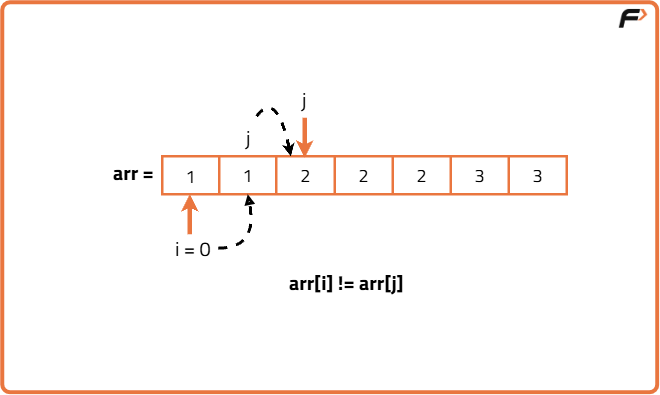
The logic is very similar, but the condition for "keeping" an element changes. Since the array is sorted, we know that duplicates will be adjacent. An element is a "new" unique element if it's different from the last unique element we kept.
write_idx(let's call itslow) can again track the end of our unique-elements-so-far section.read_idx(let's call itfast) scans ahead.- The first element is always unique, so we can conceptually start with
slowat index0. - We then iterate with
faststarting from index1. Ifnums[fast]is different fromnums[slow], it's a new unique element. We incrementslowfirst, then copynums[fast]to this new positionnums[slow].
The image below illustrates a moment in this process, where pointer i (our slow pointer) is at the last unique element found, and j (our fast pointer) has found a new unique element.
The following video provides an excellent visual demonstration of this algorithm.
Remove Duplicates from Sorted Array - Leetcode 26 - Python
The video "Remove Duplicates from Sorted Array" by NeetCode is a fantastic resource for understanding this pattern visually.
Please watch from the main explanation where the two-pointer strategy is introduced, followed by the step-by-step example which animates how the pointers move and the array is modified. Pay close attention to how the left pointer (our slow pointer) only advances when a new unique element is found.
Generalizing the Pattern: A Reusable Template
By now, you've likely noticed the recurring structure. We can abstract this into a general template. Recognizing this pattern is a huge step toward overcoming "algo phobia"—it turns a seemingly novel problem into a familiar one.
The resource below formalizes this pattern as the "Fast-Slow Pointer Technique" and provides a generic template.
Master the Two-Pointer Technique: Your Gateway to ...
This article from Medium gives a high-level overview of the two-pointer technique, focusing on the same-direction variant we're studying.
Read the section titled "Fast-Slow Pointer Technique" to solidify the concept. Then, study the generic template. This is the abstract pattern that solves both problems we've seen so far. We will see it applies to others as well. Finally, look at the Example Solution — Remove Duplicates to see how the specific problem fits the generic template.
Here's the template adapted for TypeScript. It forms the backbone of our in-place modification strategy.
function inPlaceModification(nums: any[]): number {
    if (nums.length === 0) {
        return 0;
    }

    let write_idx = 0; // Pointer for the 'processed' partition

    for (let read_idx = 0; read_idx < nums.length; read_idx++) {
        // The core logic: decide if the element at read_idx should be kept
        if (/* condition to keep nums[read_idx] is true */) {
            nums[write_idx] = nums[read_idx];
            write_idx++; // Expand the 'processed' partition
        }
    }

    return write_idx; // The new length of the valid part of the array
}
Pattern in Action 3: Move Zeroes
Let's tackle one more problem to solidify the pattern: LeetCode 283. Move Zeroes.
- Problem: Given an array
nums, move all0's to the end of it while maintaining the relative order of the non-zero elements. This must be done in-place.
Example: nums = [0, 1, 0, 3, 12] should become [1, 3, 12, 0, 0].
At first, this might seem different. But think about the problem differently: moving zeroes to the end is the same as moving all non-zero elements to the beginning, while maintaining their relative order. This reframing makes it a perfect fit for our template!
The condition to "keep" an element is simply nums[read_idx] !== 0.
After the loop in our template finishes, all non-zero elements will be at the start of the array, from index 0 to write_idx - 1. The write_idx now points to the first position where a zero should be. We can simply loop from write_idx to the end of the array and fill the remaining spots with zeroes.
This video masterfully explains this rephrasing and solution.
Move Zeroes - Leetcode 283 - Python
In "Move Zeroes" by NeetCode, the key is the mental shift in how to view the problem.
Watch the section that explains the core insight of reframing the problem. Then, follow the visual walkthrough of the algorithm, which again uses the two-pointer method to partition the array in-place.
Conclusion
In this lesson, you've learned a powerful and versatile pattern for in-place array modification. This technique is fundamental and appears in many variations.
Key Takeaways:
- In-Place Mindset: Instead of deleting or creating new arrays, think about overwriting elements by partitioning the array into a "kept" section and an "unprocessed" section.
- The Fast-Slow Pointer Pattern: Use a
writepointer (slow) to track the end of the "kept" section and areadpointer (fast) to scan the array. - Adaptable Condition: The core of solving a new problem is identifying the specific
ifcondition that determines whether an element should be kept. - Complexity: This pattern typically yields solutions with
O(N)time complexity (a single pass) andO(1)space complexity (no extra arrays).
This pattern is a cornerstone of array manipulation. As you practice, you'll start to recognize it instantly whenever a problem mentions "in-place modification" and "O(1) space."
In our next lesson, we will move from one-dimensional arrays to two-dimensional grids. We'll learn how to traverse a matrix without omitting or revisiting cells at its boundaries, extending our systematic approach to traversal into a new dimension.