Recommended resources
The freely available resources this lesson will direct you to.
- The Ultimate Fabric Guide - the differences between natural vs synthetic vs semi-synthetic fiberswww.youtube.com
- NO BURN! How to Tell if a Fabric is Natural or Synthetic Fibre?- Learn the skill to identify fabric!www.youtube.com
- Identifying Fibres and Fabricswww.dressandtextilespecialists.org.uk
- Fibers and Fabricsextension.usu.edu
Hello! Fashion design begins with a practical question: what is the fabric made from? A fibre label gives you a reliable starting point, while the swatch itself shows how that fibre has been turned into something you can wear. In this first module, you’ll build the fabric knowledge needed to choose materials for designs and, later, cut and sew them successfully.
Today you’ll classify swatches into natural, regenerated, and synthetic fibres. You’ll learn to read composition labels, use touch and appearance as supporting clues, and recognize when a swatch cannot be identified confidently without a label.
Fibre origin: the three groups
A fibre is the material used to make yarn or fabric. For this lesson, classify a fibre by where it comes from and how it is made, not by whether the finished fabric feels soft, looks shiny, or stretches.
Natural fibres come from plants or animals. Cotton, linen (from flax), and hemp are plant fibres; wool and silk are animal fibres. Regenerated fibres begin with a natural source, usually plant cellulose, which is processed and formed into new fibres. Viscose, modal, and lyocell belong here. Synthetic fibres are made from manufactured polymers rather than extracted plant or animal fibres. Common clothing examples include polyester, nylon, acrylic, and elastane.
The terminology can be confusing: man-made is often an umbrella term that includes both regenerated and synthetic fibres. In the short reading below, the author uses manufactured for the plant-derived middle group. In this course, we’ll call that group regenerated.
Read “Fibers and Fabrics” from Utah State University Extension for an introduction to the three origins and common label names.
In this short article, begin with the three categories. Stop after the discussion of acrylic. Focus on where each group originates and the examples in each group; treat the behavioural descriptions as tendencies, not tests that can prove a swatch's composition.
The distinction between natural and regenerated is especially important when reading labels. A fabric labelled “100% viscose” is plant-derived, but its fibre was manufactured from processed cellulose: classify it as regenerated, not natural. Likewise, “bamboo viscose” describes a regenerated fibre made using bamboo as a cellulose source; the word bamboo alone does not make it a natural-fibre fabric. By contrast, “100% linen” is natural because linen fibre comes from flax.
Let the composition label lead
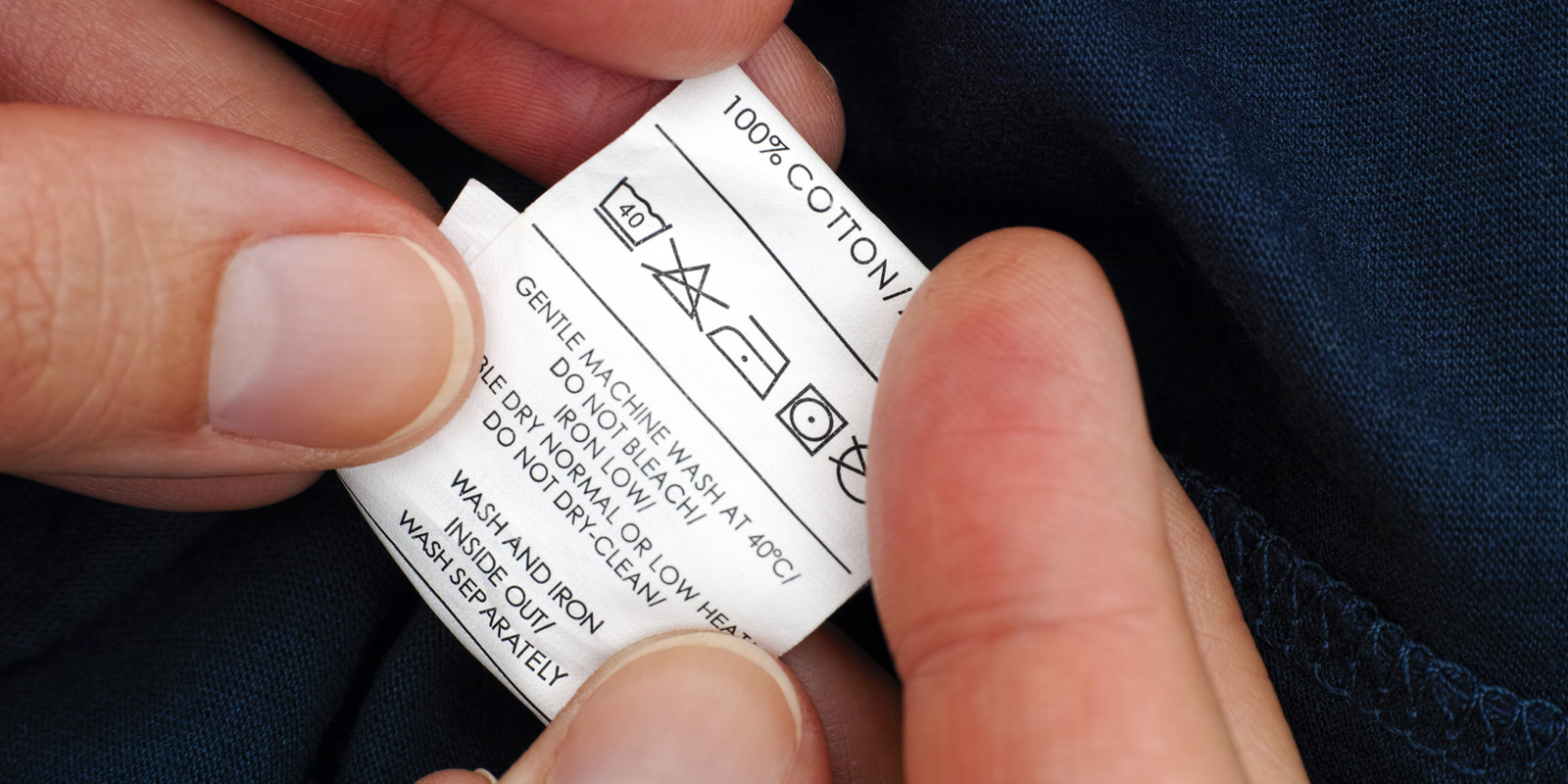
Find the part of the label that states fibre content, usually as names and percentages. Do not confuse it with the care instructions beside it. In the photograph above, “100% cotton” is composition information. “Machine wash” and the care symbols tell you how to handle the garment.
For a single-fibre fabric, classification is direct:
| Composition on label | Classification |
|---|---|
| 100% cotton, linen, wool, or silk | Natural |
| 100% viscose, modal, or lyocell | Regenerated |
| 100% polyester, nylon, acrylic, or elastane | Synthetic |
Some labels use alternative names. Rayon commonly identifies a regenerated cellulosic fibre; viscose is a type of rayon. Spandex is another name for elastane. Polyamide on an ordinary clothing label commonly refers to nylon. A trade name may accompany a fibre name, so look for the stated composition rather than relying on a brand name alone.
A blend needs a more precise description than one category. A label reading “70% cotton, 30% polyester” describes a natural–synthetic blend, predominantly cotton—not a natural fabric in its entirety. “95% viscose, 5% elastane” is a regenerated–synthetic blend. Record both components and their percentages: even a small amount of elastane may noticeably affect stretch, though stretch alone cannot identify elastane.
The names satin, denim, and jersey do not establish fibre origin. They describe kinds of fabric rather than answering what the fibre is. A satin swatch, for example, might be silk or polyester. You’ll examine fabric structure separately in the next lesson.
Identifying Fibres and Fabrics
Consult “Identifying Fibres and Fabrics” from the Dress and Textile Specialists for a closer look at why feel can help but a label is stronger evidence. Its examples also add detail to the regenerated and synthetic groups.
In “4. Looking at Fibres” (p. 5), read eye and hand. Then, in “4a. Natural Fibres,” find “Vegetable – cellulose fibres” (p. 8) and read linen and cotton. In “4b. Man-made Fibres,” read the viscose description under “Regenerated fibres” (p. 9), from source to properties. Finally, under “Synthetic” (p. 10), skim nylon to polyester, concentrating on the fibre names and descriptions rather than the production dates.
What a swatch can—and cannot—tell you
When a label is missing, observation helps you make a provisional classification. Start with what you can actually see and feel: is the surface smooth or fuzzy, dull or lustrous? Does it feel cool or warm to the touch? If you gently scrunch a corner in your hand and release it, do creases remain?
A cotton or linen swatch often holds more visible creases than a comparable polyester swatch. Wool may feel warm and springy; acrylic can also feel warm and wool-like. Viscose often feels soft and drapes readily, sometimes resembling silk. These overlaps are the reason to describe observations first and infer fibre content second.
In the following demonstration, watch the difference between an observed property (“this swatch retains creases”) and a conclusion about composition (“it may be cotton”). The presenter checks that conclusion against a label.
NO BURN! How to Tell if a Fabric is Natural or Synthetic Fibre?- Learn the skill to identify fabric!
Watch “NO BURN! How to Tell if a Fabric is Natural or Synthetic Fibre?” by Evelyn Wood for a non-destructive scrunch comparison and a useful habit for checking your guesses.
Watch the scrunch comparison, where cotton and polyester are squeezed and their remaining creases compared. Then watch guess and check: observe a fabric first, then read its composition label. The demonstration compares particular swatches; it does not make the scrunch test a definitive identification method.
Why not rely on the scrunch test alone? Fibre is only one influence on a swatch. Fabric construction, thickness, finishing treatments, and blends also change how it feels and creases. A wrinkle-resistant cotton may behave unlike an untreated one; a polyester fabric need not behave like every other polyester fabric. Regenerated fibres can crease too, so “it wrinkles” does not automatically mean “natural.”
For this lesson, you do not need a burn test. It damages the sample, presents a safety risk, and is unnecessary when an accurate composition label is available. With an unlabelled swatch, the sound conclusion may simply be “possibly regenerated or natural; fibre origin unconfirmed.”
A useful record for each swatch
Keeping evidence separate from inference makes your fabric notes more useful when you later choose materials for garments. A compact record might read:
Label: 100% viscose. Observed: smooth feel, fluid drape, visible creases after scrunching. Classification: regenerated. Confidence: high because the composition label is present.
For a swatch without a label, record the same observations but lower the confidence:
Label: absent. Observed: smooth, lustrous surface; few creases after scrunching. Classification: possibly synthetic, but unconfirmed. Confidence: low.
This approach works for blends as well: preserve the exact percentages rather than forcing the swatch into a single group. Over time, comparing labelled samples will improve your judgement of unlabelled ones without making touch a substitute for composition evidence.
Looking ahead
Classify by fibre origin: natural fibres come from plants or animals, regenerated fibres are manufactured from natural source material, and synthetic fibres are made from manufactured polymers. Read the composition label first, record every component of a blend, and use visible and tactile properties as clues rather than proof.
Next, you’ll look at a different question: how fibres and yarns are arranged into woven, knitted, and nonwoven fabrics. Two swatches with the same fibre content can behave differently because their structures differ.