Recommended resources
The freely available resources this lesson will direct you to.
- Buying Fabric Online? The Secret Is… GSM!www.youtube.com
- How to Test the Qualities of Knit Fabrics Sewing Tutorialwww.youtube.com
- How to Verify Fabric Drape Online: A 2026 Guide – New Creations Fabric & Foam Incwww.newcreationsfabricsinc.com
- How and Why to Swatch Fabrics - Threads Magazinewww.threadsmagazine.com
Hello! You’ve already checked how grain and directional surfaces affect the way fabric pieces are laid out. Now the question is what the fabric itself will do in a garment. Two swatches may have the same colour and fibre label yet produce very different results: one might hold a crisp shape, while the other falls in soft folds.
In about 40 minutes, you’ll compare weight, hand, drape, opacity, and recovery with simple tests. These observations will help you describe a fabric accurately before deciding whether it might suit a top, trousers, kameez, or blouse.
Start with a fair comparison
Gather two or three swatches, ideally at least 20–30 cm across so you can see them hang. A ruler, a table edge, a light source, and a dark piece of paper are useful. If you have a fine-resolution kitchen scale and can spare a precisely cut piece, you can also estimate fabric weight. You do not need every tool to make a useful comparison.
Test swatches under the same conditions: use the same light, hold or fold comparable amounts of fabric, and let each piece hang the same distance over the table edge. Remember last lesson’s directional surfaces; comparing opposite sides of a napped fabric may introduce a difference that has nothing to do with weight or drape.
Begin with weight. Fabric weight is mass per area, commonly stated as GSM—grams per square metre. Watch how Evelyn Wood compares swatches of different weights in Buying Fabric Online? The Secret Is… GSM! Focus on the visible differences between the examples, rather than treating any one GSM value as a rule for a garment.
Buying Fabric Online? The Secret Is… GSM!
In Buying Fabric Online? The Secret Is… GSM!, Evelyn Wood introduces GSM and compares the feel and appearance of fabrics at different weights.
Watch GSM explained for the unit, then swatch comparisons. Pay particular attention to the two linens near the end: similar-looking fabrics can differ substantially in weight and behaviour.
If you can cut an accurate 10 cm by 10 cm square and weigh it in grams, multiply its mass by 100 to estimate GSM. For example, a 2 g square of that size is approximately 200 GSM. A scale that only displays whole grams is too coarse for reliable measurements of such a small piece. Without a suitable scale, compare equal-sized swatches by handling them and record a relative judgement—“lighter than B,” for instance—rather than inventing a GSM value.
Weight is not thickness, stiffness, or opacity. They may change together in particular fabrics, as some of the video examples show, but they are separate observations. A heavier, soft fabric can fall fluidly; a lighter, crisp fabric can stand away from the body.
Feel the hand; watch the drape
Hand describes how fabric feels when you handle it. Rub a swatch lightly between your fingers, then gather it loosely in your palm. Is its surface smooth or rough? Does it feel soft, crisp, spongy, slippery, or firm? Use specific words rather than “nice” or “good”: those words will still mean something when you revisit the swatch later.
Drape describes how fabric falls under its own weight. Lay a swatch on a table with roughly half extending beyond the edge, without pulling it taut. A fluid swatch will bend downward readily and form soft folds; a fabric with more body may project outward before it bends. Hold the same swatch by one corner and let it hang freely. Does it form many soft folds or retain a relatively defined shape? A small swatch cannot predict the entire finished garment, but it makes a useful side-by-side comparison.
Watch the drape portion of How to Test the Qualities of Knit Fabrics Sewing Tutorial for the contrast between fluid fall and shape-holding structure. The presenter uses a larger piece of fabric; apply the same observation to your swatches at the table edge.
How to Test the Qualities of Knit Fabrics Sewing Tutorial
How to Test the Qualities of Knit Fabrics Sewing Tutorial from DIBY Club contrasts fabric that follows the body with fabric that maintains more of its own shape.
Watch drape and structure. Notice what the presenter looks for as the fabric hangs and moves, then look for the same distinction in your table-edge test.
The swatches below show why testing a combination of materials matters. One hammered-silk sample is shown on its own; the other has a muslin underlining. The illustration compares how they behave when held, rather than assuming the outer fabric will behave the same way after another layer is added.
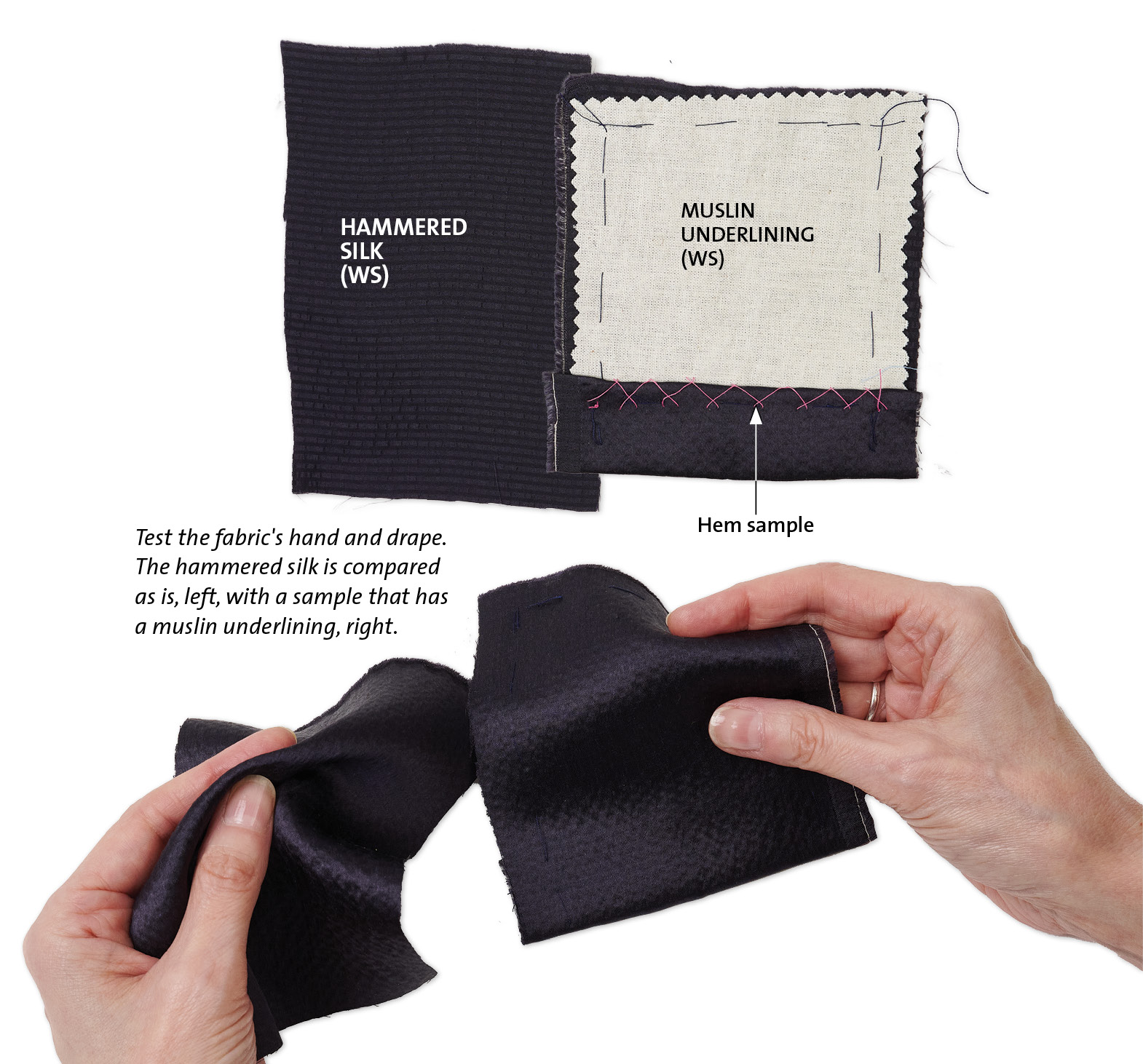
For practical descriptions, keep hand and drape distinct. “Smooth and slippery” describes a hand; “falls in soft folds” describes drape. A fabric can have one quality without the other.
Check coverage and the two kinds of “spring back”
Opacity is how much a fabric conceals what is behind it. Hold a single layer over dark paper, then over your hand, in consistent light. Can you see a clear outline, only a shadow, or virtually nothing? Try the same check with two layers if the garment design might use a lining or underlining. Record the colour and lighting conditions: a swatch that appears opaque against one background may reveal more against another. Weight alone cannot settle this question.
Stretch recovery asks whether fabric returns to its original dimensions after you pull it. For a swatch that stretches, mark or identify a 10 cm span. Stretch it gently across its width, release it, and check whether that span returns close to 10 cm or remains longer and wavy. Repeat along the length if the fabric gives in that direction. Use a similar pull for each swatch; the aim is comparison, not finding its breaking point.
Watch the short recovery demonstration from the knit-fabric tutorial. It shows why how far a fabric stretches and how well it returns are different observations.
How to Test the Qualities of Knit Fabrics Sewing Tutorial
The DIBY Club tutorial demonstrates stretch recovery by releasing a stretched fabric and looking for a return to its original shape.
Watch stretch recovery. Look for the waviness or distortion the presenter checks after releasing the fabric.
A firm woven swatch may have almost no stretch to test; write “little stretch; stretch recovery not applicable” rather than calling its recovery poor. You can still assess a different kind of spring back: crease recovery. Gently scrunch the fabric in your fist for a few seconds, release it, and observe whether wrinkles remain. Crease recovery concerns wrinkling; stretch recovery concerns dimensions after stretching. Do not combine them into one score.
Read the brief Threads Magazine discussion of swatching for an example of how descriptive observations and a crush test can inform a fabric decision.
How and Why to Swatch Fabrics - Threads Magazine
How and Why to Swatch Fabrics from Threads Magazine shows how to turn handling a swatch into useful descriptive and technical notes.
Under “Become a Fabric Expert,” read the “Qualitative assessment” subsection, from its opening discussion of shopping online through the comparison. Then, under “Technical testing,” find the “Wrinkle resistance” entry and read from “Crush it” through the crush test. Focus on recording what you observe, not just whether you like the fabric.
Turn observations into a swatch record
A useful record preserves what you did and what you saw. You could note results in this compact form for each labelled swatch:
| Property | Observation to record |
|---|---|
| Weight | Labelled GSM, measured GSM, or relative weight compared with another equal-sized swatch |
| Hand | Two or three tactile words, such as smooth, crisp, or spongy |
| Drape | Soft folds or shape-holding fall; result at the table edge |
| Opacity | What shows through one layer under your test light; whether two layers change it |
| Recovery | Return after gentle stretch, if applicable; separately, whether scrunching leaves creases |
Allow roughly 20 minutes to run the tests on two or three swatches and a few minutes to write the records. If one fabric seems promising for a structured trouser while another seems better suited to a softly falling top, note which observed properties led you to that impression. You are building evidence for a later fabric choice, not making a final selection from a single test.
Key takeaways
GSM measures weight per area, but it does not by itself tell you how fabric feels, falls, covers, or returns to shape. Compare hand by touch, drape by letting fabric hang, opacity against a contrasting background, and stretch and crease recovery as separate behaviours. Keep conditions consistent and record observations in words you can use again.
Next, you’ll test how washing and moisture may change a swatch through shrinkage or colour transfer—important checks before fabric becomes a garment.