Recommended resources
The freely available resources this lesson will direct you to.
- How To Create a Marketing Campaign (FREE Template)www.youtube.com
- How To Make a Digital Marketing Campaign Plan // Step by Step Guide to a Successful Campaign Launchwww.youtube.com
- Marketing Campaign Brief Template: Free Guideblog.aslanagency.com
- Creative briefs — how to write, examples, and templatesbusiness.adobe.com
Welcome back. You’ve already considered whether a café can afford to acquire a lunch customer and whether its ads make claims it can support. A campaign brief brings those decisions together before anyone designs an ad or buys media. It tells the people working on a campaign what result matters, whom it should reach, what it will say, what it can cost, and how success will be judged.
This lesson is about interpreting a brief, not writing a polished one yet. By the end, you should be able to read its objective, audience, offer, message, channel, budget, timing, and measurement fields—and notice when the fields do not agree.
A brief is a set of connected decisions
A brief is useful only if it helps people make choices. “Promote our lunch” leaves the advertiser guessing. “Increase weekday pickup orders” gives the work a direction, but still leaves questions: Which customers? What are they being invited to buy? Where will they see the ad? What spending is approved? How will orders be counted?
The distinction between a campaign brief and a creative brief matters here. A campaign brief covers the whole initiative, including business results, distribution, spending, dates, and reporting. A creative brief gives more detailed direction for producing particular ads or other assets. They overlap, but a production schedule and a message are not, by themselves, a complete measurement plan.
Watch two short portions of HubSpot Marketing’s How To Create a Marketing Campaign (FREE Template). Listen for the way an outcome guides the audience, message, call to action, distribution, and choice of metrics.
How To Create a Marketing Campaign (FREE Template)
HubSpot Marketing’s campaign-planning video introduces the decisions a brief needs to connect, then returns to the difference between measuring activity and measuring the intended result.
Watch campaign elements for its overview of objectives, audience, message, assets, action, and budget. Then watch distribution and metrics. Focus on why impressions or engagement would not, on their own, demonstrate that a sales objective was met.
For a field-by-field reference, read Aslan Agency’s Marketing Campaign Brief Template: Free Guide. Its template is particularly helpful because it treats each field as a decision to make rather than a space to fill with background information.
Marketing Campaign Brief Template: Free Guide
Read the distinction between campaign and creative briefs, then the template’s eight numbered parts. Use it to see what information each field should communicate; you do not need to fill out the template now.
Start with the paragraph beginning “Campaign briefs and creative briefs overlap” immediately before “Copy this marketing campaign brief template.” Read the brief template, from that paragraph through “8. Measurement plan.” Pay particular attention to “2. Objective and success target,” “3. Audience and insight,” “4. Offer, message, and proof,” “5. Channels and deliverables,” “6. Budget and resources,” “7. Timeline, dependencies, and approvals,” and “8. Measurement plan.” Stop before “A completed marketing campaign brief template example.”
The following example shows why reading a brief involves more than locating its headings.
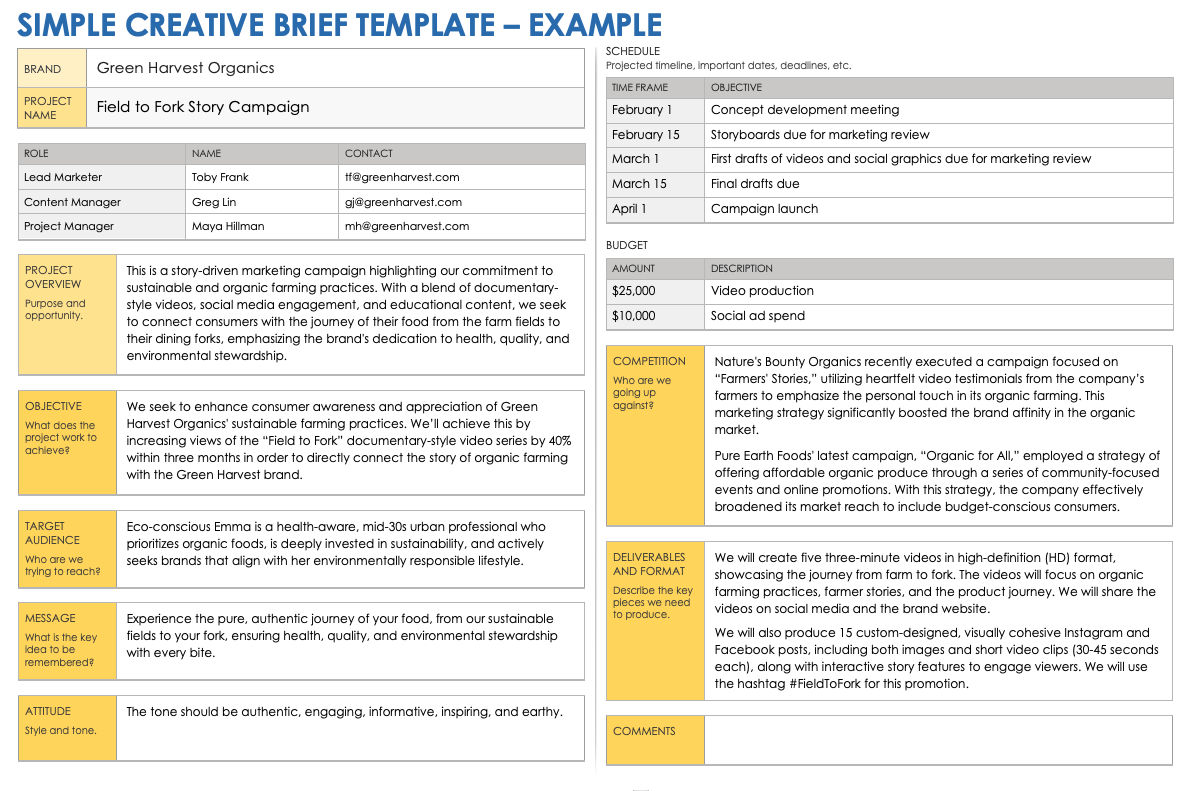
The example has a target of increasing video views by 40% within three months. That is a measurable viewing target, not automatically a sales target. Its budget distinguishes video production from social ad spend, and its schedule names milestones leading to launch. But a reviewer would still need to establish the starting view count, where views will be counted, and when the three-month measurement period begins. “Share on social media and the brand website” also names distribution locations without fully explaining what job each will do. Reading a brief well means recognizing both what it decides and what it leaves open.
Interpret the customer-facing fields together
Return to the hypothetical café from earlier lessons. Suppose its business problem is quiet weekday lunches. For this illustration, its current average is 20 weekday pickup orders per day, and it wants to reach 30 per day during week four of a four-week campaign. The café has confirmed that one $15 lunch item can be ordered for weekday pickup. These are planning assumptions for this example, not facts about a real business.
The objective states the change the campaign is intended to support: raising the average daily weekday pickup order count from 20 to 30 by week four. It names a business outcome and a deadline. When interpreting an objective, distinguish the desired result from activities that might contribute to it. More ad clicks could be encouraging, but clicks are not pickup orders.
The audience identifies whose behavior the campaign hopes to change and why the offer may matter to them. “Everyone nearby” is not much direction. “People within the café’s practical pickup area looking for a weekday lunch they can order ahead” supplies a situation and a relevant need. It does not establish that this group is large enough or that the café has researched it; those are matters to verify. Notice, too, that the audience field describes people the message is for. It is not a license to use sensitive personal inferences to identify them.
The offer is what the customer is invited to get under stated conditions: here, the $15 weekday lunch item available for pickup. The message is the main idea the ad should communicate about that offer: for example, “Choose your weekday lunch ahead of time and pick it up.” They serve different purposes. An offer can be available without giving someone a reason to care; an attractive message can fail if the item, price, or pickup arrangement does not exist as described.
The call to action—“Order lunch for pickup”—makes the requested next step explicit. A reviewer should be able to trace it back to the objective: someone who follows it can plausibly place a pickup order. The brief should also say what supports the message, such as a working online pickup route and confirmed weekday availability. If a mandatory ordering fee exists, the advertised price and offer conditions must reflect it, as discussed in the previous lesson.
In a compact brief, these distinctions are easy to blur. Read them separately:
| Field | What you should learn from it |
|---|---|
| Objective | What business result should change, by how much, and by when? |
| Audience | Who is the intended customer, and what situation or need makes the offer relevant? |
| Offer | What exactly can that customer get, and on what conditions? |
| Message | What single, supportable idea should the customer take away? |
If a brief says the objective is pickup orders but the message celebrates only the café’s history, the message may need a clearer connection to ordering. That does not make the history uninteresting; it means the brief has not yet explained its role in this campaign.
Interpret delivery as a practical constraint
A message does not reach customers simply because it has been written. The channel field says where the campaign will appear and why that placement suits the audience and objective. For the café, a proposed paid local search placement could reach people already looking for lunch pickup. The brief would need to identify the destination—such as the relevant ordering page—rather than merely say “online.” If the destination does not allow pickup orders, the channel choice and call to action do not join up.
A channel is also different from a deliverable. “Paid local search” describes distribution; the ad text and the functioning ordering destination are things that must be produced or checked. A brief may list both, but they answer different questions.
The budget is an approved limit with boundaries, not just a prominent total. Suppose this campaign has $600 available: $450 for media, $100 for simple production, and $50 held in reserve. The interpretation changes if $600 means media alone and production requires additional spending. The brief should make clear what is included and who can approve a change. Previous lessons’ contribution-margin and allowable-acquisition-cost calculations remain a separate feasibility check: a $450 media allocation does not prove the likely order cost will be acceptable.
Timing includes more than a launch date. For this café, a four-week campaign might require the item and price to be confirmed, ordering to be tested, and ads to be approved before launch. It also needs a defined end to the campaign and a week-four period for evaluating the objective. If ads are scheduled around weekday lunch, pickup must actually be available when a customer responds. Timing therefore describes operational readiness as well as calendar dates.
These fields can expose a contradiction even when each sounds reasonable in isolation. A strong lunch offer paired with an ordering page that cannot take pickup orders is not ready. Neither is a weekday ad scheduled after the café stops accepting weekday pickups. A brief should make such conflicts visible early, while they are still inexpensive to fix.
Read measurement as the test of the brief
Finally, the measurement field explains how the objective will be evaluated. For the café, it could specify the average number of weekday pickup orders recorded in its order system during week four, compared with a comparable pre-campaign weekday average of 20. It should identify the reporting source, the dates included, and when someone will review the result. Without those details, “reach 30 orders per day” invites different people to count different things.
The brief can also name diagnostic measures: for instance, visits from an ad to the ordering page or orders associated with a campaign link. These help investigate what happened, but they do not replace the primary business measure. Conversely, an increase in total pickup orders does not prove the ads caused every additional order; other activity or ordinary variation may have contributed. A useful brief is clear about what will be observed without promising more certainty than the records can provide.
Before work begins, read across all eight fields as one argument:
- Objective and audience: Is the desired change about a behavior this audience can take?
- Audience, offer, and message: Is the offer relevant, and is the message accurate and supportable?
- Message, channel, and action: Will people encounter the message in a suitable place and have a workable next step?
- Budget and timing: Can the team deliver the campaign within the approved resources while the offer is available?
- Objective and measurement: Will the stated data actually show whether the target was met?
Aslan Agency’s short list of brief mistakes provides a useful final pass. Read it for the warning signs—particularly objectives that compete with one another, channels with no defined role, ambiguous budget boundaries, and measurement planned too late.
Marketing Campaign Brief Template: Free Guide
Return to Aslan Agency’s guide for its approval and common-mistakes guidance. Use it to check whether the brief would remain understandable after people start changing assets, dates, or spending.
Near the end of the guide, find “Freeze the approved version,” followed by “Marketing campaign brief mistakes to avoid.” Read the approval checks, beginning with the sentence under “Freeze the approved version” and ending at the “Late measurement planning” bullet. Focus on the omissions a new reviewer would have to resolve before approving the work.
Takeaways
A campaign brief is not eight independent boxes. Its objective defines the result; its audience, offer, and message explain whom the campaign addresses and what it promises; its channel, budget, and timing define how and when the work can run; and its measurement field establishes how the result will be assessed. Your strongest reading skill is to spot a missing decision or a contradiction between those fields before it becomes an ad.
This completes the foundations module. Next, you’ll move from reading an audience description to developing one using evidence about local customers, their needs, and their barriers.