Recommended resources
The freely available resources this lesson will direct you to.
Hello! Welcome to the next lesson in our exploration of the Van der Waals model.
In our last session, we located the critical point of the Van der Waals fluid by finding where the first and second derivatives of pressure with respect to volume vanish. This allowed us to calculate the critical constants , , and in terms of the microscopic parameters and . We concluded by deriving the critical compression factor, , a universal value predicted by the model, independent of the specific fluid. This was our first significant hint of universality.
Today, we will build directly on that idea. Our goal is to derive the Law of Corresponding States and explain its connection to the concept of universality. We will show that by rescaling pressure, volume, and temperature by their critical values, the Van der Waals equation transforms into a universal form, completely independent of the parameters and . This is a foundational concept in the study of critical phenomena and our first deep dive into the powerful idea that diverse systems can exhibit identical behavior near a phase transition.
Defining Reduced Variables
The key to unlocking this universal behavior is to stop measuring pressure, volume, and temperature in arbitrary units (like Pascals, liters, and Kelvin) and instead use the natural scale set by the fluid's own critical point. This leads to the definition of reduced variables.
A reduced variable is simply the ratio of a thermodynamic variable to its value at the critical point:
- Reduced Pressure:
- Reduced Volume:
- Reduced Temperature:
These variables are dimensionless. A state described by means the fluid is at twice its critical pressure, three times its critical volume, and 1.5 times its critical temperature.
The following short video provides a clear introduction to these definitions.
Principle of Corresponding States | Physical Chemistry I | 019
Let's begin by watching a segment from a video by Professor Derricotte that defines these reduced variables.
Watch the first part of the video, from 00:11 to 01:38. Focus on how the reduced variables are constructed as simple ratios.
Deriving the Law of Corresponding States
Now for the central task. We will substitute these reduced variables into the Van der Waals equation and see what happens. The algebra is a bit involved, but the final result is profound.
Recall the Van der Waals equation:
And our expressions for the critical constants from the previous lesson:
The process involves three steps:
- Rewrite , , and in terms of the reduced variables and critical constants: , , .
- Substitute these into the Van der Waals equation.
- Substitute the expressions for , , and in terms of and .
- Simplify the resulting expression.
To see this derivation performed step-by-step, we'll continue with the video.
Principle of Corresponding States | Physical Chemistry I | 019
The next segment of the video walks through the complete algebraic substitution and simplification, showing how the parameters 'a' and 'b' are systematically eliminated.
Watch from 01:38 to 05:46. Follow the substitution of the reduced variables and then the critical constants into the equation. The crucial part is seeing how all instances of 'a' and 'b' cancel out.
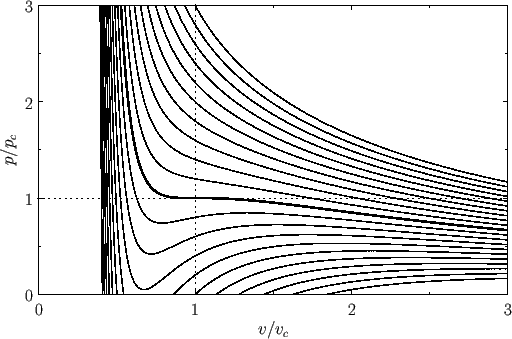
After all the cancellations, we arrive at the Van der Waals equation in reduced form:
Or, rearranged to solve for pressure:
This equation is the Law of Corresponding States.
Universality and its Physical Meaning
Take a moment to appreciate this result. The final equation contains only the dimensionless reduced variables and pure numbers. The gas-specific parameters and , which encode the details of molecular interaction strength and excluded volume, have completely vanished.
This is a profound statement. It implies that all fluids that obey the Van der Waals equation of state have the exact same equation of state when expressed in these reduced variables. Two different gases, say Helium and Xenon, might be at vastly different absolute temperatures and pressures, but if their reduced temperatures and reduced volumes are the same, their reduced pressures must also be the same. They are in "corresponding states".
This is our first concrete example of universality. The specific microscopic details of the system become irrelevant, and a single, universal description emerges.
The following resources provide further insight and, crucially, experimental validation for this idea.
5.1.4 The Law of Corresponding States
David Tong's lecture notes provide a concise derivation and an excellent discussion of the implications of this law. Pay close attention to the mention of the Guggenheim plot.
Please read the section titled 'The Law of Corresponding States'. This section starts by defining the reduced variables (which we've already done) and then presents the reduced equation of state. Focus on the discussion that follows, particularly the concept of the universal compressibility ratio and the introduction to the experimental evidence.
As Tong's notes mention, this isn't just a theoretical curiosity. It has striking experimental support.
The most famous demonstration is the Guggenheim plot, which shows the liquid-gas coexistence curves for several different substances plotted in reduced variables.
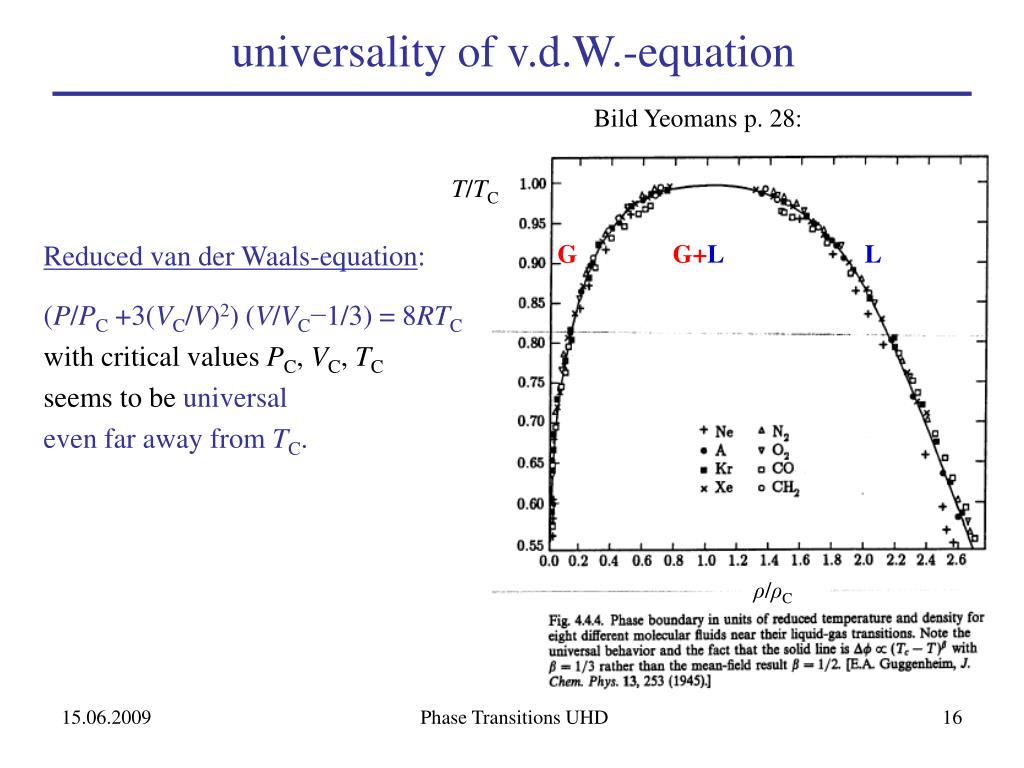
The experimental data collapsing onto a single curve is a powerful illustration of universality. Near the critical point, nature seems to forget the specific details of the molecules and conforms to a universal behavior. The Van der Waals model, for all its limitations, provides the first theoretical explanation for this phenomenon. As the notes from resource [LINK](https://www.asc.ohio-state.edu/jayaprakash.1/846/phaseho.pdf) state after deriving this law: "This is an amazing result!".
Test your understanding!
The Law of Corresponding States implies that the critical compression factor must be a universal constant for all Van der Waals fluids. We calculated this value to be in the last lesson.
How can you see this directly from the reduced equation of state, , without going back to the original parameters and ?
Hint: The critical point in reduced coordinates is simply .
Show answer
The reduced equation must hold for all states, including the critical point itself. Let's substitute into the reduced equation:
The equation holds, as it must. Now, what does the definition mean at the critical point?
It means , etc. The expression evaluated at the critical point gives:
Now let's expand this using the definitions of the reduced variables:
If we evaluate this at the critical point (), we get:
This doesn't seem to lead anywhere. Let's try rearranging the reduced equation of state.
From , let's rewrite it in terms of the compressibility factor .
Note that .
So, is the factor that relates the reduced variables to the compressibility factor.
The fact that a single universal equation connects implies that there must be a universal relationship between them. The prediction for comes from the specific coefficients (3, 3, 1, 8) in the reduced equation, which in turn came from the structure of the original vdW equation. The value is essentially a statement about the shape of the critical isotherm at the critical point, which is what the reduced equation describes.
Conclusion
In this lesson, we took a major conceptual step forward, moving from a model of a specific gas to a universal law of nature.
Key Takeaways:
- By scaling pressure, volume, and temperature by their critical values, we define reduced variables .
- In terms of these variables, the Van der Waals equation simplifies to a universal form, , which is independent of the substance-specific parameters and . This is the Law of Corresponding States.
- This law is a direct manifestation of universality: near a critical point, the physical behavior of a system (its equation of state) becomes independent of its specific microscopic constituents.
- The collapse of experimental data for different gases onto a single curve (the Guggenheim plot) provides strong evidence for this principle.
Preview of the Next Lesson:
The Law of Corresponding States tells us that the behavior near the critical point is universal. But how does the system behave? For our next lesson, we will analyze the reduced Van der Waals equation in the immediate vicinity of the critical point . By expanding the equation around this point, we will derive the mean-field critical exponents (). These exponents are universal numbers that describe the power-law singularities in quantities like density, compressibility, and the pressure-volume relationship as the critical point is approached. This will be our first quantitative characterization of a critical point.