Recommended resources
The freely available resources this lesson will direct you to.
Hello! Welcome to your first lesson in our course on programming theory.
Given your background and goals, we're starting at a high level to build a conceptual map of the programming language landscape. This first module, "Programming Paradigms in Context," will establish the foundational ideas that we'll explore in greater detail throughout the course.
Today's lesson focuses on the most fundamental division in programming paradigms: imperative versus declarative programming. We will:
- Define and contrast these two approaches.
- Trace their distinct historical origins, linking the imperative style to the von Neumann computer architecture and the declarative style to the mathematical theory of lambda calculus.
This understanding will provide the essential context for our later deep dives into functional programming, type systems, and other advanced concepts.
Let's begin by establishing what we mean by "imperative" and "declarative."
1. The Great Divide: Imperative vs. Declarative
At its core, the difference between these two paradigms is about what you tell the computer to do.
- Imperative programming specifies the sequence of steps, or commands, the computer must take to reach a desired outcome. It's focused on how to compute the result by explicitly changing the program's state.
- Declarative programming describes the logic of a computation—the desired result—without describing the control flow. It's focused on what to compute, leaving the "how" to the language's implementation.
To see this distinction clearly, please read the following short excerpt from the paper "Conception, Evolution, and Application of Functional Programming Languages" by Paul Hudak.
Conception, Evolution, and Application of Functional ...
This section from Hudak's paper provides a concise and clear definition of the imperative and declarative paradigms, using a factorial calculation as a comparative example.
Please read the section titled 'Programming Language Spectrum' on page 361. Focus on how it characterizes imperative languages (implicit state, commands, sequencing) versus declarative languages (no implicit state, expressions).
As the reading highlights, an imperative program is like a detailed recipe: a list of instructions to be followed in order. A declarative program is more like a mathematical equation: it states a truth or a relationship.
Consider summing a list of numbers.
Imperative Approach (Python-style):
You would initialize a variable, loop through the list, and update that variable on each iteration. You are managing the state (total) step-by-step.
def sum_list(numbers):
    total = 0  # 1. Initialize state
    for num in numbers: # 2. Sequence through the data
        total = total + num # 3. Modify the state
    return total
Declarative Approach (Haskell-style):
You would state the definition of a sum: the sum of an empty list is 0, and the sum of a non-empty list is the first element plus the sum of the rest of the list.
sum_list [] = 0
sum_list (x:xs) = x + sum_list xs
Notice there are no steps, no loops, and no changing variables. We've simply defined what sum_list is.
These two fundamentally different ways of thinking about programming didn't arise in a vacuum. They are the products of two very different historical and intellectual traditions, which we'll explore next.
2. The Imperative Paradigm and the Von Neumann Architecture
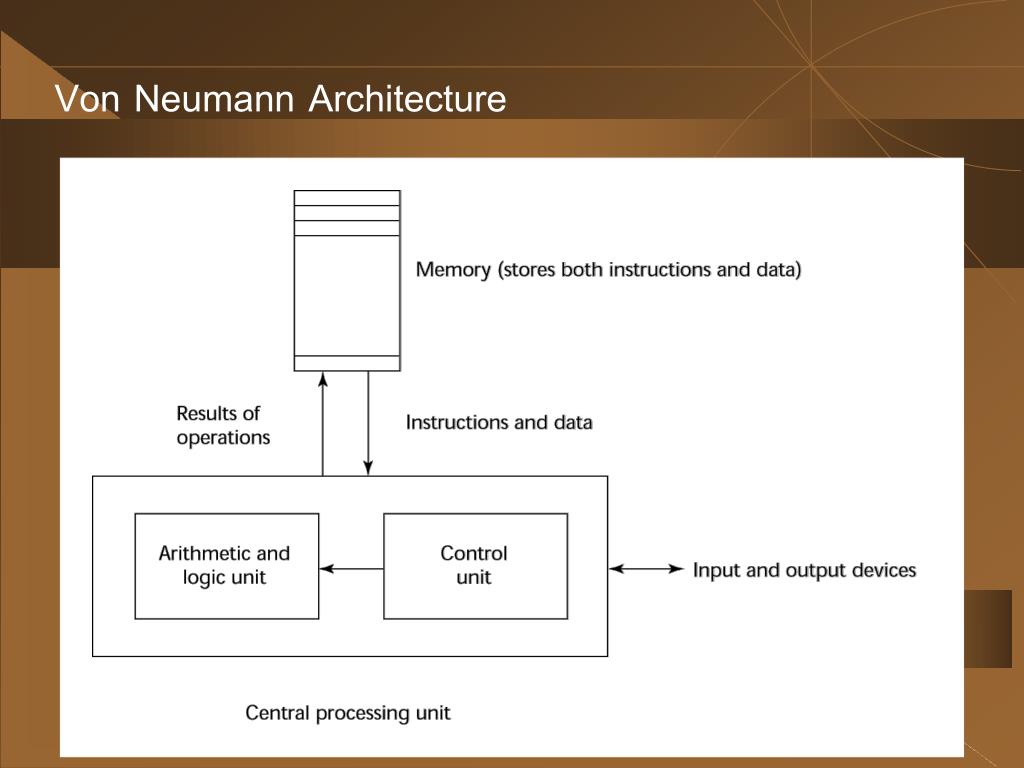
The imperative style of programming is a direct reflection of the underlying hardware of most computers built since the 1940s. This design is known as the Von Neumann architecture.
To understand this connection, let's look at the architecture itself.
This video from MIT OpenCourseWare provides a clear and concise explanation of the Von Neumann model, which is the foundation for almost all modern computers.
Please watch the following segments: 'Introduction to the von Neumann Model' (00:00-01:26), 'Instructions and Data in Memory' (01:26-03:20), and 'Instruction Execution Cycle' (05:25-06:25). Focus on the core components (CPU, Memory) and the fetch-execute cycle.
The key takeaway from the video is that in a Von Neumann machine:
- There is a central memory that stores both program instructions and data.
- The CPU fetches one instruction at a time from memory, executes it, and then fetches the next one.
- An instruction often involves fetching data from memory, performing an operation on it (e.g., in the ALU), and writing the result back to memory.
This physical process—fetching an instruction, modifying a piece of memory—is what imperative programming languages abstract.
The first widely used high-level language, FORTRAN, was designed explicitly to be an efficient abstraction over this architecture.
Concepts in Programming Languages Practicalities Main ...
These slides from your reference text, 'Concepts in Programming Languages', discuss the origins and design of FORTRAN, the archetypal imperative language.
Please review slides 29-32. Pay attention to John Backus's quote on slide 31 and the 'Execution model' on slide 32. Note the emphasis on efficiency and the direct mapping to a machine model with a linear memory array.
As you can see, the design of FORTRAN was heavily influenced by the need to generate efficient machine code for the Von Neumann architecture. The concepts of a linear array of memory, modifiable variables, and sequential execution are direct software analogues of the hardware's structure and operation.
In his 1977 Turing Award lecture, John Backus (the leader of the FORTRAN team) later critiqued this style, which he famously termed "word-at-a-time programming," for being intellectually constrained by its tight coupling to the "von Neumann bottleneck." This critique helped galvanize interest in an alternative: the declarative paradigm.
3. The Declarative Paradigm and the Lambda Calculus
The declarative paradigm, and specifically functional programming, has its roots not in machine architecture, but in mathematics. Its theoretical foundation is the lambda calculus, a formal system developed by the mathematician Alonzo Church in the 1930s.
This next video provides an excellent overview of what lambda calculus is and its historical significance.
Lambda Calculus - Computerphile
This Computerphile video introduces the lambda calculus, explaining its origin with Alonzo Church and its fundamental contrast with the state-based model of Turing Machines.
Please watch from the beginning to 06:04. Focus on the core ideas: lambda calculus as a model of computation based on pure functions, the contrast with Turing's state-based model, and its role as the foundation for functional languages.
As the video explains, lambda calculus provides a model of computation based on two simple ideas:
- Function Abstraction: Defining a function.
- Function Application: Using a function.
Computation is simply the process of evaluating expressions until no more evaluation rules can be applied. Crucially, functions in lambda calculus are pure: they have no side effects and no internal state. Their output depends only on their input.
This is a profound departure from the Von Neumann model. Instead of a sequence of state changes, computation is a process of transformation and reduction.
The first major language to embody these ideas was LISP, developed by John McCarthy around 1960.
Concepts in Programming Languages Practicalities Main ...
Let's return to the 'Concepts in Programming Languages' slides to see how LISP pioneered the declarative, expression-based style.
Please read slides 48-53. Note the key innovations: LISP as an 'expression-based language', the use of recursive functions, and the idea of programs as data. This contrasts sharply with FORTRAN's statement-based model.
While early LISP was not purely functional (it included imperative features for pragmatic reasons), its core was expression-based and it introduced key functional concepts like recursion over lists and higher-order functions. It demonstrated that a programming language could be built on a mathematical foundation (lambda calculus) rather than as a direct abstraction of a machine architecture. Your own experience with Lisp will give you a direct feel for this different style.
Conclusion
Today, we've drawn the map of the two primary programming paradigms.
Key Takeaways:
-
Imperative Programming:
- Focuses on how to compute.
- Consists of a sequence of commands that modify program state.
- Its historical origin is the Von Neumann architecture, which it directly abstracts (sequential instruction fetching, mutable memory).
- Archetype: FORTRAN, C.
-
Declarative Programming:
- Focuses on what to compute.
- Consists of expressions that define relationships and transformations.
- Its historical origin is lambda calculus, a mathematical model of computation based on pure functions.
- Archetype: LISP, ML, Haskell.
It's useful to think of the move from imperative to declarative programming not as a rejection of one for the other, but as a step up in abstraction. Paul Hudak draws a powerful analogy between this shift and the earlier shift from unstructured (goto-based) to structured programming.
Conception, Evolution, and Application of Functional ...
This final excerpt from Hudak's paper frames functional (declarative) programming as a logical evolution of imperative programming, much like structured programming was an evolution that replaced the goto statement.
Please read the first few paragraphs of Section 4, 'Dispelling Myths About Functional Programming' (pages 403-404). Focus on the analogy between 'goto-less' programming and 'assignment-free' programming.
This perspective—viewing functional programming as a discipline that replaces explicit state mutation with more structured constructs like recursion and data transformation—is a key theme we will return to throughout this course.
Preview of the Next Lesson:
In our next lesson, we will build directly on this foundation. We'll examine a famous software design challenge known as the Expression Problem and contrast how object-oriented (a subtype of imperative) and functional (declarative) languages approach solving it. This will make the abstract differences between the paradigms concrete and highlight their respective strengths and weaknesses.