Recommended resources
The freely available resources this lesson will direct you to.
- How to Introduce Yourself Professionally (in 3 steps!)www.youtube.com
- How to Introduce Yourself to a New Team (CONFIDENTLY AND EFFECTIVELY)www.youtube.com
- Develop a 30-Second Elevator Pitch – Career Hub | Duke Universitycareerhub.students.duke.edu
- Job & Internship Fair Preparationcareercenter.umich.edu
Hello. In the previous lesson, you revised an executive-facing message so that its grammar, claims, and request were clear. Now the same discipline moves into speech. In about 40 minutes, you’ll build and deliver a professional introduction that tells a senior decision-maker what you do, why you are speaking with them, and where the conversation could go next.
A 30-second introduction is not your full career history or a compressed sales presentation. Its job is to give the listener enough context to begin a useful conversation.
Give the listener a reason to keep talking
When you introduce yourself to a senior decision-maker, three points matter most: your role, the work you do, and your purpose in this conversation. A relevant detail about your experience can add credibility, but only if it helps the listener understand those points. An unverified promise or a long list of responsibilities will make the opening harder to follow.
The University of Michigan Career Center’s Job & Internship Fair Preparation is written for conversations with employers, but its advice to select relevant experience, state a purpose, and finish with a question also applies here. Read the indicated portion as a guide to what an introduction does, rather than as a script to copy.
Job & Internship Fair Preparation
Read the University of Michigan Career Center’s approach to an elevator pitch for its emphasis on relevance and conversation. Its rehearsal advice will also be useful when you practise aloud later.
Under “Elevator Pitch & Strategy,” find the subsection “Elevator Pitch.” Read the pitch guidance, beginning with the definition of a short introduction and ending with the example open-ended question. Notice how “your purpose” differs from a description of your past work. Then, under “Strategy | The 3Rs,” find “Rehearse” and read the rehearsal advice, from the suggestion to practise aloud through the suggestion to record yourself.
The following four-step visual presents a related pattern. Its example is about seeking a job, not speaking with a potential business customer. Keep the structure, but change the purpose to fit the conversation.
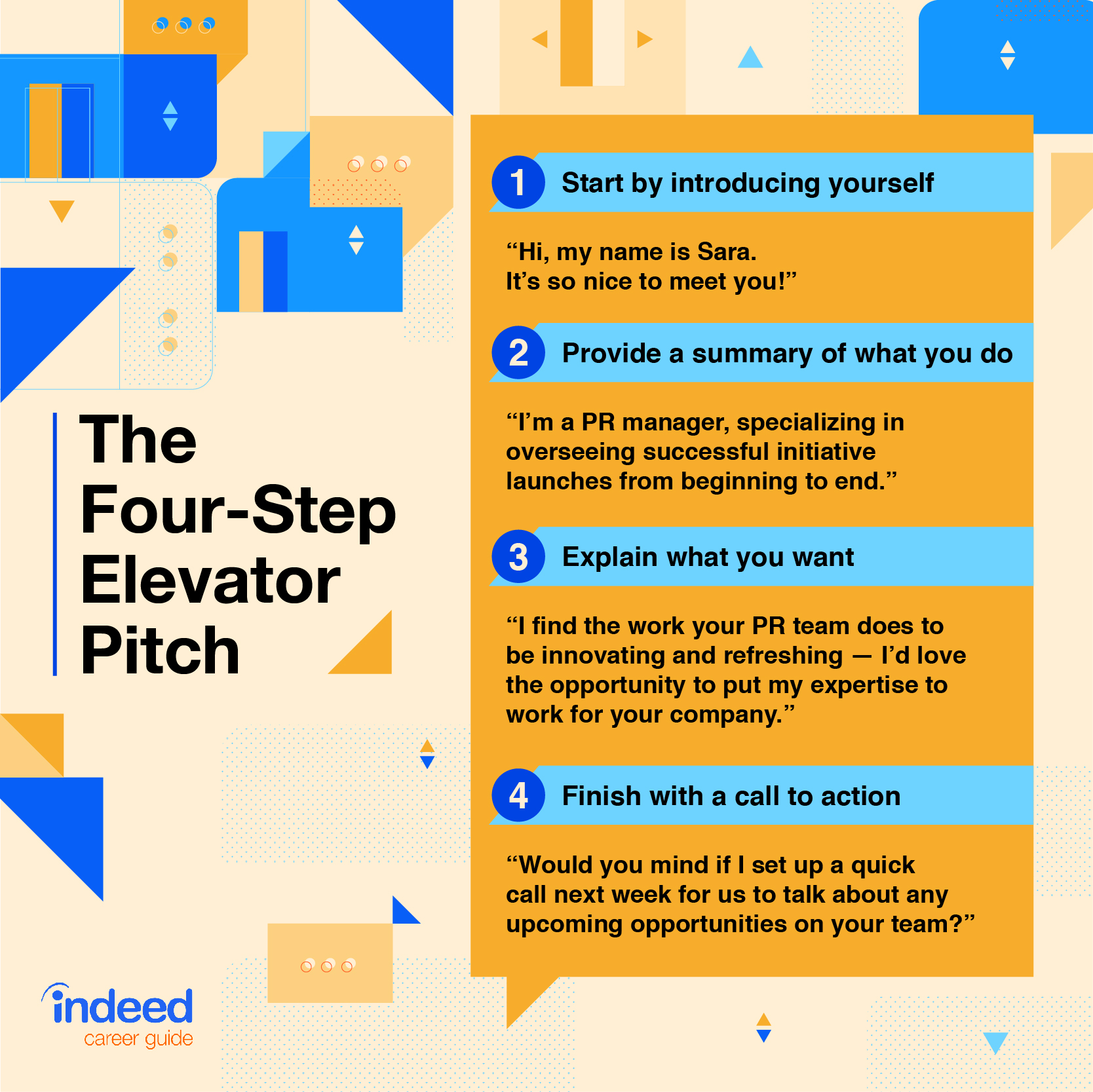
For an executive conversation, “what you want” might be to understand a priority, not to announce that you want to work for the listener’s organization. The closing could invite the listener to describe that priority. That gives them room to correct your assumptions before you discuss an offering.
Shape the message to fit 30 seconds
A useful way to choose material is to think in terms of present, past, and future: what you do now, one relevant point that establishes your perspective, and why you are here today. Maria Sheeran demonstrates this pattern in How to Introduce Yourself Professionally (in 3 steps!). Watch how she limits each part; you do not need to adopt the exact wording of her examples.
How to Introduce Yourself Professionally (in 3 steps!)
Watch Maria Sheeran’s “How to Introduce Yourself Professionally (in 3 steps!)” for a brief structure you can adapt to an executive conversation.
Watch the framework, then the present for how to state a role without listing every duty. In the background, notice that she selects one pertinent detail rather than a full history. Finish with the future and the complete example. Her closing expresses enthusiasm; for this lesson, make your own closing state a specific conversational purpose.
The video’s introduction can be shorter than 30 seconds. You can use the remaining time to make your purpose clear and leave space for a natural question. At a measured speaking pace, roughly 55–65 words is a reasonable starting draft for 30 seconds, but your recording—not the word count—will tell you whether it fits.
Here is an illustrative introduction for a client-facing conversation:
Hello, I’m a client solutions adviser focused on operational reporting. I work with leadership teams to understand where reporting takes time and where a more consistent process could help. I’m here to learn which reporting outcomes matter most to your team and, if useful, explore whether our approach is relevant. Would it be helpful to start with your priorities?
The opening establishes a role and area of work. The middle explains the speaker’s perspective without claiming that the listener has a reporting problem. The ending states a purpose and offers the listener an easy way into the conversation. It does not promise a result before the speaker understands the situation.
For your own version, use your real role and work. If you cannot substantiate an achievement, leave it out; a precise account of what you do is stronger than an impressive-sounding claim you cannot explain. Aim to sound like a person beginning a conversation, not someone reciting a profile.
Deliver it with a confident, conversational tone
Confidence is audible clarity, not volume or certainty about things you do not know. Speak at a pace that lets the listener absorb your role and purpose. Pause briefly after your opening sentence, and give the final question a genuine questioning tone. Avoid rushing through qualifications to reach the “important” part: the listener needs the context to understand why you are asking.
Practise aloud rather than polishing the script only on the page. Record one complete delivery and time it. As you listen, check whether your role is understandable on first hearing, whether the purpose sounds specific, and whether the ending invites a response. If the recording runs long, remove a less relevant detail before speaking faster. If it sounds memorized, keep the three main ideas but allow the wording to vary slightly on the next delivery.
Try one final recording without reading every word. A brief glance at three prompts—role, relevant work, purpose—can help you retain the structure while sounding natural. The goal is not a flawless performance; it is an introduction you can deliver clearly when the conversation begins.
Key takeaways
A strong 30-second introduction gives your role, selects only relevant work, and states why you are speaking with this listener. Deliver it at a measured pace, with claims you can support and a closing that opens the conversation.
In the next module, you’ll build on that opening by asking questions that uncover an executive’s priorities, challenges, and desired outcomes.