Recommended resources
The freely available resources this lesson will direct you to.
Hello Shiva,
Welcome to the final lesson in our module on core engineering mechanics. In our previous session, we established the power of the impulse-momentum principle for analyzing rigid body rotation, especially for problems involving time. We even touched upon its application in impact scenarios, like a projectile embedding in a rotating disk. Today, we will expand on this foundation to formally tackle the dynamics of colliding bodies.
This lesson focuses on solving problems involving impact, a topic that frequently appears in the UPSC exam. We will dissect the physics of collisions, distinguishing between different types of impact and levels of elasticity. Your main tools will be the conservation of linear momentum, which you are already familiar with, and a new concept: the coefficient of restitution. Mastering their combined application is key to efficiently solving these problems.
By the end of this lesson, you will be able to systematically analyze and solve problems for both direct (central) and angled (oblique) collisions.
1. The Anatomy of an Impact
An impact is a collision between two bodies that occurs over a very short time interval, during which large impulsive forces are exerted. In the analysis of such events, we typically neglect other forces (like gravity or friction) because they are insignificant compared to the large, short-duration impact forces.
Impacts are categorized based on the geometry of the collision.
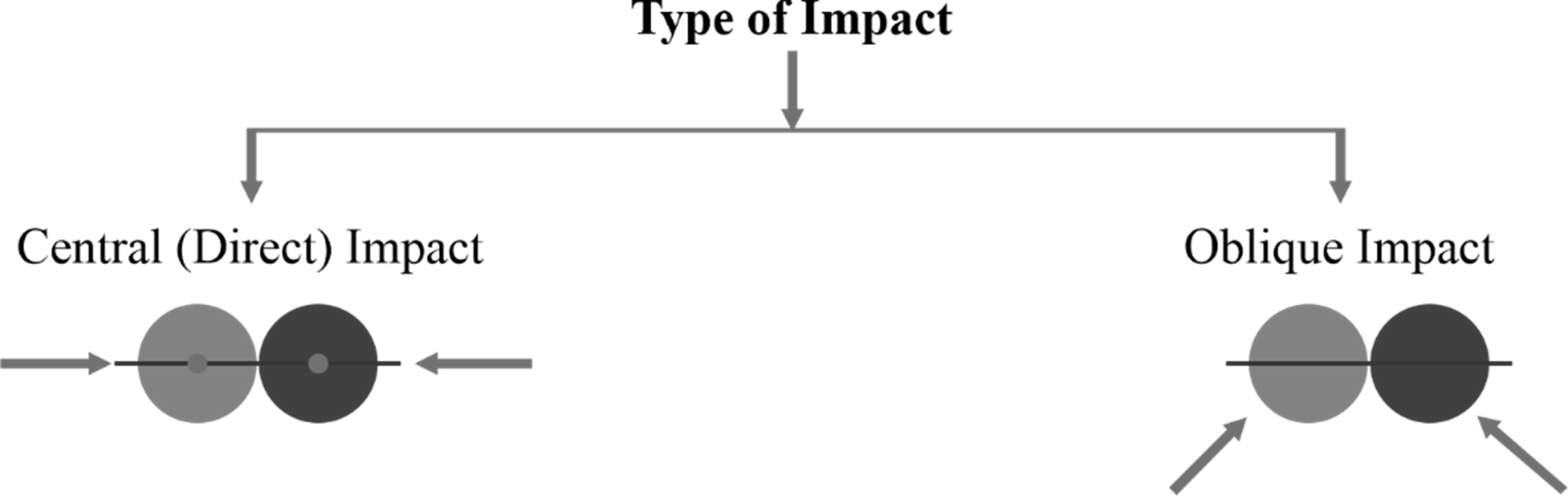
- Central (or Direct) Impact: This occurs when the initial velocities of the colliding bodies are directed along the line of impact—the line passing through the mass centers of the bodies. Think of two billiard balls hitting each other head-on.
- Oblique Impact: This occurs when the initial velocity of one or both bodies is at an angle to the line of impact. A billiard ball striking a cushion at an angle is a classic example.
To analyze these collisions, we need a mathematical framework.
2. The Governing Equations of Impact
For a system of two colliding particles (A and B), we can generally solve for their final velocities using two primary equations.
a) Conservation of Momentum
As we saw in the previous lesson, if the net external impulse on a system is zero, its total momentum is conserved. During the brief moment of impact, the large impulsive forces between the particles are internal to the system. They are equal and opposite (Newton's Third Law), so their net effect on the system's total momentum is zero. Therefore, the total momentum of the system just before impact is equal to the total momentum just after impact. This principle is applied along the line of impact:
Here, the subscript 'x' denotes the component along the line of impact. For central impact, this simplifies to the scalar equation: .
b) The Coefficient of Restitution (e)
This single momentum equation has two unknowns: the final velocities and . We need a second equation, which comes from the coefficient of restitution (e). This coefficient is a measure of the "bounciness" of the collision and is defined as the ratio of the relative velocity of separation to the relative velocity of approach, both measured along the line of impact.
The value of tells us about the nature of the collision and the associated energy loss:
- Perfectly Elastic Collision (): No kinetic energy is lost. The relative speed of separation is equal to the relative speed of approach.
- Perfectly Plastic (or Inelastic) Collision (): The bodies stick together after impact and move with a common final velocity. This corresponds to the maximum possible loss of kinetic energy.
- Semi-Elastic/Inelastic Collision (): This is the case for most real-world collisions, where some kinetic energy is lost to heat, sound, or permanent deformation.
The following reading provides a concise summary of these core concepts.
This document provides a clear, structured overview of impact mechanics. It's a great reference for the fundamental definitions and equations.
Please focus on these key sections: Read the initial definitions of central and oblique impact. Study the section on Central Impact. Pay close attention to the conservation of momentum equation and the definition of the coefficient of restitution. Finally, review the explanation of plastic and elastic impacts and the concept of energy loss.
3. Solving Central Impact Problems
With the two governing equations, solving central impact problems becomes a systematic process of applying algebra. The following video demonstrates this with a classic example of two balls colliding head-on.
Impact: Coefficient of Restitution (learn to solve any problem)
This video from "Question Solutions" clearly demonstrates the application of the core principles to solve impact problems.
First, watch the brief conceptual introduction from the beginning to the first example. Then, focus on the first worked problem, which shows how to solve for the final velocities of two balls after a central impact. Notice how the two main equations—conservation of momentum and coefficient of restitution—are set up and solved simultaneously.
The general procedure is:
- Establish a coordinate system (e.g., positive to the right).
- Write the conservation of momentum equation for the two-body system.
- Write the coefficient of restitution equation.
- Solve the resulting two linear equations for the two unknown final velocities.
- If required, calculate the kinetic energy of the system before and after the impact to find the energy loss: .
4. Analyzing Oblique Impact
Oblique impact problems appear more complex, but the strategy is straightforward: decompose the problem into components along and perpendicular to the line of impact.
Let's define our coordinate system with the x-axis along the line of impact and the y-axis perpendicular to it (in the plane of contact).
-
Along the Line of Impact (x-axis): The physics are identical to central impact. The system's momentum is conserved, and the coefficient of restitution applies.
-
Perpendicular to the Line of Impact (y-axis): Assuming the colliding surfaces are smooth, there are no impulsive forces in the y-direction. Therefore, the linear momentum of each particle is conserved independently in this direction.
This decomposition gives us four equations to solve for the four unknowns (the x and y components of the final velocities of both bodies).
We will now use the same document to understand the method for oblique impact and see it applied.
First, read the section on Oblique Impact. Pay close attention to the four key equations used for analysis: two for the line of impact (x-axis) and two for the perpendicular direction (y-axis). Next, carefully review the Procedure for Analysis, which summarizes the step-by-step method. This is your general framework for all impact problems. Finally, work through the first Example involving a ball striking an inclined plane. Follow the solution steps, noting how they first use kinematics to find the velocity just before impact, then set up axes along and perpendicular to the incline (the line of impact), and apply the oblique impact equations to find the final velocity. A similar two-part problem structure is common in exams.
Conclusion
This lesson concludes our exploration of particle and rigid body kinetics. We have developed a systematic method for analyzing collisions, which are a special, but important, application of the impulse-momentum principle.
Key Takeaways:
- Impact problems are solved using two main principles: conservation of linear momentum for the system and the coefficient of restitution (e). Both are applied along the line of impact.
- For central impact, these two equations are sufficient to find the final velocities.
- For oblique impact, you must resolve velocities into components. Along the line of impact, the same two principles apply. Perpendicular to it, the momentum of each body is conserved individually.
- The value of e dictates the collision type: (perfectly elastic, KE conserved), (perfectly plastic, bodies stick together), or (semi-elastic, some KE is lost).
With this, we have completed the Engineering Mechanics portion of your syllabus. Our next lesson will mark a transition back to Strength of Materials, starting with Module 2: Complex Stress and Strain Energy. We will begin by analyzing plane stress conditions using Mohr's circle, a fundamental graphical method for understanding stress transformations in materials.