Recommended resources
The freely available resources this lesson will direct you to.
- How LLMs Actually Generate Text (Every Dev Should Know This)www.youtube.com
- LLM Transformer Model Visually Explainedpoloclub.github.io
- How Tokenization, Inference, & LLMs Actually Workwww.youtube.com
- Greedy? Min-p? Beam Search? How LLMs Actually Pick Words – Decoding Strategies Explainedwww.youtube.com
- How LLM Inference Works - Arpit Bhayaniarpitbhayani.me
- Autoregressive Generation: How GPT Generates Text Token by ...mbrenndoerfer.com
Welcome to your second lesson. In our previous session, we explored how raw text is converted into tokens and token IDs, preparing it for the model. Now, we'll dive into the next crucial stage: how a Large Language Model uses these tokens to generate a response.
This lesson focuses on the core mechanism of text generation in models like GPT. We'll unpack the autoregressive token-by-token generation process. Understanding this sequential, iterative loop is fundamental for an LLM Ops Engineer. It's the reason why generating long responses takes time, and it forms the basis for many performance optimizations we will cover later in this course, such as the KV cache.
By the end of this lesson, you will be able to describe how an LLM generates text one token at a time by repeatedly predicting the most likely next token based on all the preceding ones.
1. The Generation Loop: One Token at a Time
At its heart, an LLM is a next-token predictor. It doesn't plan an entire sentence or paragraph in advance. Instead, it generates a response piece by piece in a loop.
The video below provides an excellent overview of the five key steps involved in generating a response, from the initial prompt to the final output. It beautifully illustrates the iterative nature of this process.
How LLMs Actually Generate Text (Every Dev Should Know This)
This video, from the LearnThatStack channel, explains the end-to-end process of text generation.
Watch the entire video. As you watch, focus on understanding these five stages: Tokenization: A quick recap of our last lesson. Embeddings: How token IDs are converted into meaningful numerical vectors. Transformer: How the model processes context (we'll dive deeper into this in the next lesson). Probabilities: How the model produces a score for every possible next token. Sampling: How one token is selected from that probability distribution. Pay special attention to the final section, "The Loop", as this is the essence of autoregressive generation.
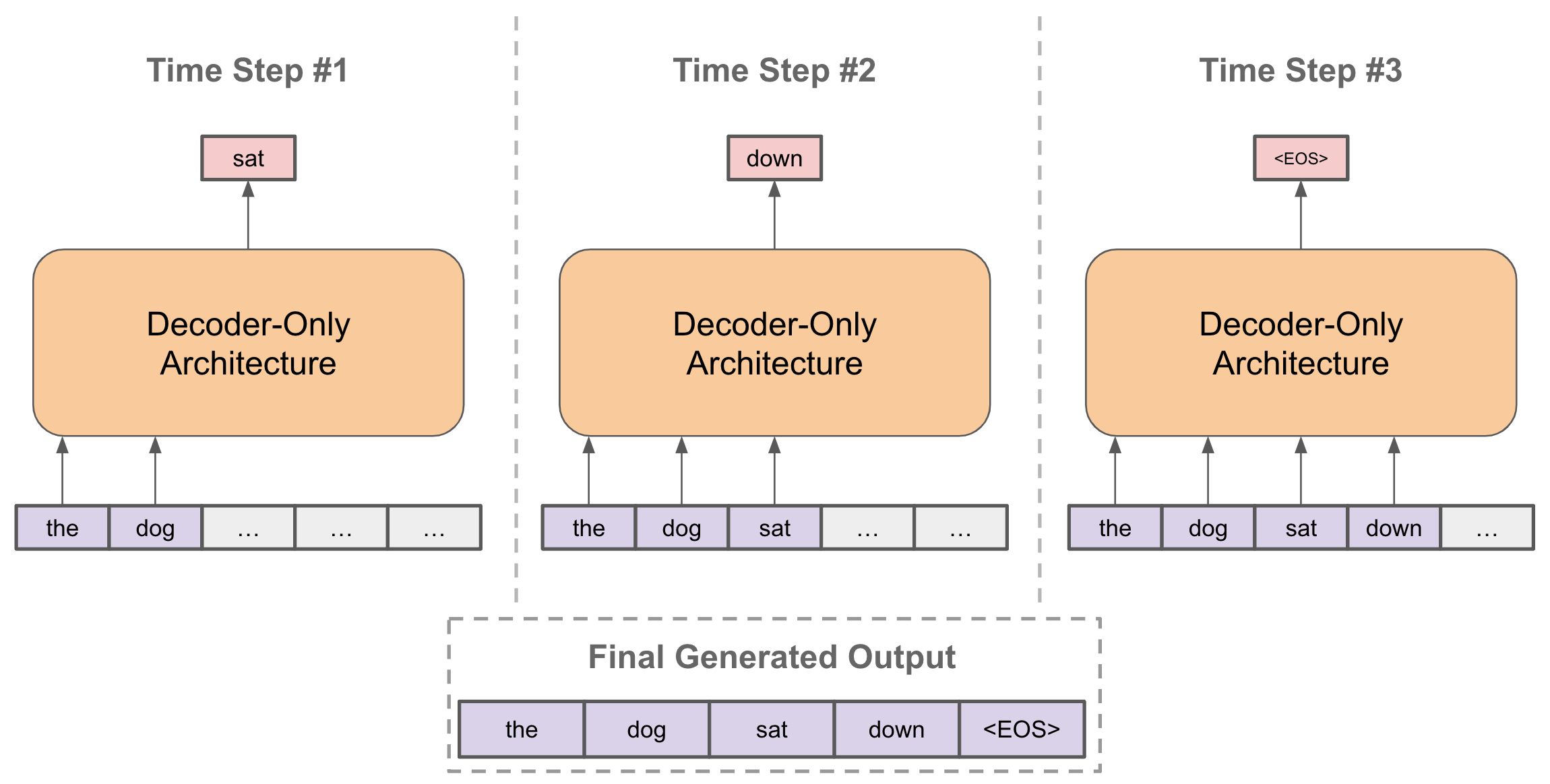
As the video explained, the process is cyclical:
- The model takes a sequence of tokens as input.
- It calculates a probability distribution over its entire vocabulary for what the very next token should be.
- A token is selected from this distribution using a sampling strategy.
- This newly selected token is appended to the input sequence.
- The process repeats with the new, longer sequence until a stopping condition is met (like generating a special end-of-sequence token or reaching a maximum length).
This is why the process is called autoregressive: the model's prediction at each step is regressed on (or conditioned on) its own previous outputs.
The diagram below provides a static, step-by-step visualization of this loop.
2. The Mathematical Foundation
This intuitive process is grounded in a fundamental principle of probability: the chain rule. The probability of an entire sequence of tokens can be broken down into the product of conditional probabilities of each token given its predecessors.
For a sequence of tokens , the probability is:
Each term is exactly what the model calculates in one step of the generation loop.
The following article provides a more formal and technical explanation of autoregressive generation, including a Python code snippet that implements a simple generation loop. Given your background, seeing this in code will help connect the concept to a practical implementation.
Autoregressive Generation: How GPT Generates Text Token by Token
This article by Marc Brehmer provides a clear, technical breakdown of the generation process.
Read from the beginning of the article up to, but not including, the section "Why Naive Generation is Expensive". Focus on these key parts: The definition of autoregressive generation. The greedy_generate Python function, which shows a minimal implementation of the loop. The detailed trace of the generation loop with diagrams. The mathematical formulation using the chain rule and the role of the softmax function in converting model outputs (logits) into probabilities.
3. The Two Phases of Inference: Prefill and Decode
The autoregressive process creates two distinct computational phases during inference, a critical concept for performance optimization.
- Prefill (or Prompt Processing): This is the first step where the model processes the entire input prompt. This can be done in parallel, as all input tokens are known. The main goal here is to generate the hidden states for each input token and compute the probability distribution for the first output token.
- Decode (or Generation): This phase consists of the sequential, token-by-token loop we've been discussing. Each step is fast but must be done one after another, as the prediction for token depends on the result of token .
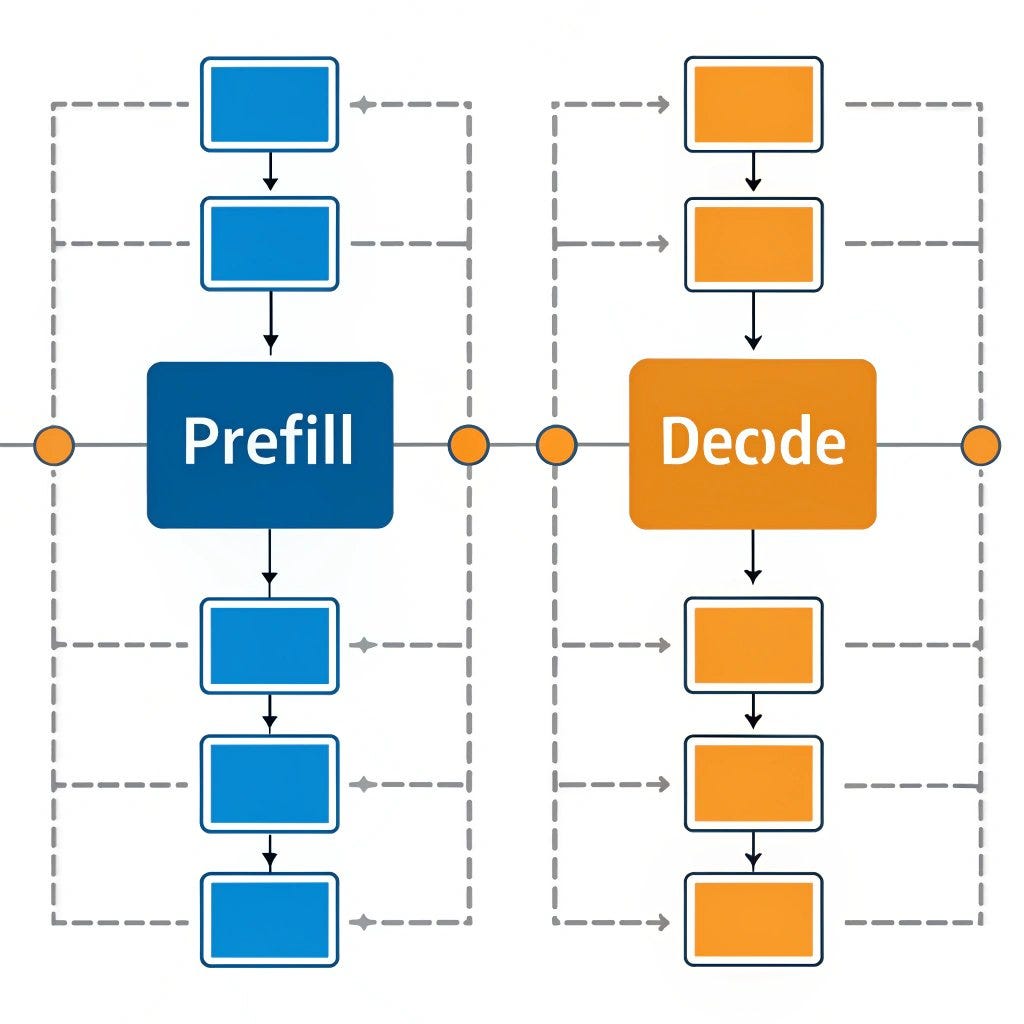
This distinction is vital for an Ops engineer. The Prefill phase is typically compute-bound, limited by the raw processing power of the GPU. The Decode phase is often memory-bandwidth-bound, as each step requires loading the large model weights from GPU memory to process just one token. Understanding this helps in diagnosing bottlenecks and optimizing serving infrastructure, which we'll cover in detail later.
4. Steering the Generation: Sampling Strategies
The model doesn't output a token; it outputs a probability distribution. The final step in each loop is to sample a token from this distribution. You have control over this step using parameters, which allows you to steer the model's behavior between deterministic and creative.
The two most important parameters are:
- Temperature: Controls the randomness of the output. A low temperature (e.g., 0.2) makes the model more confident and deterministic, favoring high-probability tokens. A high temperature (e.g., 1.0 or higher) "flattens" the distribution, increasing the chance of selecting less likely tokens, leading to more diverse or "creative" outputs.
- Top-P (Nucleus) Sampling: Instead of considering all tokens in the vocabulary, Top-P sampling considers only the smallest possible set of tokens whose cumulative probability exceeds a threshold
P. This dynamically narrows the pool of candidates to the most plausible options, avoiding bizarre tokens that can appear with high temperature alone.
The following interactive tool is a fantastic way to build an intuition for these parameters.
This interactive tool visualizes the internals of a GPT-2 model during text generation.
Go to the Transformer Explainer page. Enter a short prompt in the text box (e.g., "The best programming language is"). Use the Temperature slider. First, set it to a low value like 0.1 and click Generate. Observe the output and the probability distribution on the right. The top choice will have a very high probability. Now, set Temperature to 1.0 or higher and click Generate again with the same prompt. Notice how the probabilities are more evenly distributed and the output is less predictable. Experiment with the Top-k and Top-p settings to see how they prune the list of candidate tokens.
By playing with this tool, you can see how an Ops engineer, by configuring these serving parameters, directly influences the trade-off between factual consistency and creative exploration in the model's output.
Summary
In this lesson, we dissected the core mechanism of LLM text generation. This sequential process is a cornerstone of modern LLMs and a key consideration for anyone managing them in production.
Here are the key takeaways:
- LLMs generate text autoregressively, producing one token at a time in a loop.
- Each new token is predicted based on a probability distribution conditioned on the original prompt and all tokens generated so far.
- The generation process consists of two phases: a parallel prefill phase for the prompt and a sequential decode phase for the output tokens.
- Parameters like temperature and top-p give you control over the sampling strategy, allowing you to tune the model's output for creativity or determinism.
Now that we have a high-level understanding of the generation loop, the next lesson will zoom in on a critical component mentioned in this lesson: the attention mechanism. We will explore its role in processing context and introduce the KV cache, a crucial optimization that makes autoregressive generation efficient enough for practical use.