Recommended resources
The freely available resources this lesson will direct you to.
Welcome to the next lesson in our journey through data structures! In the previous session, we explored tree traversal algorithms—in-order, pre-order, and post-order—which are powerful ways to visit and process every node in a tree. These methods are fundamental but often involve visiting multiple nodes to find a specific one, with a search time of in a balanced tree or in the worst case.
But what if we need to access data almost instantaneously? Imagine a dictionary where you don't have to flip through pages but can magically open to the exact right page just by knowing the word. This is the promise of hash tables, a data structure optimized for incredibly fast lookups, insertions, and deletions.
Today, we will lay the conceptual groundwork for this powerful tool. You will learn to explain the concept of hashing, hash functions, and collisions. This lesson will focus on the "what" and "why" behind hash tables, preparing us to build one in C in our next session.
1. The Need for Speed: From Arrays to Hash Tables
At its core, a hash table is a clever use of an array. We know that accessing an element in an array by its index is an operation—it's immediate. The challenge, however, is that we usually want to look up data using a meaningful key, like a username string, not an arbitrary integer index. Searching for that key in an array would require a linear scan, which is an inefficient operation.
Hash tables solve this by creating a direct link between the key and an array index.
HashMaps & Dictionaries, Explained Simply
To understand the problem that hash tables solve, watch the first part of the video "HashMaps & Dictionaries, Explained Simply" from Nic Barker.
The Problem: This section clearly illustrates the inefficiency of using a simple array for key-based lookups (like finding a user profile by username). A Hash Function: Here, the video introduces the core idea: using a hash function to convert a string key into a number that can be used as an array index.
As the video explains, the central idea is to use a special function—a hash function—to compute an array index directly from the key.

2. The Hash Function: The Engine of the Hash Table
A hash function is a procedure that takes a key and maps it to an integer index. This index is then used to store or retrieve the corresponding value in the hash table array.
A simple hash function for a string, as mentioned in the video, could be to sum the ASCII values of its characters. Let's make this more robust. Usually, the array we use for the hash table is much smaller than the range of possible hash values. To ensure the index is always within the array's bounds, we use the modulo operator (%).
The most common hashing scheme is:
Let's watch a clear, practical example of this.
Hash Tables and Hash Functions
This video, "Hash Tables and Hash Functions" from Computer Science Lessons, provides a great walkthrough of the hashing process.
Hashing Concept: Watch how the presenter populates an array by calculating an index for each name. The hash function used is (sum of ASCII codes) % 11. This demonstrates the core mechanism. Hash Function Defined: This part formally defines a hash function and introduces the idea of key-value pairs, which is how hash tables are often used.
For a deeper dive into the properties and types of hash functions, the following reading is excellent.
Introduction to Hashing in Programming | EnjoyAlgorithms - Medium
This article from EnjoyAlgorithms on Medium formalizes the concepts we've just seen.
Start at the section "The Idea of the Hash Table" and read through to the end of "A simple Hash Function for strings". This reading covers: How a hash table improves upon direct addressing. The formal definition of a hash function and its purpose. The division method (k mod m), which is the most common technique. Pay attention to the advice on choosing a prime number for the table size m. How to handle non-numeric keys like strings by converting them to numbers first.
A good hash function should have two main properties:
- It should be fast to compute. If the hash function is slow, it defeats the purpose of having a fast data structure.
- It should distribute keys uniformly. It should spread keys evenly across all the available slots in the array, minimizing clumps and gaps.
3. Collisions: An Unavoidable Problem
What happens if our hash function generates the same index for two different keys? For example, using the (sum of ASCII) % 11 function, what if "Sue" and "Mia" both result in an index of 4? This is called a collision.
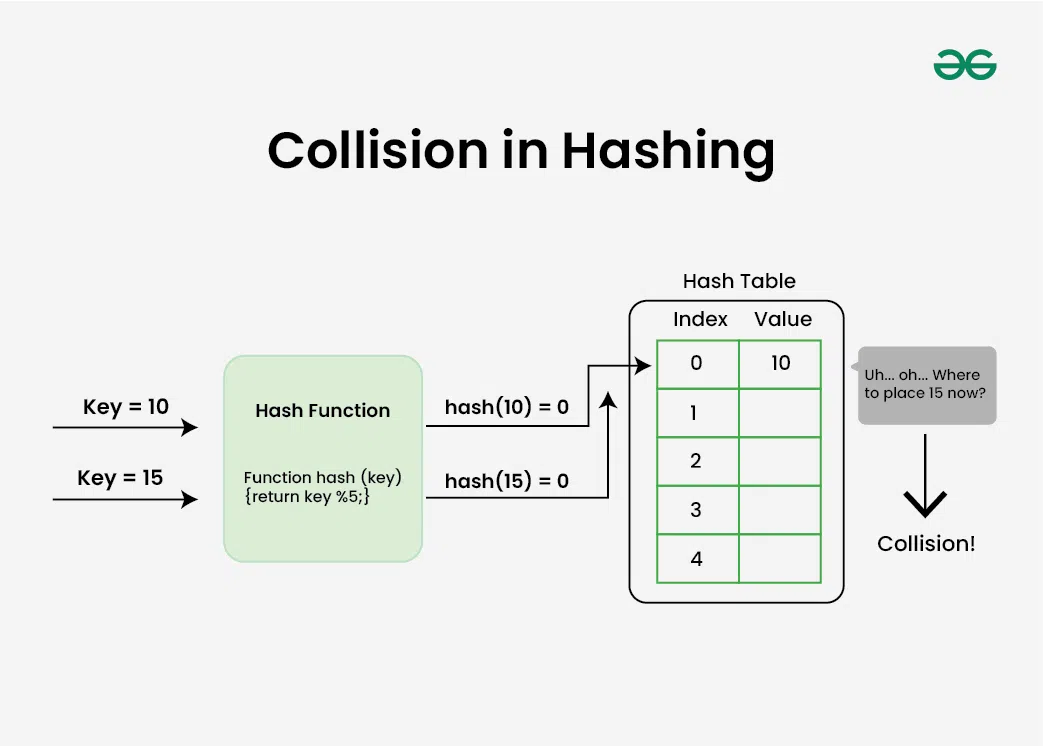
Collisions are not just a possibility; they are a mathematical certainty in any practical hash table. This is due to the pigeonhole principle: if you have more items (keys) than you have containers (array slots), at least one container must hold more than one item.
The next video segment explains this inevitability perfectly.
HashMaps & Dictionaries, Explained Simply
Let's return to the "HashMaps & Dictionaries, Explained Simply" video.
Why Collisions Happen: This part explains why even the best hash functions can't prevent collisions. It uses a powerful example comparing the number of possible 7-letter usernames to the limited range of a 32-bit hash. Using Modulo: This section provides an excellent visual explanation of how the modulo operator maps a vast range of hash values into a small, fixed number of array slots ("buckets"), which is the direct cause of most collisions.
Since collisions are unavoidable, every hash table implementation must have a collision resolution strategy. While we won't implement these today, it's crucial to know the two main approaches.
- Open Addressing (e.g., Linear Probing): If the target slot is occupied, we probe for the next available empty slot in the array and place the item there.
- Separate Chaining: Each slot in the array acts as a "bucket" that can hold multiple items. This is typically implemented using a linked list, where each slot in the array stores the head of a list containing all items that hashed to that index.
The following video segments will give you a clear visual introduction to these two strategies.
Hash Tables and Hash Functions
Let's watch the final segments of "Hash Tables and Hash Functions" to see how collisions are handled conceptually.
Linear Probing: See how collisions are resolved by finding the next empty slot. Notice the "clustering" effect this can cause. Chaining: Observe how this method uses linked lists at each array index to store multiple colliding elements.
4. Practice and Review
Let's do a quick pencil-and-paper exercise to solidify these concepts.
Imagine you have a hash table of size m = 7. Your hash function for strings is sum of ASCII values of the first three letters % 7.
Calculate the hash index for the following keys. Do any of them collide?
"apple"(ASCII: a=97, p=112, p=112)"banana"(ASCII: b=98, a=97, n=110)"cherry"(ASCII: c=99, h=104, e=101)"date"(ASCII: d=100, a=97, t=116)"grape"(ASCII: g=103, r=114, a=97)
Solution:
apple:(97 + 112 + 112) % 7 = 321 % 7 = 6banana:(98 + 97 + 110) % 7 = 305 % 7 = 4cherry:(99 + 104 + 101) % 7 = 304 % 7 = 3date:(100 + 97 + 116) % 7 = 313 % 7 = 5grape:(103 + 114 + 97) % 7 = 314 % 7 = 6
Collision! "apple" and "grape" both hash to index 6. If we were inserting these into our table, we would need a strategy to handle this conflict.
Conclusion
In this lesson, we've unpacked the core theory behind hash tables. You've learned that they offer the potential for extremely fast data operations by directly computing an array index from a key.
Key Takeaways:
- Hashing is a technique that maps a key to an index in an array (the hash table).
- A hash function is the algorithm that performs this mapping. A good hash function is fast and distributes keys uniformly.
- The modulo operator is essential for scaling down large hash values to fit within the bounds of the array.
- A collision occurs when two different keys map to the same index. They are an inevitable consequence of hashing.
- Collision resolution strategies, like linear probing and separate chaining, are required to handle these conflicts.
Preview of the Next Lesson:
Theory is great, but practice is better. In our next session, we will roll up our sleeves and implement a basic hash table in C. We will use the separate chaining method to handle collisions, which will be a fantastic opportunity to combine our knowledge of arrays, pointers, structs, and linked lists.