Recommended resources
The freely available resources this lesson will direct you to.
Hello! Welcome to the sixth lesson in our module on classical and modern critiques of the argument for an unmoved mover.
In our last lesson, we evaluated the profound dilemma between accepting a Necessary Being as the ultimate explanation for reality, versus accepting the Universe as a brute fact that requires no further explanation. We saw that this choice often comes down to which fundamental principles one prioritizes: the Principle of Sufficient Reason or metaphysical parsimony (Occam's Razor).
A key move in arguments for a Necessary Being is to show that an infinite regress of causes is impossible, thereby forcing the need for a terminating, first cause. Today, we will discover that not all "infinite regress" arguments are created equal. In fact, there are two fundamentally different types, and confusing them is a common source of error in these debates.
Our learning outcome is to contrast Aristotle's argument against an infinite hierarchical series with the temporal Kalam cosmological argument. By distinguishing these two lines of reasoning, you will gain a much sharper understanding of what different "first cause" arguments are actually trying to prove.
1. Two Kinds of Causal Series
The entire contrast we are exploring today hinges on the distinction between two types of causal chains. Grasping this is the most critical step.
- Hierarchical Series (per se or "essentially ordered"): A series of causes that must all exist simultaneously to produce the final effect. The causal power of each intermediate member is derived from and dependent on the prior member at the same instant.
- Temporal Series (per accidens or "accidentally ordered"): A series of causes that are ordered sequentially in time. The effect can persist long after the cause has ceased to exist.
The following video provides an excellent explanation of this distinction and clarifies that Aquinas's famous arguments (which he inherited from Aristotle) are about hierarchical series, not temporal ones.
The Argument Atheists Always Get Wrong
This video, titled 'The Argument Atheists Always Get Wrong,' explains the crucial difference between linear (temporal) and hierarchical causation. Pay close attention to the analogies used, such as the potter and the pot, versus the laws of physics sustaining the pot's existence.
Please watch the segment from 06:00 to 10:04. Focus on how the presenter distinguishes a 'cause per accidens' (linear/temporal) from a 'cause per se' (hierarchical).
As the video explains, Aristotle and Aquinas were primarily concerned with hierarchical series. Let's formalize this.
2. Aristotle's Argument: Against an Infinite Hierarchical Regress
Aristotle's argument, later codified in Aquinas's "First Way" (the argument from motion), is about what must be true right now for any change to be occurring.
The core logic is:
- We observe change (motion) in the world.
- Whatever is in the process of changing is being changed by another.
- This chain of concurrent movers cannot be an infinite hierarchical series.
- Therefore, there must be a first mover that is not itself moved by another—an Unmoved Mover.
The crucial step is premise (3). Why can't a hierarchical series be infinite? Because it is a series of instrumental causes. Think of a hand moving a stick that moves a stone. The stick only has the power to move the stone because it is simultaneously being moved by the hand. Its causal power is entirely derived.
If the series were infinite—a stone moved by a stick, moved by another stick, moved by another, and so on forever—it would consist only of instrumental movers. No member of the series would have its own causal power. But a chain of pure instruments, with no prime agent, has no causal power to give. It is like an infinitely long train with no engine; it's not going anywhere.
Implication: An Eternal Universe is Possible
Crucially, this argument says nothing about a beginning in time. Since the hierarchical series is simultaneous, the First Mover must be acting now to sustain all the change happening now. This is perfectly compatible with the universe having always existed. In fact, Aristotle himself believed the world was eternal. The "First Mover" is first in the order of hierarchy and dependence, not first in a temporal sequence.
This is a point often misunderstood, so it's worth seeing it stated clearly.
Cosmological Arguments - PhilPapers
In this short section from his paper 'Cosmological Arguments,' Chad Meister discusses Aquinas's stance on an eternal world, which directly reflects the non-temporal nature of the Aristotelian argument.
Please read the subsection '1.4 The Eternity of the World'. Note how Aquinas (and Leibniz) explicitly state that even an eternal world would still require a cause for its existence.
3. The Kalam Cosmological Argument: Against an Infinite Temporal Regress
Now, let's turn to a completely different style of argument: the Kalam cosmological argument. Its roots are in early Christian and Islamic philosophy, particularly the work of al-Ghazali, and it has been famously revived in contemporary philosophy by William Lane Craig.
The Kalam argument is elegantly simple in its structure.
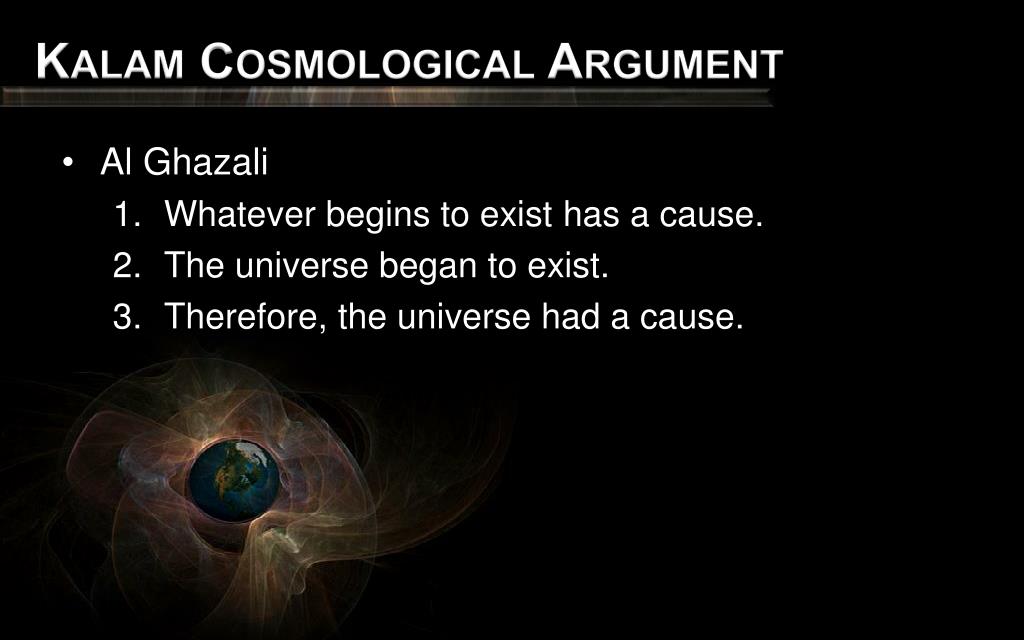
The argument is a syllogism:
- Everything that begins to exist has a cause.
- The universe began to exist.
- Therefore, the universe has a cause.
Notice immediately the fundamental difference. This argument's entire force rests on Premise 2: the universe had a temporal beginning. This is an argument against an infinite temporal series of past events. It aims to prove there was a first moment in time, and thus a creator who initiated that moment.
4. Why Does Kalam Reject an Infinite Past?
The Aristotelian argument rejected an infinite hierarchical series based on the nature of instrumental causality. The Kalam argument rejects an infinite temporal series for entirely different reasons, rooted in the metaphysics of infinity. There are two main philosophical pillars for this claim.
Pillar 1: The Impossibility of an "Actual Infinite"
The first argument is that while the idea of infinity is useful as a concept (a potential infinite), a concretely existing, completed infinite number of things (an actual infinite) is impossible and leads to absurdities.
The classic thought experiment is Hilbert's Grand Hotel, which has an infinite number of rooms, all occupied.
- If a new guest arrives, the manager can ask every guest to move from room n to room n+1, freeing up Room 1. The hotel absorbs the new guest, yet remains full.
- If an infinite number of new guests arrive, the manager can ask every guest to move from room n to room 2n, freeing up all the odd-numbered rooms. The hotel absorbs an infinite number of new guests.
- If all the guests in odd-numbered rooms check out, an infinite number of guests have left, but an infinite number still remain.
Proponents of the Kalam argument claim that while this is fine in abstract mathematics, such a hotel could not exist in reality. The real-world collection of past events, they argue, cannot be an actual infinite. Given your mathematical background, you'll find the nuances of this debate particularly interesting.
Pillar 2: The Impossibility of Forming an Actual Infinite by Successive Addition
The second argument is that even if an actual infinite could exist, it couldn't be formed by adding one member after another. This is often called the argument against "traversing the infinite." The series of past events is just such a collection, formed by one event happening after another. To have reached the present moment from a beginningless past would be like counting to infinity and finishing—which is impossible. For the present to arrive, the temporal series of past events must be finite.
Let's dive into the details of these arguments against an infinite past.
Cosmological Argument - Stanford Encyclopedia of Philosophy
The Stanford Encyclopedia of Philosophy's entry on the Cosmological Argument provides a superb analysis of the Kalam argument's case against an infinite past.
First, read the paragraph in the introduction (part of Section 1) that begins 'Philosophers employ diverse classifications...' to see the key distinction laid out. Then, read '7.2 Impossibility of an Actual Infinite' and '7.3 Successive Addition Cannot Form an Actual Infinite'. As you read, focus on how the arguments from Hilbert's Hotel and 'traversing the infinite' are used to support the claim that the past must be finite.
5. Summary: A Tale of Two Arguments
We can now clearly contrast these two powerful but distinct arguments. They both argue against an "infinite regress," but they mean very different things by that phrase.
| Feature | Aristotelian Argument | Kalam Argument |
|---|---|---|
| Type of Causal Series | Hierarchical (per se), essentially ordered | Temporal (per accidens), accidentally ordered |
| Nature of Causation | Simultaneous, sustaining, instrumental | Sequential, generative |
| Stance on Infinite Regress | Rejects an infinite series of concurrent movers | Rejects an infinite series of past temporal events |
| Stance on Universe's Age | Compatible with an eternal universe | Argues for a temporal beginning of the universe |
| "First Cause" Means... | First in the order of being/hierarchy (a sustainer) | First in the order of time (a creator) |
| Reason for Rejecting Infinity | A series of pure instruments has no causal power. | An actual infinite cannot exist or be formed by successive addition. |
Conclusion
You have now analyzed a critical distinction in the history of philosophy. Aristotle's argument, concerned with a hierarchical series of causes, leads to a First Mover that acts as the constant, simultaneous sustainer of all motion and change in the cosmos. The Kalam argument, concerned with a temporal series of events, leads to a First Cause that acts as a transcendent creator at the beginning of time.
Failing to see this distinction leads to misplaced critiques, such as objecting to Aristotle's argument by saying "But what if the past is infinite?" (irrelevant to a hierarchical series) or objecting to the Kalam argument by pointing to a self-sustaining system (irrelevant to a temporal beginning).
Key Takeaways:
- Aristotle's argument against infinite regress concerns a hierarchical series of simultaneous, sustaining causes. Its conclusion is compatible with an eternal universe.
- The Kalam argument against infinite regress concerns a temporal series of past events. Its conclusion demands a temporal beginning for the universe.
- The reasons for rejecting the infinite series are different: for Aristotle, it's about the logic of instrumental causality; for Kalam, it's about the metaphysics of actual infinities.
- The "First Cause" of Aristotle is a prime sustainer, while the "First Cause" of Kalam is a prime creator.
This lesson concludes our module exploring classical and modern critiques. We've untangled complex ideas from Kant, Russell, and now the two major traditions of regress arguments.
In our next lesson, we will begin the final module of the course. We will see how contemporary philosophers like Edward Feser have revived and modernized Aristotle's metaphysical framework—precisely the hierarchical, non-temporal argument we've just re-examined—to construct new proofs for a first cause that they believe are immune to the standard modern objections.