Recommended resources
The freely available resources this lesson will direct you to.
- Countering the Contingency Argument & Defending Brute Factswww.youtube.com
- Russell-Copleston Debate on God's Existence (1948)www.youtube.com
- Cosmological Argument – Copleston vs. Russell and Strengths ...beardchronicles.wordpress.com
- Cosmological Argument - Stanford Encyclopedia of Philosophyplato.stanford.edu

Hello! Welcome back to our course on Aristotle's theory of the immovable mover.
In our last lesson, we examined Immanuel Kant's formidable critique. Kant argued that causality is a structure of our own minds, a tool for organizing experience. As such, we can't legitimately use it to reason about things beyond all possible experience, like a First Cause. Kant's objection is thus structural, concerning the very limits of human cognition.
Today, we leap into the 20th century to analyze a very different, yet equally powerful, challenge from the philosopher and mathematician Bertrand Russell. Instead of erecting a complex system to define the limits of reason, Russell makes a more direct and existentially stark proposal.
Our learning outcome for this lesson is to analyze Bertrand Russell's objection that the universe can be considered a 'brute fact' without an external explanation. We will see how this simple but profound idea attempts to cut the legs out from under the entire project of cosmological arguments, including Aristotle's.
1. The Confrontation: Contingency and Sufficient Reason
To understand Russell's objection, it's best to see it in its most famous context: his 1948 BBC radio debate with the Jesuit priest and philosopher Frederick Copleston. Copleston, drawing on thinkers like Leibniz, presented a version of the cosmological argument known as the argument from contingency.
The argument, in essence, goes like this:
- Things in the world are contingent; they depend on other things for their existence and don't have to exist.
- The universe is the totality of all contingent things.
- Therefore, the universe as a whole is contingent and requires an explanation for its existence that is external to it.
- This ultimate explanation must be a necessary being—a being that contains the reason for its own existence and cannot not exist. This being is God.
This argument relies on a key principle, often called the Principle of Sufficient Reason (PSR), which states that everything must have a reason or explanation.
Let's listen to Copleston set up the argument before we see how Russell responds.
Russell-Copleston Debate on God's Existence (1948)
This is a recording of the famous 1948 debate. This first clip introduces the context and features Copleston laying out his argument from contingency.
Please listen from the beginning to 03:53. Focus on how Copleston defines 'contingent being' and why he argues that the 'totality of objects' must have a reason external to itself.
2. Russell's Rejection: "The Universe is Just There"
Copleston's argument seems intuitive: if everything we see needs an explanation, surely the whole collection of things needs one too. Russell's response is a radical rejection of this very intuition. He denies that the question Copleston is asking is even a legitimate one.
For Russell, the demand for an ultimate explanation of the cosmos is a cognitive error. His position is famously summarized in a simple, powerful phrase.
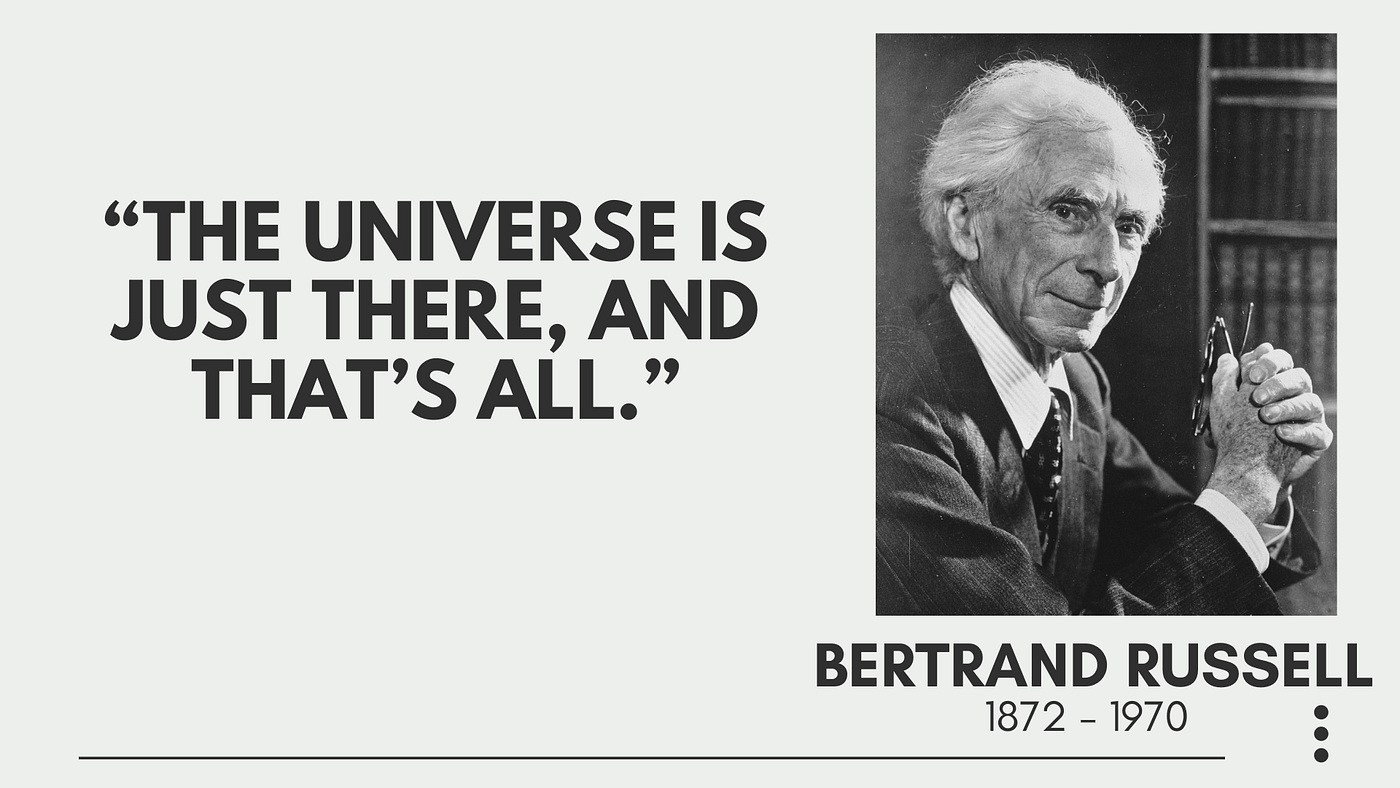
A fact that has no further explanation is called a brute fact. While Copleston and Aristotle insist that the chain of explanation must terminate in a self-explanatory necessary being, Russell proposes that the chain doesn't need a terminus beyond the universe itself. The universe is the unexplained brute fact.
Now, let's hear Russell's rebuttal in his own words.
Russell-Copleston Debate on God's Existence (1948)
This clip from the debate gets to the heart of the disagreement. Listen for Russell's direct rejection of the need to explain the 'total' and his use of a memorable analogy.
Please listen from 13:31 to 17:19. Pay close attention to Russell's response when Copleston asks why we shouldn't seek a cause for the totality of objects. Note his 'mother' analogy and his final summary of his position.
As you heard, Russell's view is that "the notion of the world having an explanation is a mistake." Let's break down the philosophical arguments underpinning this claim.
3. Deconstructing the "Brute Fact" Stance
Russell's position isn't simply an arbitrary refusal to engage; it's based on specific logical and philosophical principles. Two arguments are central.
a) The Fallacy of Composition
Russell's primary logical tool here is the fallacy of composition. This fallacy is committed when one reasons that something must be true of the whole because it is true of the parts of the whole.
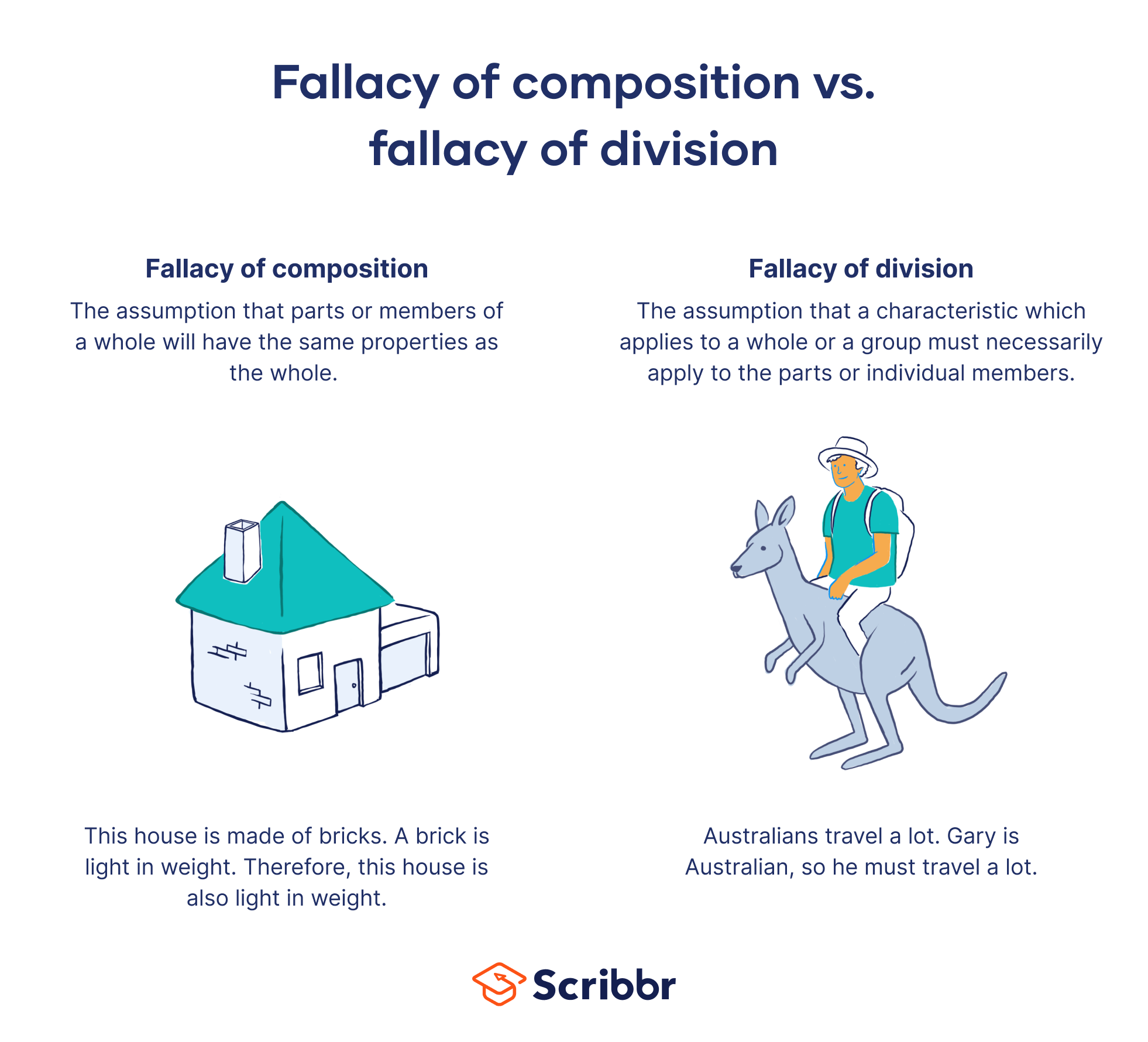
Russell's analogy from the debate makes this point perfectly: "Every man who exists has a mother... therefore the human race must have a mother." This is obviously false.
He applies the same logic to the universe. We observe causality operating on contingent things within the universe. Copleston, Aristotle, and others then leap to the conclusion that the universe as a whole must have a cause. Russell argues this is an unwarranted leap—an instance of the fallacy of composition.
Of course, this is an informal fallacy, meaning the inference isn't always wrong. A wall made of bricks is a brick wall. The crucial question is whether the contingency of the universe is more like the "smallness" of the bricks or the "brick-ness" of the bricks.
Cosmological Argument - Stanford Encyclopedia of Philosophy
The Stanford Encyclopedia of Philosophy provides a rigorous analysis of this very point. It discusses Russell's objection and some sophisticated responses.
Please read the section '4.2 Objection 1: The Universe Just Is'. Focus on how Russell uses the fallacy of composition and the counterarguments presented, particularly the idea that if all the contingent parts ceased to exist, the universe would too, implying it is itself contingent.
b) The Critique of "Necessary Being"
Russell's second line of attack is semantic and logical. Coming from the tradition of analytic philosophy he co-founded, he insisted on rigorous linguistic clarity. He argued that the term "necessary" can only be meaningfully applied to propositions, not to things.
- A necessary proposition (or an analytic truth) is one whose negation is a self-contradiction. For example, "All bachelors are unmarried." It is true by definition.
- A contingent proposition (or a synthetic truth) is one that is true, but could have been false. For example, "The sky is blue."
Russell argues that to speak of a "necessary being" is a confusion of categories. For a being to be "necessary," its non-existence would have to be a logical contradiction. But Russell, following Hume and Kant, holds that no statement asserting existence can ever be a logical necessity. You can always deny the existence of any thing without contradicting yourself. Thus, the concept of a "necessary being" is, for Russell, a piece of linguistic nonsense.
Russell-Copleston Debate on God's Existence (1948)
Let's return to the debate to see how Russell uses this argument against Copleston's concept of a necessary being.
Please watch from 03:53 to 09:46. Notice how Russell repeatedly pushes the idea that 'necessary' can only apply to analytic propositions and how this invalidates the very concept of a 'necessary being' that Copleston's argument depends on.
4. The Dilemma: Which Brute Fact?
Russell’s critique forces a profound choice. If we reject the demand for an ultimate explanation, we are left with the universe as a brute fact. But is the alternative, a necessary being like God, any less of a brute fact?
Many philosophers argue that every worldview, whether theistic or naturalistic, must ultimately terminate in a brute fact—an unexplained explainer.
- For the naturalist, the existence of the universe (or its fundamental laws) "just is."
- For the theist, the existence of God "just is." One cannot ask "What caused God?" because God is, by definition, the uncaused cause.
The debate, then, shifts. It's not about whether we can eliminate brute facts entirely, but about which brute fact serves as a better or more rational terminus for explanation. Is an uncaused, purposeless universe a more or less plausible ultimate reality than an uncaused, personal, necessary being?
Interestingly, some argue that even within a theistic framework, the charge of "brutishness" doesn't disappear; it simply relocates. If God has libertarian free will and chose to create this universe when He could have created another (or none at all), then His choice to create this specific world is itself a brute fact—it has no further explanation beyond "He just chose to."
Countering the Contingency Argument & Defending Brute Facts
This video offers a modern take on the brute fact debate, arguing that all worldviews ultimately rely on one.
Please watch from 08:12 to 08:46, where the speaker defines a brute fact and claims all worldviews have them. Then, watch from 10:55 to 14:23, which presents the sophisticated argument that God's free choice to create is itself a kind of brute fact.
This brings Russell's challenge into sharp focus. If even theism ends in a brute fact (God's choice), why not simply stop earlier and accept the universe itself as the ultimate brute fact? This is the essence of Russell's position, often associated with Occam's razor.
Conclusion
Bertrand Russell's objection is a cornerstone of modern critiques of the cosmological argument. It bypasses complex metaphysical systems like Kant's and presents a direct, logically grounded challenge to the very first step of the argument: the demand for an explanation of everything.
Key Takeaways:
- The "Brute Fact" Objection: Russell's core claim is that the universe "is just there, and that's all." It does not require an external explanation.
- The Fallacy of Composition: He argues it is a logical error to infer that because parts of the universe have causes, the universe as a whole must have a cause.
- Critique of "Necessary Being": Russell maintains that "necessity" is a property of propositions, not things, making the concept of a "necessary being" linguistically and logically incoherent.
- The Inevitability of Brute Facts: The debate may not be about eliminating brute facts, but about which starting point—the universe or a necessary being—is a more rational unexplained reality.
Russell's critique fundamentally reshapes the dialectic. It forces the proponent of the Unmoved Mover to not only argue that an infinite regress is impossible but to first justify why the entire chain of contingent things requires an explanation at all.
In our next lesson, we will delve deeper into this very choice. We will evaluate the dilemma of accepting a necessary being versus accepting the universe as a brute fact, examining the philosophical costs and benefits of each position.