Recommended resources
The freely available resources this lesson will direct you to.
Introduction
Welcome back! In our last lesson, we explored Kant's "Copernican Revolution," his groundbreaking proposal that objects of experience must conform to the structures of our mind. We saw this was his grand strategy for reconciling rationalism and empiricism, allowing for knowledge that is both necessary (a priori) and grounded in experience.
Today, we will examine the central product of that revolution: the synthetic a priori judgment. This lesson fulfills the learning outcome: Define the 'synthetic a priori' and explain its importance to Kant's project. We will dissect this crucial concept, see how Kant uses it to answer Hume's skepticism, and explore why he believed it was the absolute foundation for both natural science and, most importantly for your interests, mathematics.
1. Carving up Knowledge
As we reviewed, Kant employs two key distinctions to categorize any judgment:
- A Priori vs. A Posteriori: An epistemological distinction. Is the judgment justified independently of experience (a priori), or through experience (a posteriori)?
- Analytic vs. Synthetic: A logico-semantic distinction. Is the predicate concept already contained within the subject concept (analytic), or does it add new information (synthetic)?
Before Kant, philosophers like Hume generally assumed these two distinctions mapped onto each other perfectly, leaving only two useful categories. Kant's analysis revealed a more complex landscape.
To start, let's watch a concise video that lays out these two distinctions and how Kant begins to combine them.
PHILOSOPHY - Kant: On Metaphysical Knowledge [HD]
This video from Wireless Philosophy provides a very clear explanation of the two fundamental distinctions Kant uses to build his framework.
Please watch from 01:29 to 07:26. Pay close attention to: The characteristics of a priori knowledge (necessity and universality). The 'containment' metaphor for analytic judgments vs. the 'ampliative' nature of synthetic judgments. How Kant challenges the old view that these distinctions perfectly overlap.
As the video explains, combining these two distinctions creates a 2x2 grid with four possibilities.
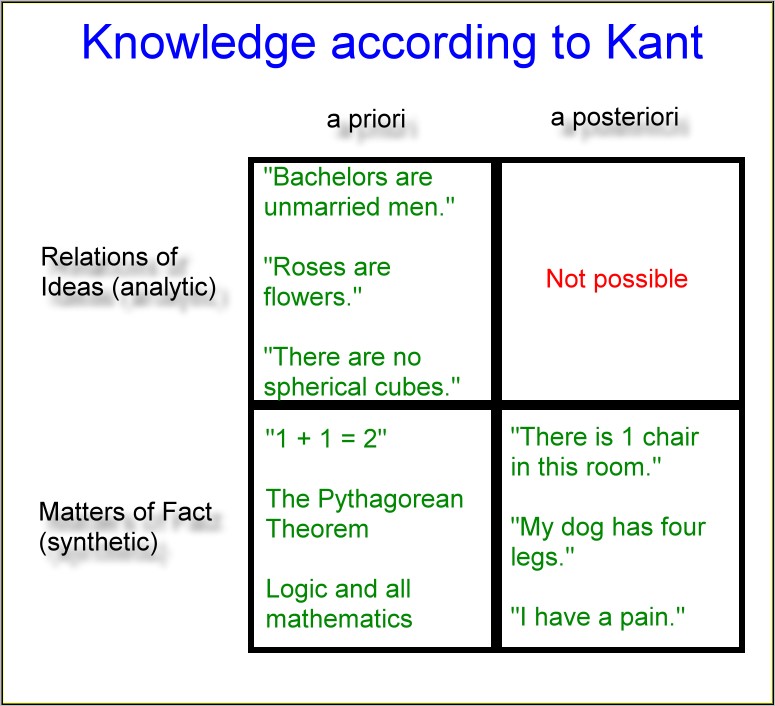
Let's quickly review the three less controversial quadrants:
- Analytic A Priori: True by definition, known without experience. Example: "All bachelors are unmarried." These are clarifying but don't teach us anything new about the world.
- Synthetic A Posteriori: Adds new information, known through experience. Example: "The book is on the table." This is the basis of most everyday and scientific empirical knowledge.
- Analytic A Posteriori: This category is considered empty. A judgment can't be both true by definition and require experience to be known.
This leaves the fourth, revolutionary quadrant, which lies at the very heart of Kant's project.
2. Defining the Synthetic A Priori
A synthetic a priori judgment is a proposition that is:
- Synthetic: It is ampliative, meaning the predicate adds new information that is not contained in the subject concept. It extends our knowledge.
- A Priori: It is known with necessity and strict universality, meaning its justification is independent of any particular sense experience.
This category was Hume's blind spot. For Hume, anything known a priori had to be analytic ("relations of ideas"), and anything synthetic had to be known a posteriori ("matters of fact"). Kant argues that this is a false dichotomy.
To understand how Kant establishes this third way, please read the following brief text. It explains how Kant moves beyond Hume and articulates the fundamental question that the synthetic a priori is meant to answer.
Kant on the Synthetic A Priori
This reading from a course on Kant provides a direct and concise explanation of the synthetic a priori, using Kant's own famous example of causality.
Please read the section titled 'The Synthetic A Priori'. Focus on Kant's question about the 'unknown=X' that connects a subject to a predicate that is not contained within it, yet is connected necessarily.
The text highlights Kant's core problem: how can we link a concept A to a "foreign" predicate B with necessity? For example, in "Every alteration has a cause," the concept of cause is not contained within the concept of alteration. Yet we believe this connection is necessary, not just something we've happened to observe so far. This necessary but non-definitional link is what the synthetic a priori captures.
3. The Importance of the Synthetic A Priori
Why was establishing this category so important for Kant? Because he believed it was the only way to save genuine knowledge from Hume's skepticism and provide a secure foundation for both science and mathematics.
Answering Hume and Grounding Science
Hume argued that concepts like causation could not be rationally justified. We never experience the necessary connection between cause and effect, only a "constant conjunction" of events, which leads to a psychological habit of expectation.
Kant's response is that "Every event has a cause" is a synthetic a priori principle.
- It is synthetic because, as noted, the concept of a cause is not part of the definition of an event. We learn something new.
- It is a priori because it is a rule that the mind itself imposes to make sense of the sequence of experiences. According to the Copernican Revolution, for experience to be intelligible at all, it must be structured according to cause and effect. It is a precondition for objective experience, not a conclusion from it.
Let's watch a short clip that illustrates this point about causality and other metaphysical principles.
Kant 1: Synthetic A Priori Knowledge
This segment of the lecture on 'Synthetic A Priori Knowledge' explains how Kant's concept provides an answer to Hume's skepticism regarding causality.
Watch the clip from 46:38 to 51:18. Notice how Kant distinguishes between the a posteriori part of knowing a specific causal law (e.g., that fire specifically causes pain) and the a priori part (knowing that there must be a necessary connection of some kind).
By making principles like causality synthetic a priori, Kant provides them with the necessity that rationalists demand, while agreeing with the empiricists that this necessity only applies to the world of phenomena—the world structured by our minds.
4. The Prime Example: Mathematics
For Kant, the clearest and most undeniable examples of synthetic a priori judgments were found in mathematics. This directly challenges the view, common among empiricists and even some rationalists, that mathematical truths are analytic. Given your background, this is where Kant's argument becomes particularly interesting and sets the stage for major debates in the philosophy of mathematics.
Let's first watch an explanation of Kant's famous arithmetic example.
Kant 1: Synthetic A Priori Knowledge
Here, we return to the lecture to see Kant's argument for why even a simple proposition like '7 + 5 = 12' is synthetic, not analytic.
Watch from 41:46 to 46:38. Focus on the core argument: why is the concept '12' not contained within the concept of 'a sum of 7 and 5'?
Kant's argument is that the concept a sum of seven and five contains only the idea of uniting two numbers. To get to 12, you must go beyond an analysis of the concepts and perform an act of synthesis or "construction." This act, for Kant, relies on what he calls pure intuition—our a priori sense of time (for counting) or space (for geometry). Because this construction happens a priori in the pure forms of our sensibility, the resulting judgment is both necessary and synthetic.
For a more rigorous and detailed analysis tailored to your interests, let's turn to a leading academic resource on this topic.
Kant's Philosophy of Mathematics
The Stanford Encyclopedia of Philosophy entry on 'Kant's Philosophy of Mathematics' delves into the specifics of his argument. This will provide the formal depth that a mathematician would appreciate.
Please read section 2.2, 'Kant’s answer to his question “How is Pure Mathematics Possible?”' This section unpacks the '7 + 5 = 12' example in detail and also discusses his argument regarding geometry. Focus on how the idea of 'construction in intuition' is the key to proving syntheticity.
By arguing that mathematics is synthetic a priori, Kant sought to explain how it can be both certain (a priori) and genuinely informative about the structure of the phenomenal world (synthetic). The properties of space described by geometry are not just definitions; they are necessary features of any object we could ever experience, because space is the a priori form of our outer intuition. This view set a benchmark against which later foundational programs, like logicism (which we will study later), would define themselves.
Test your understanding!
Consider the following two propositions:
- "All triangles are three-sided figures."
- "The interior angles of a triangle sum to 180 degrees."
How would Kant classify each of these judgments (analytic/synthetic and a priori/a posteriori)? Justify your answer based on the concepts of containment and construction.
Show answer
-
"All triangles are three-sided figures" is analytic a priori.
- Analytic: The concept "three-sided figure" is part of the very definition of a triangle. The predicate is "contained" within the subject. Analyzing the concept of a triangle reveals this property.
- A Priori: Its truth is known by definition, not through empirical measurement of triangles.
-
"The interior angles of a triangle sum to 180 degrees" is synthetic a priori.
- Synthetic: According to Kant, the concept "sums to 180 degrees" is not contained in the concept "triangle." You can fully understand the definition of a triangle (a three-sided plane figure) without knowing this property. To arrive at this conclusion, you must perform a geometric construction (in pure intuition), such as drawing a line parallel to one side through the opposite vertex, to demonstrate the relationship. This construction adds new information.
- A Priori: The truth of this theorem is universal and necessary. It doesn't depend on measuring any particular triangle drawn on paper. It is demonstrated through a pure, formal procedure valid for all possible triangles.
Conclusion
Today we have defined the cornerstone of Kant's critical philosophy. The synthetic a priori is his solution to the crisis he inherited from rationalism and empiricism.
Key Takeaways:
- Definition: A synthetic a priori judgment is one that expands our knowledge (synthetic) but is justified with necessity and universality, independent of experience (a priori).
- Importance: This category is crucial for Kant because it allows him to:
- Reconcile Rationalism and Empiricism: It secures necessary truths (for the rationalists) but limits their application to the world of experience (for the empiricists).
- Answer Hume's Skepticism: It provides a foundation for necessary connections like causality, which Hume had dismissed as mere psychological habit.
- Ground Mathematics and Science: It explains how truths in these fields can be both certain and ampliative, describing the fundamental structure of the phenomenal world.
Preview of the next lesson:
We've now established that Kant believes synthetic a priori judgments are possible and why they are important. But how, exactly, does the mind generate them, especially for principles beyond mathematics, like causality? In the next lesson, we will describe the role of the categories of understanding in structuring experience. These "categories" are the specific concepts the mind uses to synthesize the raw data of the senses into the ordered, objective world we know.