Recommended resources
The freely available resources this lesson will direct you to.
Introduction
Welcome to the final lesson in our module on Kant's critical philosophy. In the last lesson, we saw Kant's powerful response to Hume's skepticism. You learned that principles like causality are not derived from experience but are synthetic a priori conditions that the mind imposes to make objective experience possible. This structured world of experience, governed by the mind's own laws, is what Kant calls the world of phenomena, or appearances.
This naturally raises a profound question: if the world we know is the world as it appears to us, what can we say about the world as it is in itself, independent of our minds? This question brings us to the heart of today's lesson and one of Kant's most famous and consequential ideas.
Our learning outcome is to explain the distinction between phenomena and noumena and its consequences. We will dissect this distinction, explore its nuances, and understand why it fundamentally re-drew the map of human knowledge, setting the stage for much of the philosophy that followed.
1. The World of Appearance and the Thing-in-Itself
Let's start with the basic definitions:
-
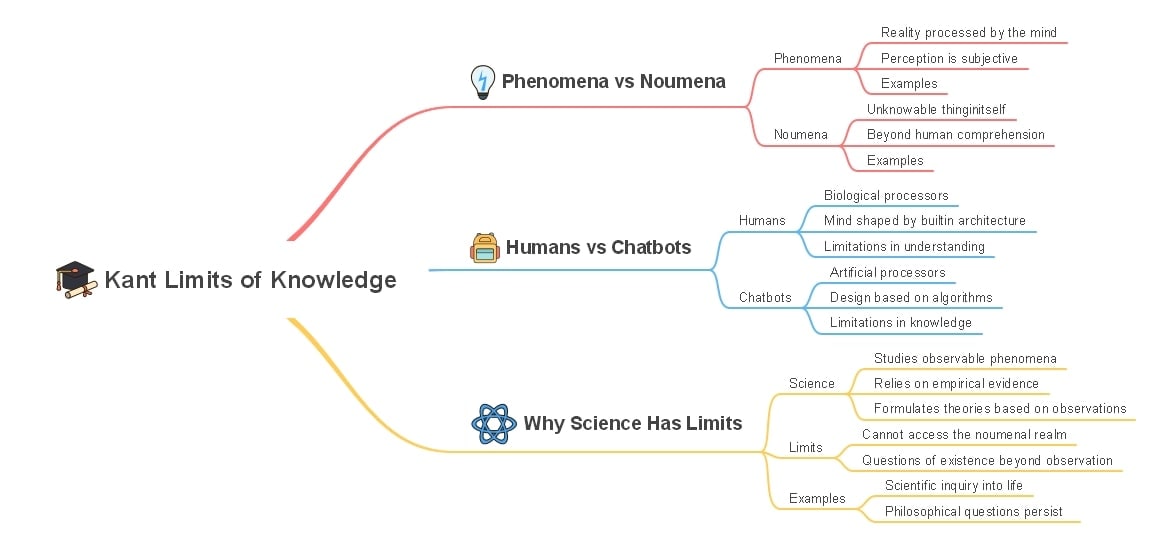
Phenomena: (from Greek phainomena, "things that appear") These are objects as we experience them, structured by the a priori forms of our sensibility (space and time) and the categories of our understanding (causality, substance, etc.). This is the world of science and everyday experience—the only world we can have objective knowledge of.
-
Noumena: (from Greek noumena, "things that are thought") These are objects as they are "in themselves," independent of the structuring activity of our minds. A noumenon is an object of a purely intellectual, non-sensible intuition.
This distinction is a direct consequence of Kant's Copernican Revolution. If the mind actively shapes the objects of experience, then we must distinguish the shaped object (phenomenon) from whatever is being shaped (the thing-in-itself, or noumenon).
2. The Standard Story (and Why It's Misleading)
There is a very common way of understanding this distinction which is intuitive, but ultimately problematic and not true to the spirit of Kant's project. This "standard story" paints a picture of two separate worlds:
- A "real world" of things-in-themselves (noumena) that is hidden behind a veil.
- A "world of appearances" (phenomena), which is a kind of mental movie or distorted representation of that real world, created as our minds process incoming data from the noumenal realm.
On this view, our minds act like distorting lenses, and we can never see reality as it truly is. The following video explains this common interpretation and then provides compelling reasons why it cannot be what Kant meant.
What is Transcendental Idealism? - Epistemology Video 27
Dr. Victor Gijsbers' video, 'What is Transcendental Idealism?', begins by laying out the 'standard story' of Kant's philosophy and then systematically dismantles it. This critical approach is an excellent way to arrive at a more accurate understanding.
Please watch the first part of the video, from the beginning to 10:25. 00:00 - 03:34: Pay attention to how the 'standard story' is presented, with its emphasis on 'distortion' and a 'hidden' reality. 03:34 - 10:25: Follow the four key arguments for why this story must be wrong. Note how it turns Kant into a skeptic, contradicts his concept of 'intuition' (immediate contact with an object), and makes some of his central claims nonsensical.
As the video argues, if the standard story were true, Kant's philosophy would be a form of external world skepticism, not an answer to it. It would mean we are trapped in our own minds, which is precisely the problem Kant sought to solve.
3. A Better Interpretation: A Shift in the "Standards of Reality"
If the two-worlds story is wrong, what is the right way to understand the phenomena/noumena distinction? The key is to see it not as an ontological distinction between two sets of objects, but as a transcendental distinction about the very conditions of reality and knowledge.
-
Transcendental Realism (the view Kant opposes): Assumes that the standards for what is real are independent of, and prior to, the standards of our thought. On this view, our mind's job is to conform to a mind-independent reality, and the skeptic can always ask if it's succeeding.
-
Transcendental Idealism (Kant's view): Reverses this. It claims that for finite beings like us, the standards of reality are the standards of our thought. For something to be a real object for us, it must conform to the conditions of our experience—it must be in space and time and subject to the categories.
Let's return to the video, which explains this more sophisticated interpretation.
What is Transcendental Idealism? - Epistemology Video 27
In this next segment, Dr. Gijsbers explains his interpretation of transcendental idealism, which reframes the entire discussion.
Now watch from 10:25 to 13:48, and then from 20:00 to 21:50. 10:25 - 13:48: Focus on the definitions of Transcendental Realism and Transcendental Idealism. Grasp the core idea that for Kant, 'to be real is to fit how we ought to think about the world.' 20:00 - 21:50: Listen for the revised role of the 'thing-in-itself' (noumenon). Notice that it's not the 'real reality' but a 'limiting concept' that reminds us of our finitude.
On this view, the phenomenal world isn't a lesser, distorted copy. It is the one and only empirical reality. The noumenon is what remains when we think away the conditions of our sensibility—it is the purely intellectual concept of a "something," which serves to mark the boundary of our knowledge.
4. Positive vs. Negative Noumena: What Can We Think?
So, the noumenon is a "limiting concept." Kant formalizes this by making a crucial distinction, which will resonate with your background in formal systems and their limits. He distinguishes between a negative and a positive sense of the term.
Phenomena and Noumena - MIT Lecture Notes
This short excerpt from a set of MIT lecture notes provides a very clear and concise explanation of this key distinction.
Please read section 2, titled '‘Noumenon’ in a negative vs. a positive sense (B307-8)'. Focus on the difference between thinking of a noumenon as an 'unknown something' versus an 'object of a non-sensible intuition'.
To summarize the reading:
- Noumenon in the negative sense: The thought of a thing insofar as it is not an object of our sensible intuition. It's a boundary concept that tells us where our knowledge stops. This is the only legitimate use of the concept for us.
- Noumenon in the positive sense: The thought of a thing that is an object for some other kind of intuition—a "non-sensible" or "intellectual" intuition (e.g., the kind of intuition God might have). Since we do not possess such a faculty, this concept is "problematic" for us; we can form the idea, but we can't know if anything corresponds to it.
Our categories (causality, substance, etc.) are only rules for organizing sensible intuition. Without that intuition, they have no content or application. As Kant says, they are empty. This is why a "science" of noumena is impossible.
Phenomena and Noumena - GJ Mattey's - UC Davis
G.J. Mattey's lecture notes from UC Davis offer a more detailed look at why the categories of understanding cannot be applied beyond the realm of phenomena.
Please read the sections titled 'The Limits of Understanding' and 'Transcendental Use'. You don't need to trace every reference to other parts of the Critique, but focus on the main argument: why are concepts without intuition 'without sense'? Why must the 'proud name of an ontology' give way to a 'mere analytic of the understanding'?
Test your understanding!
A famous criticism, raised almost immediately after Kant published his work, is that he contradicts himself. He claims that categories like 'causality' or 'existence' only apply to phenomena. Yet he seems to make claims about noumena, for instance, that a thing-in-itself exists and causes our sensations.
Based on what you've learned, how might you defend Kant against this charge? Consider the 'one-world/two-aspects' interpretation mentioned in the MIT notes (resource LINK, section 3) and the idea of the noumenon as a limiting concept.
Show answer
This is a deep and difficult problem in Kant scholarship. There isn't one single accepted answer, but a good defense could run along these lines:
-
Distinguishing Uses of 'Cause': A defender might argue that when Kant says the noumenon "causes" phenomena, he isn't using the category of causality in its full, schematized, scientific sense (i.e., as a rule determining succession in time). Time is a form of our intuition, so it cannot apply to the noumenon. Instead, he might be using 'cause' in a much broader, more abstract, purely logical sense of 'ground' or 'reason,' simply to mark the fact that our sensations are not self-generated.
-
The Two-Aspects View: The most popular modern defense is the 'two-aspects' or 'one-world' view. On this interpretation, there aren't two different worlds. There is just one world, which we can consider from two different standpoints:
- As it appears to us, subject to the conditions of our knowledge (phenomenon).
- As it is in itself, abstracted from those conditions (noumenon).
On this view, saying "the noumenon causes the phenomenon" is a potentially misleading way of saying that the very same object, when considered in abstraction from our cognition, is the ground for how it appears to us under the conditions of our cognition. The statement is about the relationship between two descriptions or considerations of the same thing, not between two different things.
5. The Consequences: Limiting Knowledge to Make Room for Faith
The distinction between phenomena and noumena has massive consequences that reverberate through all of modern thought.
Consequence 1: The Limits of Science and Reason
Kant's primary goal is to establish the limits of pure reason. The conclusion is stark: human knowledge is fundamentally and irrevocably limited to the phenomenal world. We can have objective, necessary, and universal knowledge (like in Newtonian physics or mathematics) of the world of experience, but we can have no theoretical knowledge whatsoever of things-in-themselves.
This means that traditional speculative metaphysics—which attempts to prove the existence of God, the immortality of the soul, or the ultimate nature of reality—is a futile endeavor. These are noumenal matters, and our cognitive faculties are simply not equipped to deal with them.
Consequence 2: Making Room for Morality and Faith
By "clipping the wings of speculative reason," Kant is not trying to destroy belief. On the contrary, he famously stated, "I have therefore found it necessary to deny knowledge, in order to make room for faith."
Because theoretical reason cannot prove or disprove claims about the noumenal world, the door is opened for a different kind of justification: practical reason. Kant will later argue in his ethical works that the moral law, which we discover within ourselves, requires us to postulate the existence of God, freedom of the will, and the immortality of the soul as necessary conditions for morality to make sense. These become objects of a rational, morally-grounded faith, not objects of knowledge. He fences off a territory for science, but in doing so, also protects a territory for morality and religion from scientific refutation.
Conclusion
Today we have navigated one of the most challenging but rewarding concepts in Kant's philosophy. His distinction between the world as it appears to us and the world as it is in itself is not a simple claim about two different worlds, but a profound statement about the very nature and limits of human cognition.
Key Takeaways:
- Phenomena are objects as experienced and structured by our minds; this is the realm of objective knowledge and science.
- Noumena are things considered in themselves, independent of our cognitive faculties; this realm is unknowable to us.
- The common "two worlds" interpretation is misleading. A better view is that this is a transcendental distinction about the conditions for reality itself: for us, to be real is to be an object of possible experience.
- The concept of the noumenon is best understood in its negative sense: as a limiting concept that marks the boundary of our knowledge and reminds us of our cognitive finitude.
- The primary consequence is the limitation of knowledge to the phenomenal realm. This refutes the pretensions of traditional speculative metaphysics.
- By limiting knowledge, Kant paradoxically makes room for faith, arguing that concepts like freedom and God can be rationally postulated on moral, rather than theoretical, grounds.
Preview of the next lesson:
This lesson concludes our intensive study of Kant. His attempt to delineate the structure and limits of reason set the agenda for philosophy for over a century. However, his successors took his ideas in very different directions. Our next module, "The Logical Turn: Frege, Russell, and Early Analytic Philosophy," marks a pivotal shift. We will see how the German mathematician and philosopher Gottlob Frege developed a new system of logic—predicate logic—that was far more powerful than the traditional Aristotelian logic we briefly touched on. This new logic allowed for an unprecedented level of rigor in analyzing language and mathematical concepts, launching the movement that would become analytic philosophy—a direct area of your interest. We will begin by exploring how Frege's new logic solved problems that had been intractable for two millennia.