Recommended resources
The freely available resources this lesson will direct you to.
- Classical Mechanics: The Two Body Problemwww.youtube.com
- LEC 5 Angular momentum of a particle | CLASSICAL MECHANICS | HC VERMA | GDS K Swww.youtube.com
- Angular Momentum Is Conserved In Orbital Motion — Orbital Mechanics & Astrodynamicsorbital-mechanics.space
- 8.01SC S22 Chapter 25: Celestial Mechanicsocw.mit.edu
Welcome back. Last lesson, you separated the two-body problem into uniform centre-of-mass motion and a single equation for the separation vector. That equation still describes motion in three dimensions. Today we will derive a constraint that removes one of those dimensions: gravity cannot change the angular momentum of the relative motion, so the separation remains in a fixed plane.
This result will make an orbital simulation simpler to set up and easier to scrutinise. It also requires a qualification: “the orbit is planar” refers to the relative motion, or to the two bodies viewed from a barycentric rest frame. We will see why that distinction matters.
Gravity has no leverage about the separation origin
Keep our convention from last lesson:
For nonzero separation, the relative equation is
The acceleration is always parallel or antiparallel to . Its strength changes with distance, but it has no component across the line of separation. This is what makes it a central-force equation.
Angular momentum measures the rotational aspect of motion about a chosen origin. For our relative equation, define the specific angular momentum
“Specific” means per unit reduced mass. If you want the angular momentum of the effective particle from last lesson, multiply by :
The cross product has two useful geometric properties. Its magnitude depends on the component of velocity perpendicular to , rather than on motion directly towards or away from the other body. Its direction is perpendicular to both and , with its sign set by the right-hand rule.
For a visual account of angular momentum, torque, and the resulting plane, watch these selected parts of Angular Momentum of a Particle from GDSTUDYWORLD ARCHIVE. The lecturer discusses a particle moving about a fixed force centre. We can apply the argument to our relative equation without assuming that either physical body is fixed.
LEC 5 Angular momentum of a particle | CLASSICAL MECHANICS | HC VERMA | GDS K S
Watch the introduction to angular momentum and torque, then the later central-force argument and its geometric consequence.
Start with angular momentum for the definitions and the torque relation. Skip to zero torque and planarity. Focus on why a force along the position vector gives zero torque, and why the direction, not merely the magnitude, of conserved angular momentum matters.
Deriving conservation rather than assuming it
Differentiate using the product rule for a cross product:
The first cross product is zero: a vector has no perpendicular component to itself. Substitute the gravitational acceleration into the second:
Hence, throughout any collision-free interval,
This is the torque argument written directly in the variables of our model. Gravity pulls along the separation vector, so its torque about the relative-coordinate origin is zero. Crucially, the entire vector is constant: both its magnitude and its direction.
You can compare this calculation with the “Conservation of Angular Momentum” subsection of Angular Momentum Is Conserved In Orbital Motion from Orbital Mechanics & Astrodynamics. Its notation differs from ours: the in its gravitational acceleration denotes , not our reduced mass .
Angular Momentum Is Conserved In Orbital Motion — Orbital Mechanics & Astrodynamics
Read the definition and cross-product derivation as a compact second presentation of the argument.
In “Conservation of Angular Momentum,” start at the sentence beginning “The orbital angular momentum of” and stop at “Thus, the system satisfies conservation of angular momentum,” just before the “Tip.” Read the derivation, paying particular attention to why both terms in the time derivative vanish. The page describes a coordinate system attached to one body; use our relative equation, derived by subtracting two inertial-frame equations, rather than treating that accelerating body as a fixed inertial origin.
There is also a direct connection to the two physical bodies. In the barycentric rest frame, last lesson’s reconstruction formulas give
with the same mass factors multiplying for their velocities. Their combined angular momentum about the barycentre is therefore
So the angular momentum of the reduced-mass description is exactly the combined orbital angular momentum of the two bodies about their barycentre. We have not introduced a different physical conservation law.
Why a constant angular-momentum vector fixes a plane
Suppose first that . At every later time, the definition of the cross product gives
But , so
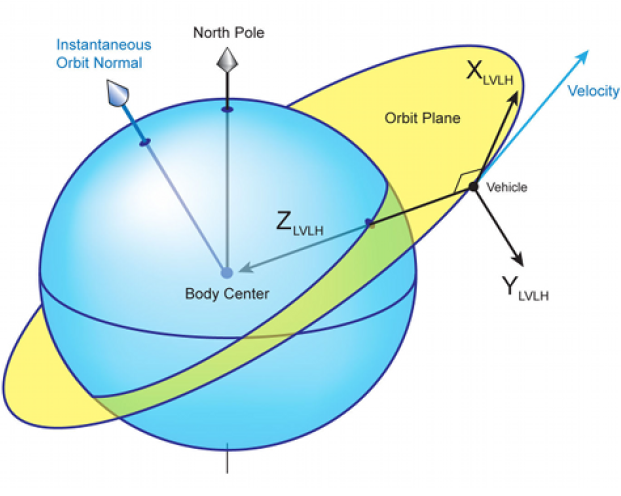
This is the equation of a single fixed plane through the relative-coordinate origin: its normal vector is . The velocity lies in that plane too, because . The force can change the motion within the plane, but cannot tilt the plane.
For example, suppose initial relative position and velocity, in consistent units, are
Then . Every later relative position must satisfy , or . This is a plane in three-dimensional space; there was no need to choose the usual -plane at the outset. If convenient for calculation, you can rotate the coordinate axes until points along the new -axis. In those coordinates the relative motion has , leaving two position coordinates to integrate.
What if ? A zero vector cannot define a unique plane normal. Instead, provided , the initial relative velocity is parallel to the separation: the motion is radial, confined to the initial line of separation until a possible collision. One way to see the fixed direction is to write, while ,
because remains parallel to . The point-mass gravitational equation is undefined at zero separation, so the model makes no claim about motion through a collision.
What “planar two-body motion” means for a simulation
The fixed-plane proof applies to . In a barycentric rest frame, , and the reconstruction formulas show that both bodies’ positions are scalar multiples of . Both physical trajectories therefore lie in the same fixed plane through the barycentre.
In another inertial frame, the barycentre may move as . At each instant, the bodies occupy the orbital plane translated to pass through the moving barycentre. If that drift has a component perpendicular to the relative orbital plane, their full trajectories need not each lie in one fixed plane. For instance, perpendicular drift combined with a circular relative orbit produces helical-looking paths in that inertial frame. The relative orbit remains planar throughout.
This distinction gives you two precise checks when you eventually integrate the equations numerically. Compute and compare it with its initial vector to check angular-momentum conservation. Independently, check whether stays near zero to test confinement to the predicted plane. Small nonzero values in a simulation may be numerical error; a persistent physical change in the plane would instead require an effect absent from this isolated, point-mass two-body model.
Key takeaways
For the isolated gravitational pair, is conserved because gravitational acceleration points along and produces no torque about the relative-coordinate origin. When , its fixed direction is the normal to a fixed plane containing the entire relative trajectory. Zero angular momentum is the radial, line-of-motion case. In the barycentric rest frame, the two physical bodies share the relative orbital plane; a drifting barycentre can change how their paths look in another inertial frame.
Next, we will derive conservation of mechanical energy. Together, energy and angular momentum will constrain the orbit and provide complementary checks on a computed trajectory.