Recommended resources
The freely available resources this lesson will direct you to.
- How to Write Strong Essay Body Paragraphs – with REAL Example | Scribbr 🎓www.youtube.com
- How to Write Perfect Answers in UPSC Mains? | Mains Answer Writing Strategy | Drishti IAS Englishwww.youtube.com
- Expository Essays - Purdue OWL® - Purdue Universityowl.purdue.edu
- Essay Exams – The Writing Centerwritingcenter.unc.edu
नमस्कार! In the previous lesson, you practised making English sentences complete, grammatical, and suitably formal. Now you will put those sentences to work in a short descriptive answer: one that responds directly to the question, supports its points with evidence, and finishes with a clear conclusion.
This is a foundation for later answers in both Administration and Foreign Affairs preparation. The example below concerns a public office, but the method applies whenever a question asks you to explain an issue using facts, principles, or examples. Allow about 40 minutes for the lesson and its resources. The practice length and timing used here are illustrative, not a claim about the next Lok Sewa examination; check the official notice for its actual requirements.
Read the question before planning the answer
A well-written answer can still miss marks if it answers a nearby question rather than the one asked. First identify the topic, the directive (what you must do with the topic), and any limits on scope. Describe generally calls for an account of what something is or how it works. Explain calls for reasons or relationships as well. A question asking you to evaluate needs a supported judgement, not just a description.
The University of North Carolina Writing Center’s Essay Exams guide is useful here because it connects question analysis with the limited time and space of an exam answer.
Essay Exams – The Writing Center
Read the University of North Carolina Writing Center’s guide to see how a question’s wording determines what belongs in your answer, and why specific support matters under exam conditions.
Under “Taking the exam,” go to “Analyze the questions,” then “Key terms.” Read the question guidance. Then find “Writing your answers” and read the answer guidance. Focus on relevance, specific support, and visible structure.
Consider this fictional practice question:
A municipal office received 120 applications in one month. It processed 78 within its stated timeframe, and 30 residents reported difficulty using its online form. Describe two measures the office could take to improve access and timeliness, using the information given.
The topic is service delivery. The directive is describe, so the answer should make two measures understandable and show how each would work. The scope is access and timeliness, not every possible problem in local government. The figures must inform the answer, but they do not tell us why applications were delayed or whether the residents who reported difficulty represent all applicants.
You may plan briefly in Nepali if that helps you identify the logic—पहुँच (access), समयबद्धता (timeliness), प्रमाण (evidence). If you are preparing to write your descriptive answers in English, express the final reasoning in clear English, subject to the language rules in the official notice.
Build a small argument, not a pile of points
For a short answer, plan three parts before drafting. The introduction names the issue and states your overall response. The body develops distinct points, each supported and explained. The conclusion brings those points together without opening a new topic. A thesis need not sound grand: in the practice question, “The office should combine assistance for applicants with closer monitoring of processing times” is enough to tell the reader where the answer is going.
Purdue OWL’s Expository Essays discusses this relationship among a focused opening claim, evidential body paragraphs, and a conclusion. Its subject is essays, so adapt the principles to a shorter exam answer rather than treating a five-paragraph essay as compulsory.
Expository Essays - Purdue OWL® - Purdue University
Read Purdue OWL’s account of how an explanation stays coherent from its opening claim through its supporting paragraphs to its conclusion.
Under “What is an expository essay?”, begin at the structure guidance. Stop before “A complete argument.” Pay particular attention to the guidance on one general idea per body paragraph and on concluding in light of the evidence already presented.
A useful planning note for the fictional question would be: opening claim; access measure; timeliness measure; combined conclusion. That takes only a few words. Its value is that each body paragraph now has a job: one addresses the reported difficulty with the form; the other addresses processing within the stated timeframe.
Turn evidence into analysis
Evidence does not speak for itself. A body paragraph needs a point, relevant support, and a sentence explaining what that support means for the question. Scribbr’s short video demonstrates how a topic sentence sets a paragraph’s purpose and how commentary connects evidence to the larger claim.
How to Write Strong Essay Body Paragraphs – with REAL Example | Scribbr 🎓
Watch “How to Write Strong Essay Body Paragraphs – with REAL Example” from Scribbr. Its example is a longer academic essay, but the paragraph principles also work in a compact exam answer.
Watch the setup for the role of an opening claim and an outline. In paragraph focus, notice how unity, relevance, and a topic sentence keep one paragraph on one idea. Finally, watch support and analysis: distinguish the evidence itself from the writer’s explanation of its significance and the closing link back to the main point.
The same distinction is visible in this paragraph diagram. Its subject is insomnia research, not Nepal’s public services; look at the writing functions labelled around the paragraph rather than borrowing its factual claims.
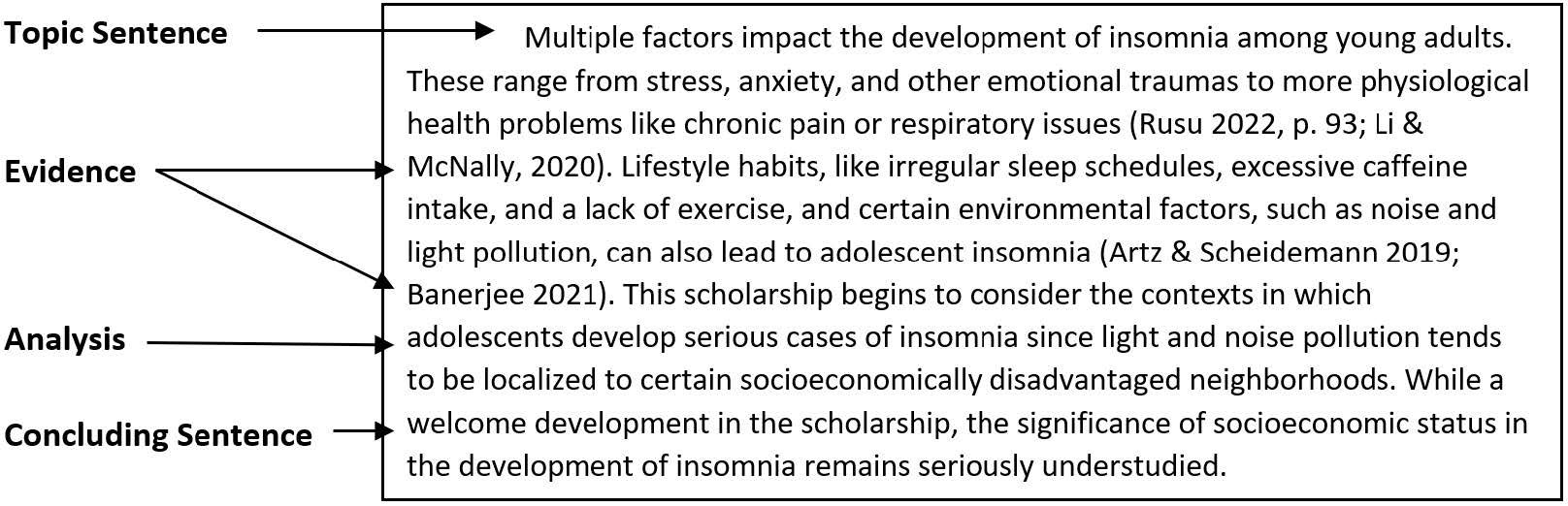
For the practice question, “Thirty residents reported difficulty using the online form” is evidence given in the prompt. “The office should offer assistance when residents submit applications” is a proposed measure. The analysis connects them: assistance could help residents who struggle to complete the form. Do not change the evidence into “Most residents cannot use the portal”; nothing given establishes that.
The other figure can be used precisely. 78 of 120 applications, or 65%, were processed within the stated timeframe. That supports a case for examining timeliness. It does not show that the remaining 42 applications were rejected, or identify the cause of their delay. Careful language makes the answer more credible, not weaker.
See the complete answer
Here is one response to the fictional question. The figures and office are invented for writing practice, not presented as facts about any municipality.
The office needs to address both residents’ access to the application process and the time taken to process applications. It could combine assistance at submission with closer monitoring after receipt.
Access: The office could provide a staffed help desk and a non-digital way to submit forms where appropriate. Thirty residents reported difficulty with the online form, indicating a problem worth investigating, though the figure does not show how widespread it is. Staff could record the difficulties reported so that the form and its instructions can be improved.
Timeliness: The office could record when each application enters and leaves a processing stage, then review cases approaching the deadline. In the month described, 78 of 120 applications were processed within the stated timeframe. Stage-level records would help managers locate delays before deciding what changes are needed.
Together, assisted access and routine tracking would address the two concerns identified in the question. The office should review subsequent records and feedback to see whether these measures work.
Notice the work done by each part. The opening does more than repeat the topic: it gives the answer’s two-part direction. Each labelled body paragraph takes one measure, uses a relevant piece of information, and explains what the office would do. The final sentences synthesize the measures and indicate how to check progress; they do not introduce a third, unsupported problem.
The answer is also appropriately cautious. It says the 30 reports identify a problem worth investigating, not that all applicants face it. It uses the processing figure to justify monitoring, not to invent an explanation for delays. This is the same discipline you used in passage analysis and sentence editing: make the claim no stronger than its evidence.
A workable routine for timed writing
When practising, use a short cycle rather than writing immediately and hoping the structure emerges:
- Decode: Mark the directive, topic, and limits. Ask what the question requires you to cover—and what it does not.
- Plan: Write a one-line central answer and choose two or three distinct body points that fit the available space.
- Draft: Give each point a clear opening sentence, specific support, and an explanation linking that support to the question.
- Close and check: End with a concise synthesis. Then check relevance, unsupported claims, missing links between facts and conclusions, and the sentence-level errors covered in the previous lesson.
For a 15-minute practice answer, you might reserve roughly two minutes to decode and plan, eleven to draft, and two to review. This is a practice allocation, not an official exam time limit. If a question has different marks, length, or demands, adjust the number and depth of body points accordingly. Headings can help a reader navigate a short answer, but they cannot replace sentences that explain the evidence.
A strong short descriptive answer has a direct opening, body points that interpret rather than merely list evidence, and a conclusion that completes the response. The habit to carry forward is simple: identify what the question asks, make each paragraph serve that task, and keep every claim within the evidence available.
This completes the module’s English foundations. In the next module, you will begin studying Nepal’s constitutional development; the same answer structure will help you connect historical milestones to institutional changes.